
Key Features to Specify When Sourcing Commercial-Grade Gas Ranges: A Quick Checklist
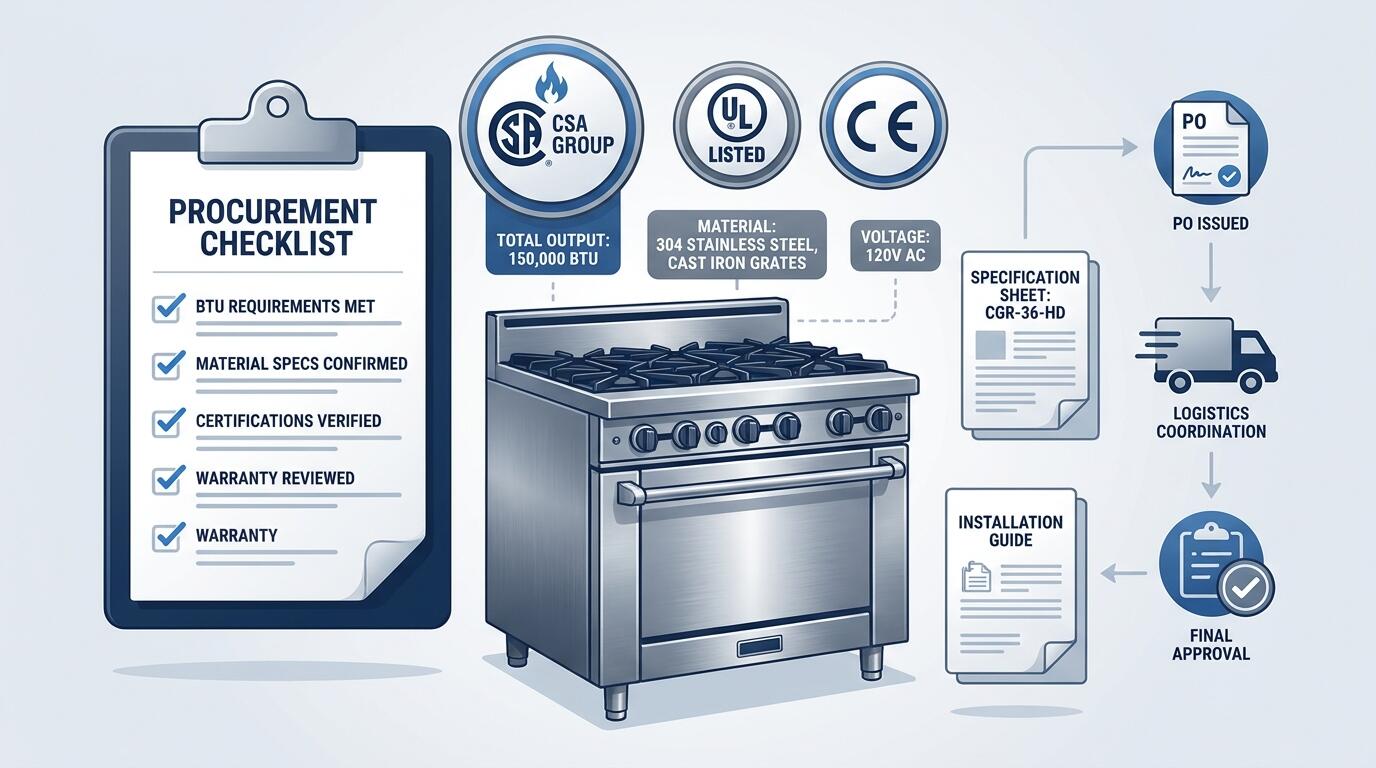
ALT: Procurement checklist for sourcing commercial-grade gas ranges from OEM manufacturers
What Procurement Teams Must Specify When Sourcing Commercial-Grade Gas Ranges
What separates a successful commercial gas range procurement from a costly rework is knowing exactly what to specify before a purchase order is ever issued. For B2B buyers — whether you are a kitchen appliance importer, a private-label brand, or a distributor serving foodservice and residential markets — the gap between a vague product brief and a detailed technical specification sheet can mean the difference between a product that clears customs and sells through, and one that fails safety certification or disappoints end users.
This checklist was developed from the kind of sourcing conversations we have consistently encountered at the OEM/ODM manufacturing level: buyers who arrive with broad requirements and leave with a tightly scoped product brief that reduces revision cycles and accelerates time to market. The items on this list are ordered by procurement priority — from non-negotiable compliance requirements down to the customization details that differentiate your product in a competitive market. Use it as a working reference during supplier conversations, factory audits, or internal product development reviews. Each item is framed to help you ask the right questions and anticipate the trade-offs involved.
The Core Specification Checklist for Commercial-Grade Gas Ranges
Rated gas heat input is one of the fundamental performance specifications for a commercial-grade gas range. It indicates the amount of fuel energy supplied to each burner per unit of time and is commonly expressed in Btu/h or kW. This specification helps buyers evaluate burner capacity and determine whether the product is suitable for its intended cooking application. In professional and semi-commercial settings, buyers and their customers expect burners to deliver high, consistent heat. Rated gas heat input helps buyers evaluate burner capacity and cooking performance, while product classification should be determined based on the intended application, destination market, and applicable local standards and regulations.
Rated Gas Heat Input and Burner Configuration
When specifying rated gas heat input, distinguish between the individual burner input rating and the total appliance input rating. A range with multiple burners has separate input ratings for each burner, as well as a combined total gas input rating. All values should be clearly stated in Btu/h or kW to ensure consistent communication between buyers and manufacturers. Depending on the product classification and local installation codes, total gas input may be one of the factors used to determine ventilation, clearance, and gas supply requirements. Buyers should verify these requirements with the relevant local authorities and qualified installation professionals.
Burner configuration — how many burners, their physical arrangement, and whether the layout includes specialty options such as high-output center burners, sealed vs. open burners, or continuous grate systems — is equally important to define early. In our work with clients developing private-label lines, burner configuration is often the detail that most directly reflects the target use case, whether that is a heavy-duty commercial kitchen range or a prosumer residential product positioned at the upper end of the market.
Best for: Importers and distributors targeting foodservice operators, restaurant supply channels, or premium residential kitchen segments where cooking performance is a primary purchase driver.
Watch out: Rated gas heat input affects burner performance specifications and may influence certain installation requirements. However, product classification should be determined based on the intended application, destination market, and applicable local standards and regulations, rather than BTU rating alone. Buyers should confirm the relevant product category and associated certification, ventilation, and installation requirements before finalizing the design.
Safety Certifications and Regional Compliance
Safety certification is a non-negotiable specification for any gas appliance entering regulated markets. Commercial-grade gas ranges must comply with the certification standards of every market in which they will be sold or installed, and the certifying body, standard number, and applicable scope must all be explicitly stated in your product brief.
In North America, gas cooking appliances must be evaluated against the applicable product safety standards for their intended use and destination market. CSA Group and UL are among the recognized organizations that provide testing and product certification services. Buyers should identify the relevant standard, certification body, and required certification mark for the specific appliance category and model before finalizing the product specification. The CSA and UL marks are widely recognized by North American retailers, distributors, and code inspectors, and a product lacking the appropriate certification mark will typically be refused by major retail buyers and may be held at customs. For products entering the European market, buyers should identify the applicable EU legislation and harmonized standards, assess the required conformity assessment procedures, and ensure that the manufacturer prepares the appropriate EU Declaration of Conformity and applies CE marking where required.
In Australia, gas appliance certification requirements vary depending on the appliance category, intended application, and applicable state or territory regulations. Commercial catering gas equipment may be subject to standards such as AS 4563, with certification or approval required through the relevant conformity assessment pathway. In New Zealand, gas appliances must meet the applicable requirements under the Gas (Safety and Measurement) Regulations 2010, including relevant certification, gas-type compatibility, and supplier documentation requirements. Buyers should verify the applicable standards, certification scope, and market-entry requirements for the specific product model and destination market before sourcing.
A pattern we consistently see is that buyers under time pressure attempt to defer certification discussions to the final stage of development — this invariably causes delays and cost overruns. Specifying the exact certification marks and standards required at the RFQ stage allows the manufacturer to design to those requirements from the outset and to allocate testing resources accordingly. For a deeper look at how certification requirements affect sourcing timelines, the 2026 Guide to Kitchen Appliance Safety Certifications for North American Importers covers the landscape in useful detail.
Best for: Buyers sourcing gas ranges for regulated markets who need to identify the applicable product safety, conformity assessment, and market-entry requirements before placing an order.
Watch out: Certification scope matters: a certificate covering a specific product model and configuration does not automatically extend to a modified variant. Any change to gas valve, burner type, or ignition system may require re-testing.
Gas Type Compatibility and Conversion Capability
Commercial gas ranges are engineered to operate on a specific gas type — either natural gas (NG) or liquefied petroleum gas (LPG/propane) — and the product specification must clearly state which gas type the unit will ship configured for, as well as whether it includes a field-conversion kit for the alternative gas type.
Gas type compatibility affects orifice sizing, burner pressure settings, and regulator specifications. In markets where one gas type dominates infrastructure — natural gas in most urban North American markets, LPG in many rural or export markets — specifying only one gas type may be acceptable. However, for distributors serving mixed markets or retailers who cannot control end-user installation environments, a product configured for one gas type with an included conversion kit for the other significantly broadens usability and reduces post-sale service issues.
Best for: Distributors and importers supplying diverse geographic markets or multi-channel retail environments where gas infrastructure varies by installation site.
Watch out: A gas conversion kit adds unit cost and requires model-specific compatibility checks. Buyers should confirm whether the proposed conversion is covered by the product's existing certification scope, whether additional evaluation is required, and whether the manufacturer provides the necessary conversion instructions and documentation.
Construction Materials and Durability Specifications
The materials used in a commercial-grade gas range directly determine its durability, maintenance requirements, and perceived quality — all of which feed into total cost of ownership and customer satisfaction. Key material specifications to define include the grade and finish of the cooktop surface, the body and frame material, grate material and construction, and oven cavity finish where applicable.
Stainless steel is the standard expectation for commercial and semi-commercial gas ranges, but the grade of steel, surface finish (brushed, polished, or matte), and thickness all affect both durability and manufacturing cost. Cast iron grates are considered the benchmark for high-performance cooking surfaces and are expected by most commercial buyers. Oven cavity materials — porcelain enamel, stainless steel, or non-stick coatings — affect ease of cleaning and product longevity.
Clearly specifying material grade, thickness, and surface finish helps reduce ambiguity during manufacturing and inspection. Without these details, buyers and manufacturers may interpret the same specification differently, potentially leading to inconsistencies in product quality, cost expectations, and acceptance criteria.
Best for: Private-label brands and importers who need to control product quality consistently across production runs and differentiate on durability in competitive price segments.
Watch out: Specifying premium materials without reviewing their impact on the landed cost and retail price positioning can compromise the product's commercial viability — work through the material-cost implications with your manufacturer before finalizing specifications.
Ignition System and Controls Specification
The ignition system and control interface are among the most user-visible components of a gas range and directly affect product reliability, ease of use, and end-user satisfaction. Specification items to define include ignition type (electronic ignition vs. standing pilot), control knob material and placement, and — for smart or connected kitchen ranges — the type and specification of any electronic control board, connectivity module, or display interface.
Electronic ignition systems, which use a spark to light burners on demand, are commonly used in modern gas ranges. However, the appropriate ignition system depends on the product's intended application, destination market, and applicable local requirements. Buyers should confirm whether electronic ignition or standing pilot ignition is suitable for the specific product category and target market before finalizing the specification. For smart kitchen appliance products, specifying the ignition and control system also means defining any connectivity requirements — Wi-Fi, Bluetooth, or proprietary protocol — and the firmware and app ecosystem the product will integrate with.
As an OEM/ODM manufacturer working in the smart kitchen appliance space, the control and connectivity layer is frequently where buyers have the most differentiation opportunity. Early-stage specification of the control architecture — including whether the buyer requires a custom control board, a licensed smart platform, or a standard interface with private-label cosmetic treatment — can influence development scope, engineering resources, software integration requirements, and overall project cost. Any tooling impact should be assessed separately based on the actual hardware and enclosure modifications required.
Best for: Smart kitchen appliance brands and private-label buyers looking to differentiate through user experience, app integration, or premium control interfaces.
Watch out: Appliances incorporating Wi-Fi or Bluetooth modules may be subject to additional radio equipment and electromagnetic compatibility requirements, depending on the destination market, module configuration, and applicable regulations. Confirm whether the selected wireless module and final product configuration require additional testing, documentation, or conformity assessment.
Oven Cavity Size and Capacity
For gas ranges that include an oven section, cavity dimensions and usable interior capacity are specifications that directly determine end-user utility and must be explicitly defined. Cavity dimensions affect what size cookware the oven accommodates, how many rack positions are available, and whether the product is compatible with standard pan sizes used by the target customer segment.
Buyers supplying North American markets should verify oven cavity dimensions against the pan sizes and cookware commonly used by their intended customer segment. Rather than relying on general regional assumptions, specify the required pan dimensions, rack spacing, and usable interior measurements in the product brief.
Best for: Importers and distributors targeting residential or light commercial markets where oven capacity and rack configuration are key purchase decision criteria.
Watch out: Increasing oven cavity size to accommodate larger pans may affect the external footprint of the appliance and its compatibility with standard cabinetry cutout dimensions — verify dimensional compatibility before finalizing.
Grate and Cooktop Surface Design
Grate and cooktop surface design specifications go beyond aesthetics — they affect cooking performance, cleaning ease, and the structural durability of the range under heavy daily use. For commercial-grade products, continuous cast iron grates (which span multiple burners in a single piece) are preferred by professional users because they allow pots and pans to be slid across the cooking surface without lifting. Individual grates over each burner are more common in residential products and are easier to remove for cleaning.
The surface surrounding the grates — whether it is a stamped steel cooktop, a cast iron griddle plate, or a solid seamless surface — also warrants explicit specification. For products aimed at commercial kitchen environments, the cooktop surface must withstand spills, heavy pans, and daily high-heat use without warping, cracking, or discoloring.
Best for: Products targeting professional chefs, restaurant equipment supply channels, or premium residential buyers who prioritize cooking performance and ease of maintenance.
Watch out: Continuous grate systems increase unit weight and shipping cost, and may complicate packaging design — factor this into logistics planning at the specification stage.
Dimensions, Footprint, and Installation Clearances
Dimensional specifications for a commercial gas range must be defined precisely and in the context of the installation environments the product will enter. Standard commercial range widths, heights, and depths are common reference points, but products designed for specific cabinet cutouts, ventilation hoods, or modular kitchen configurations must meet those dimensional constraints exactly.
Installation clearance requirements — including the minimum distance between the appliance and adjacent combustible surfaces — should be verified against the product's approved installation instructions, applicable safety standards, and local building and gas codes. Buyers should confirm these requirements for the intended installation environment before finalizing the product dimensions. These clearances must be documented in the product's installation instructions and are often referenced by local building inspectors and insurance companies at the installation site.
For OEM/ODM projects, buyers frequently need to specify a custom footprint to match an existing product line or a specific retail display format. Defining these dimensional constraints early avoids costly tooling changes later in the development process.
Best for: Buyers developing products for specific installation formats — built-in kitchen suites, modular commercial kitchens, or replacement units for existing product lines with defined footprint requirements.
Watch out: Custom dimensions outside standard manufacturing tooling increase tooling investment and minimum order quantities — evaluate the volume justification carefully before specifying non-standard dimensions.
Packaging, Labeling, and Compliance Documentation
Packaging and labeling specifications are frequently treated as afterthoughts in the product specification process, but they are operationally critical for importers and distributors. Packaging must protect the product through the full shipping and warehousing cycle — which for heavy commercial appliances typically means multi-modal shipping, potential long-term warehouse storage, and retail floor handling. Labeling must meet the applicable requirements of the destination market, including language, product identification, gas type designation, and any required energy or safety information. Certification marks should only be applied when the specific product model and configuration have been authorized under the relevant certification program and the marking follows the certification body's requirements.
For private-label buyers, packaging design is also a brand expression opportunity that should be specified at the manufacturing stage rather than applied as a sticker or overwrap after the fact. Factory-applied private-label packaging is more cost-effective and produces a more professional result. Documentation requirements — including user manuals, installation guides, warranty cards, and certification declarations — must be specified in the buyer's native market language and in compliance with applicable consumer protection regulations.
Best for: Private-label brands and importers who need their product to arrive market-ready, with compliant labeling and documentation that meets retail and regulatory requirements without post-import intervention.
Watch out: Regulatory labeling requirements vary significantly by market — energy efficiency labeling, gas type designation, and language requirements in particular differ between North America, Europe, and Australia. Confirm all requirements with a local compliance advisor before finalizing label artwork.
Quick Comparison at a Glance
| Specification Item | Best For | Key Strength | Key Consideration |
|---|---|---|---|
| Rated Gas Heat Input & Burner Configuration | Foodservice and premium residential buyers | Directly defines cooking performance | Specify rated gas heat input in Btu/h or kW; confirm product classification based on intended use and applicable market requirements |
| Safety Certifications | All regulated markets | Required for market entry | Scope is model-specific; variants may require re-testing |
| Gas Type Compatibility | Distributors in mixed-infrastructure markets | Broadens usable market | Conversion kit adds cost and documentation complexity |
| Construction Materials | Private-label and quality-positioned brands | Controls durability and customer satisfaction | Premium materials increase landed cost |
| Ignition & Controls | Smart kitchen brands and differentiators | User experience and connectivity | Smart features add certification complexity |
| Oven Cavity Size | Residential and light commercial buyers | Determines cookware compatibility | Larger cavities affect footprint and cabinetry fit |
| Grate & Cooktop Design | Professional and commercial kitchen buyers | Cooking performance and cleanability | Continuous grates increase weight and shipping cost |
| Dimensions & Clearances | Built-in and replacement product buyers | Installation compatibility | Custom dimensions increase tooling cost |
| Packaging, Labeling & Documentation | Private-label and importer channels | Market-ready compliance | Labeling requirements vary significantly by destination market |
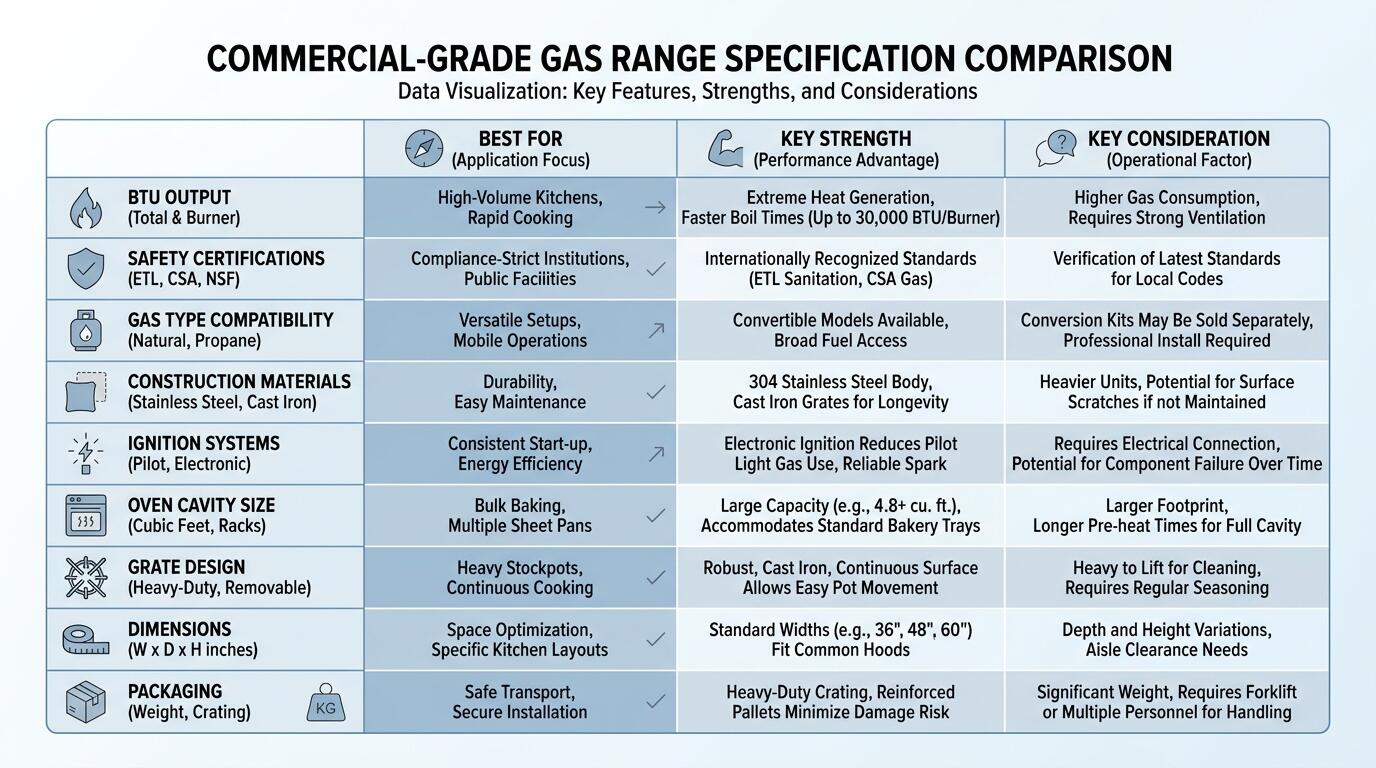
ALT: Comparison table of key specification items for sourcing commercial-grade gas ranges from OEM manufacturers, covering BTU, certifications, materials, and dimensions
How to Prioritize These Specifications for Your Sourcing Decision
The right starting point depends on your market, your product positioning, and how much development flexibility you have at the time of sourcing.
If you are sourcing for a regulated market — North America, Europe, or Australia — safety certifications are the non-negotiable foundation. Every other specification decision flows from and must be compatible with the certification requirements of your target market. Buyers who define these requirements early can reduce avoidable specification changes, improve coordination with manufacturers, and better prepare for the testing and certification activities required before market entry. Decisions around rated gas heat input, gas type, and ignition system should be reviewed alongside the applicable product classification and market-specific compliance requirements. Buyers should confirm how each specification affects the product's design, installation conditions, and required evaluation before finalizing the sourcing brief.
If your primary concern is product differentiation in a competitive private-label environment, materials specification and control/ignition design are where you have the most leverage. The difference between a forgettable private-label range and a premium product that earns repeat distribution is often found in details like grate construction, control knob materials, and the finish quality of stainless steel surfaces — not in headline specifications that look similar on a spec sheet. Understanding whether an OEM or ODM model fits your brand's development approach will help you determine how much of this specification work is yours to drive versus what the manufacturer owns.
If you are under cost pressure and need to maximize value at a specific price point, the most effective approach is to rank specifications by their impact on end-user satisfaction and channel acceptance, then trade off on specifications that affect production cost but have lower visibility to the buyer. Packaging and labeling may offer opportunities for cost optimization when regulatory requirements are maintained. By contrast, changes to material specifications or certification scope should be carefully evaluated, as post-launch revisions may involve additional engineering work, testing, documentation, or product re-evaluation.
A common misconception in commercial gas range sourcing is that a higher BTU rating automatically indicates a higher-quality product. Rated gas heat input is a performance specification rather than a standalone quality indicator. Buyers should evaluate burner performance alongside combustion stability, heat distribution, construction quality, and the intended cooking application when comparing products.
For buyers working through the broader manufacturer evaluation process, a structured approach to choosing an OEM/ODM kitchen appliance manufacturer can help ensure that the factory you select has the production capability and quality systems to consistently meet the specifications you have defined.
Questions & Answers
Q1: How should I communicate gas range specifications to a Chinese OEM manufacturer to avoid misunderstandings?
Submitting a written specification sheet in English with all critical parameters defined — rated gas heat input for each burner and the total appliance, gas type, required certification marks, material grades, and dimensional constraints — is the most effective way to prevent misinterpretation. Specify rated gas heat input consistently in Btu/h or kW, and ask the manufacturer to confirm each parameter in writing. Supplement written specs with reference samples or annotated photos where available. During the RFQ stage, ask the manufacturer to confirm each specification in writing and flag any items they cannot meet with their standard tooling. This early-stage alignment helps reduce specification misunderstandings and may lower the risk of avoidable revisions during later development and production stages.
Q2: Are commercial-grade gas ranges and residential gas ranges subject to the same certification requirements?
Commercial and residential gas cooking appliances may be subject to different safety standards and certification requirements, depending on their intended use, product configuration, and destination market.
In North America, commercial cooking equipment and residential cooking appliances may fall under different applicable product standards and certification programs. Buyers should confirm the correct product classification with the relevant certification body before finalizing the design.
The classification may also affect installation requirements, ventilation provisions, and applicable local codes. Always verify the requirements for the specific product model and intended application.
Q3: How long does it typically take to obtain safety certification for a new commercial gas range, and how does this affect sourcing timelines?
Certification timelines depend on the applicable standards, product complexity, testing scope, certification body procedures, and whether the proposed design is based on an existing certified platform.
For products developed from an existing platform, buyers should verify whether the current certification listing covers the proposed model, configuration, and destination market. Changes to critical components or product specifications may require additional evaluation or testing.
An OEM manufacturer with internal pre-compliance testing capabilities and established coordination with qualified certification laboratories may be able to identify potential issues earlier and organize testing activities more efficiently. However, the overall certification schedule remains subject to the certification body's review, required testing, documentation, and approval procedures.
Buyers should include these activities in the sourcing schedule and confirm project-specific milestones with both the manufacturer and certification body before setting a launch date.
Key Takeaways
Sourcing a commercial-grade gas range that succeeds in your target market requires specifying the right parameters upfront — not discovering gaps after samples have been produced and certification testing has begun. The three most high-leverage principles from this checklist are: start with certification requirements and work backward to design decisions; specify materials with the precision of a supplier agreement, not a marketing brief; and treat rated gas heat input and burner configuration as application-driven decisions, not performance marketing choices.
For procurement teams building a repeatable sourcing process, this checklist functions best as a live document — updated with market-specific certification requirements and product-line learnings as your sourcing relationship with your manufacturer matures. The investment in thorough upfront specification can help reduce avoidable revision cycles, improve coordination during testing and certification preparation, and establish clearer quality expectations across production runs. Consistent manufacturing results also depend on effective production controls, inspection procedures, and ongoing quality management. Maintaining rigorous inspection standards throughout manufacturing is equally important; for guidance on how quality is sustained at volume, the approach to achieving high quality standards in high-volume appliance manufacturing offers practical insight.
The next step is to take this checklist into your next supplier conversation, with your target market, application, and quality requirements clearly defined. Evaluate each manufacturer based on its ability to support the specifications relevant to your project and provide appropriate technical documentation and supporting evidence.
Planning your next commercial gas range sourcing project? Explore Hyxion's kitchen appliance manufacturing capabilities and discuss your target market, product specifications, and customization requirements with the team. You can request further information about available product configurations, testing arrangements, and relevant certification documentation to evaluate whether they fit your project needs. Explore Hyxion's full range of smart kitchen appliance manufacturing capabilities and connect with the Hyxion team to request a custom quote or begin a sourcing partnership tailored to your brand's requirements.
Sources & Citations
- CSA Group. "Gas Appliance Certification and Testing Standards."
https://www.csagroup.org - UL (Underwriters Laboratories). "Gas Range and Cooking Appliance Safety Evaluation."
https://www.ul.com - American National Standards Institute (ANSI). "Standards Development for Gas Appliances and Commercial Cooking Equipment."
https://www.ansi.org - International Electrotechnical Commission (IEC). "Standards for Household and Commercial Appliance Safety."
https://www.iec.ch
Note: Standards may be updated; please check the latest official documents or consult professional advisors.