OEM vs. ODM for Kitchen Appliances: Which Model Fits Your Brand in 2026?
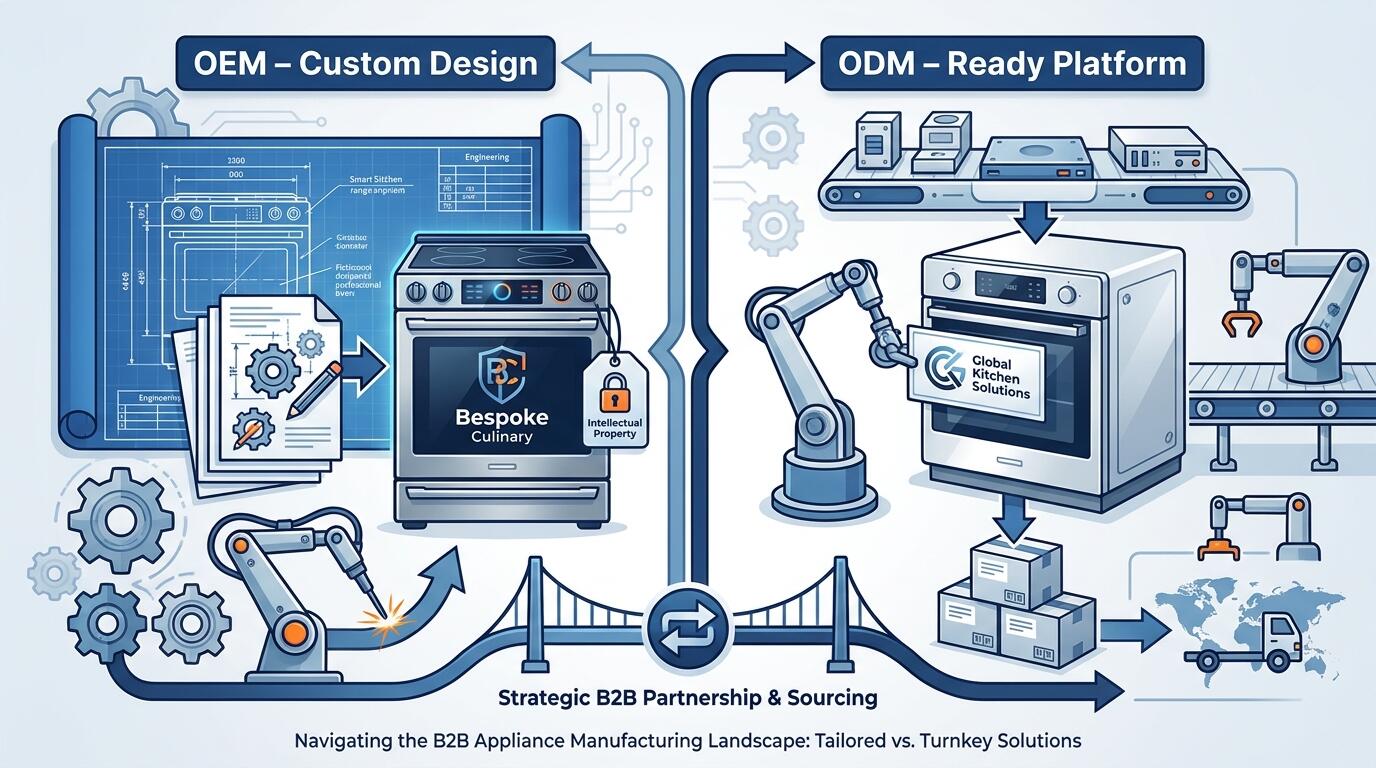
ALT: OEM vs ODM kitchen appliance manufacturing models compared for global B2B buyers in 2026
OEM vs. ODM for Kitchen Appliances: Understanding Which Manufacturing Model Fits Your Brand Strategy
Imagine you are a procurement manager for a mid-sized kitchen appliance distributor in North America. You have identified a gap in your product lineup — smart cooking equipment is surging in demand, and your retail partners are asking for your own branded solutions. You reach out to manufacturers in China, and within days you are fielding two distinct proposals: one offering to build to your specifications, another offering developed products ready for your label. Both look attractive on paper. The question is: which model actually serves your business better in 2026?
The answer depends on your brand's maturity, budget, and long-term product vision. OEM manufacturing — Original Equipment Manufacturing — and ODM manufacturing — Original Design Manufacturing — are both well-established routes to bringing branded kitchen appliances to market, but they differ fundamentally in where control, cost, and complexity sit. This article examines both models across the criteria that matter most to global buyers, so you can make a confident, cost-effective sourcing decision.
Evaluation Criteria: How to Judge the Right Manufacturing Model for Kitchen Appliances
Choosing between OEM and ODM for kitchen appliances is not simply a price comparison — it is a strategic decision that affects brand equity, speed to market, capital allocation, and long-term competitiveness. At Hyxion, in our work with global buyers across North America, Europe, and Australia, we evaluate manufacturer-partner fit across six dimensions that consistently prove decisive.
Product differentiation and design control determines how unique your end product will be in the market. Buyers who can articulate precise functional or aesthetic requirements gain more from an OEM model, while those entering a category for the first time often benefit from ODM's pre-engineered foundations.
Time to market directly affects revenue cycles and retail planning. The speed at which a product can move from concept to shipping container is shaped by how much engineering work remains to be done when the partnership begins.
Minimum order quantities and capital commitment set the financial floor of any manufacturing engagement. For distributors managing cash flow across multiple SKUs, the upfront investment required by each model carries real budget implications.
Intellectual property and exclusivity matter especially to brands building long-term product equity. Understanding who owns the design, the tooling, and the technology embedded in a product is critical before signing any agreement.
Customization depth and flexibility speaks to how far a manufacturer can deviate from a base design — in materials, dimensions, software features, finishes, and certifications — to meet your market's specific requirements.
Compliance with applicable product safety standards is essential in major markets. In the United States and Canada, kitchen appliances must be evaluated against the relevant safety standards for their product category and intended use. Examples include UL Standards and CSA Standards. Products that undergo third-party certification may carry recognized certification marks such as UL, ETL, or CSA, depending on the certification body and applicable requirements. In the European Union, products must meet the applicable EU legislation and conformity assessment requirements before the CE marking can be affixed. Buyers should confirm the specific standards and certification requirements for their target market and product configuration. Buyers should confirm the specific certifications held for their target product model and configuration, as requirements vary by region and product type. Whether certification work is already complete or must be commissioned affects both cost and timeline significantly.
The Contenders: OEM and ODM Kitchen Appliance Manufacturing Explained
OEM — Original Equipment Manufacturing for Kitchen Appliances
OEM, or Original Equipment Manufacturing, is a model in which a buyer provides detailed product specifications, and the manufacturer produces the product according to those specifications under the buyer's brand. An OEM partner like Hyxion can fabricate ranges, ovens, cooktops, or dishwashers to match a buyer's proprietary design files, feature requirements, and aesthetic standards, leveraging its engineering capability, raw material sourcing, and production infrastructure. The exact scope of services—including engineering support, component sourcing, quality inspection, and packaging—should be defined in each project agreement. This is the model of choice for established brands that have invested in R&D, have validated a product concept with their customer base, and need a manufacturing partner with the capacity and flexibility to execute at scale. It is also increasingly relevant to retailers developing private-label lines, where differentiation from competing products on the shelf is a priority.
The practical implication is that OEM requires more preparation on the buyer's side. Technical documentation, component specifications, software requirements for smart features, and compliance targets must be defined upfront. The investment in this preparation pays dividends in product exclusivity and brand coherence — but it also means the path to a first production run is longer than with an off-the-shelf ODM product.
ODM — Original Design Manufacturing for Kitchen Appliances
ODM, or Original Design Manufacturing, is a model in which the manufacturer develops the product — including its design, engineering, and core technology — and the buyer applies their own branding and, in many cases, makes surface-level or configuration-based customizations before bringing it to market.
In the smart kitchen appliance space, ODM products represent a manufacturer's existing innovation pipeline. Hyxion's ODM catalog includes selected smart kitchen appliances such as ranges with integrated cooking technology and intelligent ovens. (Note: Specific product availability and R&D capabilities should be confirmed with Hyxion's sales team. Tooling and development costs for ODM projects are typically absorbed by the manufacturer, but this may vary by project scope.)
The trade-off is differentiation. Because ODM base platforms may be available to multiple buyers (unless exclusivity is negotiated), a brand entering through the ODM route may find that a competitor's product shares underlying architecture. How much this matters depends on the brand's positioning and the depth of customization applied.
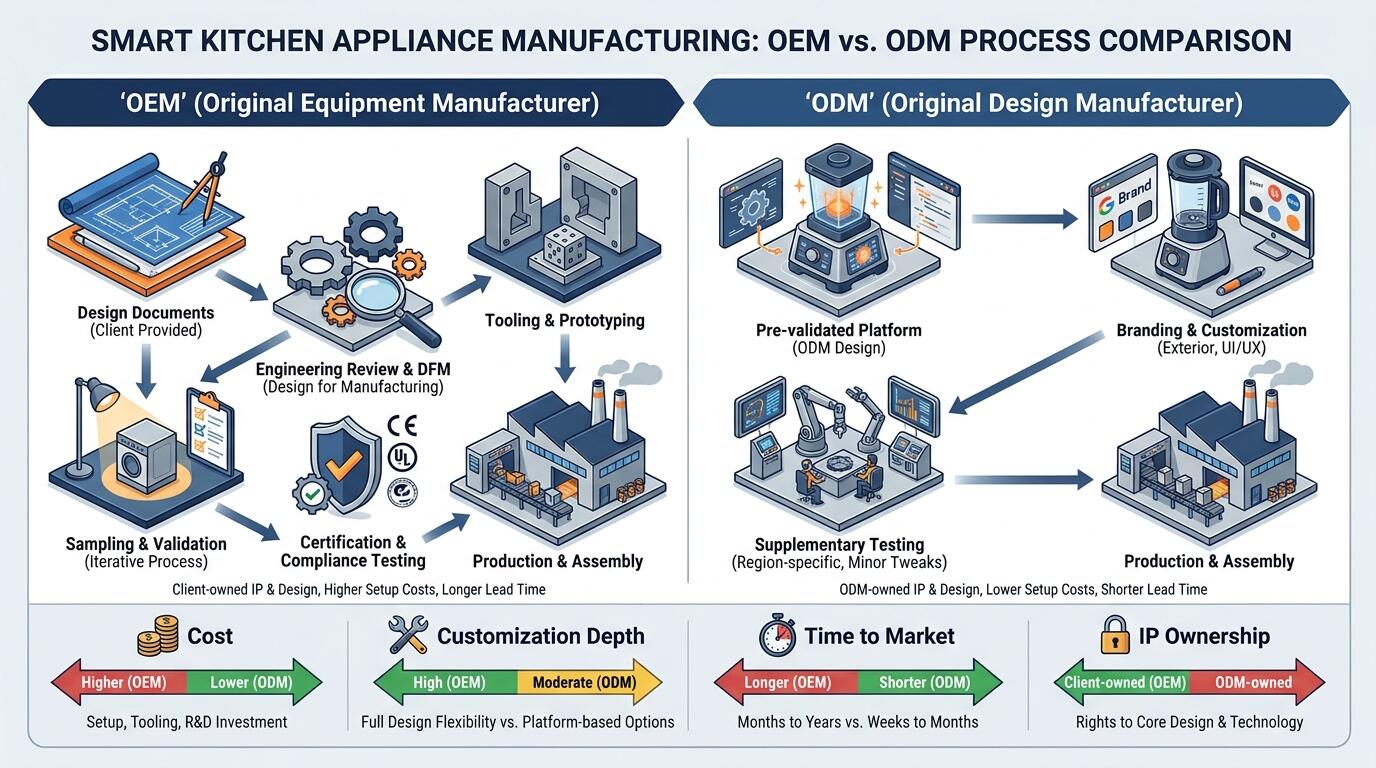
ALT: Side-by-side comparison of OEM and ODM smart kitchen appliance manufacturing processes for B2B buyers evaluating cost, customization, and speed to market
Head-to-Head Comparison: OEM vs. ODM for Kitchen Appliances in 2026
| Criterion | OEM | ODM |
|---|---|---|
| Design ownership | Buyer typically retains design/IP ownership subject to contract; otherwise per agreement | Manufacturer holds base design IP; buyer owns branding |
| Customization depth | Full — from core engineering to surface finish | Moderate — branding, configuration, and selected component swaps |
| Time to first production | Longer — requires engineering phase | Shorter — leverages pre-validated platform |
| Upfront investment | Higher — includes tooling, development, and sampling costs | Lower — development costs absorbed by manufacturer |
| Minimum order quantities | MOQ depends on product complexity, customization level, and production capacity | MOQ depends on product complexity, customization level, and production capacity |
| Regulatory certification ownership | Varies by contract; OEM buyer often funds/owns | Varies by contract; ODM mfr may hold base certs, but customization affects validity |
| IP protection and exclusivity | Per contract; buyer may own IP for custom designs, but exclusivity must be negotiated | Moderate — exclusivity arrangements available but not automatic |
| Product differentiation potential | Very high | Moderate — depends on customization depth |
| R&D dependency on buyer | High — buyer must supply design documentation | Low — manufacturer provides validated base product |
| Best suited for | Established brands, private-label retailers, brands with product IP | New market entrants, importers scaling quickly, brands testing categories |
*The allocation of design ownership, certification responsibility, and MOQ may vary by project and should be specified in the manufacturing agreement.
The table reveals a consistent pattern that we observe across our work with global buyers: the OEM model rewards brands that have already done their product thinking and are ready to invest in building something genuinely proprietary. The ODM model rewards speed, capital efficiency, and market responsiveness.
One nuance worth emphasizing is the certification dimension. Compliance with applicable product safety standards is essential in major markets. In the United States and Canada, kitchen appliances must be evaluated against the relevant safety standards for their product category and intended use. Examples include UL Standards and CSA Standards. Products that undergo third-party certification may carry recognized certification marks such as UL, ETL, or CSA, depending on the certification body and applicable requirements. In the European Union, products must meet the applicable EU legislation and conformity assessment requirements before the CE marking can be affixed. Buyers should confirm the specific standards and certification requirements for their target market and product configuration. Buyers should confirm the specific certifications held for their target product model and configuration, as requirements vary by region and product type. When a buyer commissions OEM production, they typically take on the responsibility of funding and managing the certification process for their unique product. In ODM, while the manufacturer may hold certifications for the base product platform, any customization—such as changes to electrical components, materials, or smart features—typically requires retesting or additional certification. Buyers must verify with the manufacturer and relevant certification bodies whether the existing certifications remain valid for their specific configuration.
A second important distinction concerns the total cost of ownership over a product lifecycle. OEM typically requires higher initial capital — covering tooling, engineering reviews, and iterative sampling — but can give buyers greater control over product differentiation and intellectual property, provided that ownership rights and exclusivity arrangements are clearly defined in the manufacturing agreement. Without appropriate contractual protections, working with the same factory does not automatically prevent similar products from being developed or supplied to other buyers.
Which Should You Choose? Scenario-Based Recommendations
If you are a new importer or distributor entering the smart kitchen appliance category for the first time, ODM is almost always the right starting point. The lower upfront capital requirement, compressed timeline, and access to pre-engineered smart technology allow you to validate demand in your target market before committing to a full proprietary development program. A pattern we consistently see is that buyers who enter via ODM and achieve initial commercial success then graduate to OEM for their core product lines once they understand their customers' precise preferences.
If you are an established brand or retailer building a private-label lineup, OEM offers the differentiation and IP ownership your positioning demands. Consumers and retail buyers in competitive markets increasingly scrutinize product exclusivity. A product built to your specifications — with your interface design, your material selections, and your feature set — cannot be replicated by competitors unless permitted by contract, and exclusivity must be secured via agreement to have commercial value.
If you are under time pressure to launch for a specific retail season or market window, ODM's faster path to production is a decisive advantage. Time-sensitive commercial opportunities — a retail listing with a deadline, a seasonal catalog cycle, a trade show launch — rarely accommodate the full OEM development cycle. In these situations, a well-specified ODM product with strong branding execution can be more valuable than a delayed OEM product, however technically superior.
If your product concept includes proprietary smart technology — custom software features, unique connectivity integrations, or patented cooking algorithms — OEM can be a suitable approach when your competitive advantage depends on proprietary smart technology, such as custom software features, unique connectivity integrations, or patented cooking algorithms. However, choosing OEM alone does not guarantee exclusive ownership or protection. Buyers should clearly define intellectual property ownership, technology licensing, confidentiality obligations, and any exclusivity arrangements in the manufacturing agreement. ODM products are built on the manufacturer's technology platform. If your competitive advantage lies in the intelligence of the appliance, OEM gives you the control to protect and develop that edge.
Summary of considerations:
- ODM: faster launch, lower upfront cost, proven engineering, moderate differentiation
- OEM: full design control, strong IP protection, high differentiation potential, higher initial investment and longer timeline
Both models are legitimate strategies. The right choice is the one aligned with your brand's current capabilities, market ambitions, and budget realities.
Common Questions
Q1: How do OEM and ODM kitchen appliance agreements differ in terms of intellectual property ownership?
Ownership is not automatic; it depends on the OEM agreement. In an OEM agreement, the buyer typically provides the product design and retains ownership of their intellectual property. However, the exact ownership of design files, tooling, and any jointly developed technology should be clearly defined in the contract. Hyxion respects client IP and establishes clear contractual terms for each project. Buyers should work with legal counsel to establish clear contractual terms regardless of which model they choose.
Q2: Is ODM suitable for brands that want to sell in regulated markets like the US or EU?
ODM can be suitable for regulated markets, but it requires careful due diligence. A manufacturer's existing certifications — such as UL, ETL, CE, or RoHS compliance — may cover the base product, but any customizations affecting safety-related components or electrical systems will typically trigger additional testing requirements. Buyers should confirm which certifications the manufacturer holds, understand which regulatory bodies govern their target market, and budget for any supplementary compliance work before finalizing an ODM sourcing agreement.
Q3: How long does it typically take to bring an OEM kitchen appliance to market compared to ODM?
The OEM path to market is longer because it includes an engineering and sampling phase before production can begin. This phase — covering design review, tooling fabrication, prototype evaluation, and certification — can add significant lead time compared to an ODM product that has already completed these steps. ODM timelines are compressed because the manufacturer's existing platform handles the engineering foundation, though customization complexity, certification requirements, and logistics planning still affect the final schedule. Buyers should discuss realistic timelines with their manufacturer partner early in the process.
Final Thoughts
The OEM vs. ODM decision is one of the most consequential choices a kitchen appliance brand makes when expanding or entering a product category. Three principles consistently guide the right answer.
First, align the model with your brand's current stage. Brands building scale and market presence benefit from ODM's speed and capital efficiency. Brands defending a differentiated market position benefit from OEM's exclusivity and IP control.
Second, factor in the total cost — not just the unit price. OEM's higher upfront investment can deliver a superior return over a product's commercial lifetime if the differentiation it enables commands better margins or stronger retail placement. ODM's lower entry point is attractive, but commoditization risk must be actively managed through branding, customization depth, and exclusivity agreements.
Third, choose a manufacturing partner with demonstrated capability in both models. The best outcome for most brands is a long-term relationship with a factory that can support ODM entry and OEM scale-up as the brand grows — avoiding the disruption of switching suppliers at a critical growth stage.
At Hyxion, our experience working alongside global buyers across diverse markets has shaped a flexible, transparent approach to both OEM and ODM partnerships. The goal is always the same: to help brands bring high-quality, competitively priced smart kitchen appliances to market in a way that serves their commercial strategy.
Ready to determine which manufacturing model fits your brand? Explore Hyxion's full range of smart kitchen appliance capabilities — from custom OEM development to ready-to-brand ODM solutions — by visiting the Hyxion smart kitchen appliances website today. Request a product catalogue, discuss your customization requirements, or start a conversation about a manufacturing partnership built around your brand's 2026 goals.
Sources
- International Organization for Standardization (ISO). "ISO Standards for Household Appliances and Related Manufacturing Processes".
https://www.iso.org/ - International Electrotechnical Commission (IEC). "IEC Standards for Safety and Performance of Household and Similar Electrical Appliances".
https://www.iec.ch/ - U.S. Consumer Product Safety Commission (CPSC). "Appliance Safety Standards and Compliance Guidance for Importers".
https://www.cpsc.gov/ - European Commission. "CE Marking and Product Safety Requirements for Electrical Equipment in the European Market".
https://ec.europa.eu/
Note: Standards may be updated; please check the latest official documents or consult professional advisors.