A 2026 Guide to Kitchen Appliance Safety Certifications for North American Importers
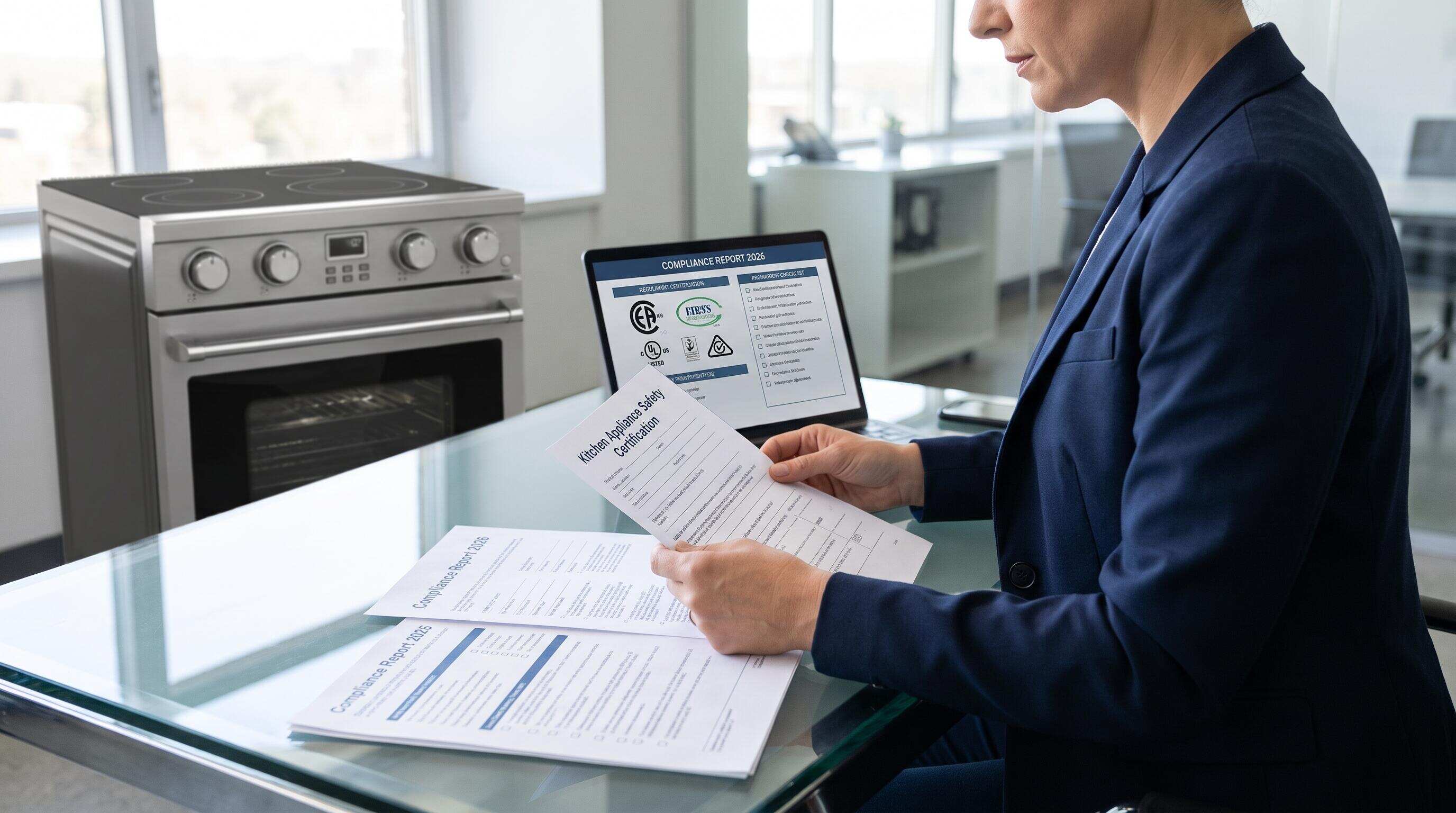
ALT: North American importer reviewing kitchen appliance safety certifications and compliance documents in 2026
What North American Kitchen Appliance Importers Must Know About Safety Certifications in 2026
Navigating the safety certification landscape for kitchen appliances imported into North America has never been more consequential — and the stakes are rising. Regulatory agencies are tightening enforcement, retailer compliance requirements are becoming more explicit, and buyers at every level of the supply chain are asking harder questions about how products were tested, by whom, and under which standards. For importers, distributors, and private-label brands sourcing smart kitchen appliances from overseas manufacturers, understanding which certifications are required, which are strategically valuable, and how to manage the compliance process end-to-end is now a core procurement competency, not an afterthought.
This guide is written for procurement managers, product sourcing specialists, and business owners who are either entering the North American market for the first time or reassessing their compliance approach ahead of new 2026 enforcement priorities. It draws on the kind of practical, day-to-day experience that comes from working alongside global buyers navigating these requirements — from initial product design to final customs clearance. Whether you are importing smart ranges, induction cooktops, smart ovens, or outdoor kitchen appliances, the framework below will help you avoid the most common and costly certification missteps.
Before You Start: Prerequisites and Preparation for the Certification Process
Before submitting a single product to a testing laboratory, importers need to lay a solid operational foundation. Rushing into third-party testing without adequate preparation is one of the most common — and expensive — mistakes we see in the certification process. Products that arrive at a lab with incomplete technical files, ambiguous product configurations, or unclear market scope routinely face delays, retesting fees, and failed audits.
The certification timeline varies depending on product type, technical complexity, documentation readiness, applicable testing standards, and any additional compliance requirements. Products with smart or connected features may require further radio frequency testing or other reviews, which can affect the overall schedule. Rather than relying on a fixed timeline, importers should consult their selected testing laboratory early in the process to establish a realistic schedule based on the product's specific requirements and testing scope.
Checklist before starting:
- Confirm your target market scope: United States only, Canada only, or both — this determines which standards and marks apply
- Identify whether your product is covered under a mandatory safety scheme or whether voluntary certification is sufficient for your retail channel
- Obtain a complete and accurate product specification sheet from your manufacturer, including all electrical components, software interfaces, fuel type (for gas appliances), and connectivity features
- Establish the product's intended use classification (residential vs. commercial), since the applicable standards differ significantly
- Verify that your chosen OEM/ODM manufacturer has prior experience supporting third-party certification audits and can provide factory inspection access
- Allocate budget and timeline for initial testing, any required redesign or retesting, and ongoing certification maintenance
- Identify an accredited certification body (CB) with recognition in both the U.S. and Canada to streamline binational compliance
- Disclaimer: The information in this guide is for general educational purposes only. Responsibilities related to certification, compliance, intellectual property, and liability in OEM/ODM relationships are governed by the specific contracts between the parties. Buyers should consult legal counsel and their manufacturing partners to establish clear contractual terms.
Step-by-Step Guide to Securing Kitchen Appliance Safety Certifications for North America
Step 1: Understand the Core Certification Marks Required for the U.S. and Canadian Markets
For kitchen appliances entering the North American market, importers should first identify the applicable product safety requirements and determine whether third-party certification is required. In the United States, certain products are subject to OSHA requirements for certification by an OSHA-recognized Nationally Recognized Testing Laboratory (NRTL). In Canada, applicable electrical products may require approval through a certification body accredited by the Standards Council of Canada (SCC). The specific requirements depend on the product category, intended use, and applicable federal, provincial, or local regulations.
In Canada, electrical products may be approved through certification by an accredited certification body, with recognized marks including CSA, cUL, and cETL, among others. The appropriate mark depends on the certification body, the applicable product safety standards, and the intended market. A cULus mark generally indicates that the product has been evaluated for applicable U.S. and Canadian requirements within the scope of its certification. Importers should verify the specific certification record and applicable provincial or territorial approval requirements rather than relying on the logo alone. Products bearing a cULus mark have been tested to both U.S. and Canadian requirements simultaneously, which is the most efficient path for importers targeting both markets. For electric cooktops and smart ranges, the primary U.S. standard is typically UL 858 (Standard for Household Electric Ranges)—though the exact applicable standard depends on the specific product model, configuration, and intended use. Buyers should verify the correct standard with their testing laboratory.
In the United States, the Occupational Safety and Health Administration (OSHA) maintains a list of Nationally Recognized Testing Laboratories (NRTLs) authorized to test and certify products within their approved scopes of recognition. Under applicable OSHA workplace safety standards, certain types of electrical equipment and other specified products require NRTL approval when used in covered workplace settings. This does not mean that every kitchen appliance sold in the U.S. is automatically subject to the same NRTL certification requirement.
Commonly recognized product certification marks include UL (UL Solutions), ETL (Intertek), and CSA (CSA Group). Each mark represents certification by a specific organization under applicable product safety standards and within its authorized certification scope. Importers should verify that the selected certification body is authorized to certify the relevant product category and that the applicable standard matches the product's type and intended use. Examples of relevant standards include UL 858 for household electric ranges, UL 197 for commercial cooking equipment, and applicable ANSI Z21-series standards for gas appliances.
Tip: Always confirm with your retail partners or distribution channels which specific marks they require before beginning testing. Some major retailers and electrical utilities specify particular NRTLs by name, and discovering this requirement after certification is complete can force a costly recertification.
Step 2: Map Your Product to the Correct Applicable Standards
Kitchen appliance safety standards are not monolithic — they differ by product category, fuel type, installation type, and end-user environment. Applying the wrong standard to a product is a surprisingly common error that leads to test failures and regulatory complications downstream.
For electric cooktops and smart ranges, the primary U.S. standard is UL 858 (Standard for Household Electric Ranges), though smart appliances with wireless connectivity may also need to comply with FCC Part 15 for radio frequency emissions. For gas cooking appliances — including gas rangetops and dual-fuel ranges — the relevant standards are ANSI Z21.1 and CSA 1.1, which govern gas pressure, burner performance, and ignition safety. Commercial-grade kitchen equipment is governed by a different set of standards, including UL 197 and NSF/ANSI 4 (for commercial cooking equipment in food service environments).
Dishwashers must comply with UL 749 in the United States, while outdoor kitchen appliances — an increasingly popular product category — may require compliance with both UL outdoor electrical standards and applicable gas equipment standards depending on configuration.
For smart kitchen appliances specifically, importers should anticipate an additional layer of compliance around wireless radio certifications (FCC in the U.S., ISED in Canada) and, where applicable, emerging cybersecurity frameworks that govern connected home devices.
Tip: Request a formal standards mapping review from your testing laboratory early in the product development cycle. Identifying applicable standards before tooling is finalized can prevent costly design changes later.
Step 3: Select an Accredited Testing Laboratory and Submit Your Technical File
Selecting the right testing body is as important as understanding which standards apply. A laboratory's scope of accreditation determines which marks it can issue, and not all labs are authorized to certify all product categories.
Importers should prioritize laboratories that are both OSHA-recognized NRTLs (for U.S. sales) and SCC-accredited bodies (for Canadian sales). UL, Intertek (ETL mark), and CSA Group are the three most established options with broad North American recognition. When evaluating a lab, confirm that its accreditation scope specifically covers your product category — not all NRTLs are authorized to certify gas appliances, for example.
Your technical file, submitted to the lab at the outset, should include a full bill of materials, electrical schematics, software and firmware documentation (for smart appliances), user manuals in draft form, and product samples for physical testing. Missing or incomplete documentation is the single most common reason for testing delays. In our work with clients sourcing appliances from Chinese manufacturers, a consistent pattern we see is that documentation gaps — particularly around internal component sourcing and firmware change logs — cause delays that are entirely avoidable with early preparation.
Tip: Engage your OEM/ODM manufacturer in the technical file preparation process from the beginning. Manufacturers with prior export experience, particularly those accustomed to supporting international certification audits, can dramatically accelerate this stage.
Step 4: Navigate the CPSC Reporting and eFiling Requirements
For products sold in the United States, the Consumer Product Safety Commission (CPSC) imposes mandatory reporting requirements that go beyond third-party testing. The CPSC requires importers to file a Certificate of Compliance (CoC) for products subject to mandatory safety rules — and in many cases, this filing must be completed electronically through the CPSC's designated eFiling system before goods are cleared by U.S. Customs.
The CPSC's enforcement posture toward imported kitchen appliances has been evolving, with increased scrutiny on connected and smart appliances. Importers should treat CPSC eFiling not as a one-time bureaucratic task but as an ongoing compliance obligation — particularly because product modifications, firmware updates, or component substitutions by the manufacturer may require updated filings.
A critical point that importers should understand is that product safety compliance responsibilities may extend across multiple parties in the supply chain. Under applicable U.S. consumer product safety laws, manufacturers and importers may each have specific legal obligations, including testing, certification, documentation, and reporting requirements. Overseas manufacturing does not automatically eliminate a manufacturer's responsibilities, nor does working with a certified supplier remove an importer's own compliance obligations. Importers should establish clear contractual responsibilities with their OEM/ODM manufacturers and ensure that both parties maintain accurate product documentation, follow applicable testing requirements, and communicate any product or component changes that could affect compliance. Regulatory and financial consequences may affect different parties depending on their respective legal obligations, roles in the supply chain, and contractual responsibilities.
Tip: Assign a dedicated compliance officer or engage a licensed customs broker with CPSC experience to manage eFiling. Treat CPSC documentation with the same rigor as your customs documentation — because regulators increasingly treat them as inseparable.
Step 5: Manage Factory Audits and Production Consistency
Critical: No component substitution, design modification, or configuration adjustment—whether initiated by the buyer or the manufacturer—should be assumed to retain the existing certification. Even seemingly minor changes may require full or partial re-testing and prior approval from the certification body. Always consult the certification body before implementing any changes.
Obtaining certification for a product sample is only the beginning. Maintaining that certification across production runs — ensuring that every unit leaving the factory matches the certified configuration — is where many importers encounter their most serious compliance challenges.
Certification bodies typically require an ongoing follow-up inspection program, often referred to as a factory surveillance or Follow-Up Service (FUS) in UL terminology. Under this program, the certification body conducts periodic unannounced or scheduled factory inspections to verify that production units match the certified design. If a factory makes component substitutions, process changes, or firmware updates without notifying the certification body, the certification can be suspended or revoked — with immediate consequences for the importer's ability to sell the product.
When evaluating OEM/ODM partners, importers should explicitly ask how the manufacturer manages certification change notifications. A supplier that understands and has demonstrated compliance with Follow-Up Service requirements is a far lower-risk partner than one that treats the initial certification as the finish line.
Tip: Include certification change notification obligations explicitly in your manufacturing agreement. This contractual clarity prevents the ambiguity that leads to unauthorized design changes slipping through unnoticed.
Step 6: Address Canada-Specific Requirements
Canada's electrical product approval framework involves accredited certification bodies and provincial or territorial regulatory authorities. Electrical products must meet the applicable Canadian safety requirements and carry a recognized certification mark, such as CSA, cUL, or cETL, where required. These are product certification marks, not federal government marks. Provincial and territorial authorities, including the Electrical Safety Authority (ESA) in Ontario, oversee the applicable electrical safety and approval requirements within their respective jurisdictions. Importers should verify that the certification body and product marking are recognized in the target province or territory.
Gas appliance product certification and installation compliance are separate considerations. CSA B149-series codes establish requirements for the installation of gas-burning appliances and related equipment in Canada; they should not be treated as product certification marks. Importers should verify that their gas appliances have the appropriate product certification for the intended Canadian market and that the appliance specifications, gas connections, and installation instructions comply with the applicable provincial or territorial installation requirements.
For smart and connected appliances, Canada's ISED (Innovation, Science and Economic Development Canada) manages radio device licensing and certification under the Radio Standards Procedure (RSP) framework — the Canadian equivalent of FCC authorization. Products that connect to Wi-Fi, Bluetooth, or other radio frequency bands require ISED certification before they can be legally marketed in Canada.
Tip: If you are targeting both the U.S. and Canadian markets, pursue binational certification (cULus or cETLus) from the outset — the marginal cost of adding Canadian scope at the testing phase is far lower than applying for a separate Canadian certification after the fact.
Step 7: Prepare Ongoing Compliance Documentation and Plan for Renewal
Certification is not a permanent status — it requires active management. Certificates expire, standards are revised, and regulatory bodies issue updated interpretations that can affect your product's compliance status without any change to the product itself.
Importers should maintain a living compliance file for each product that includes the original test reports, certificates of conformity, CPSC filings, any factory audit reports, and a change log tracking every product modification since initial certification. This documentation is essential both for regulatory purposes and for responding to retailer compliance audits, which are becoming increasingly systematic at major North American retail chains.
Standards bodies such as UL, CSA, and ANSI publish revised standards on a periodic basis. When a standard is revised, certified products are typically given a transition period to demonstrate compliance with the new requirements — but importers who are not actively tracking these changes often miss the transition window and face product holds or delisting.
Tip: Subscribe to the update notification services offered by your certification body and by ANSI to receive alerts when standards relevant to your product categories are revised or under review.
Common Certification Mistakes and How to Fix Them
The following table presents the most frequent compliance problems we see importers encounter, along with their root causes and practical remedies.
| Symptom | Likely Cause | How to Fix |
|---|---|---|
| Product fails safety testing despite passing factory QC | Product sample sent for testing does not match production configuration; internal components differ from spec | Conduct a pre-submission design audit; ensure the test sample is representative of actual production units |
| CPSC filing rejected at customs | eFiling was submitted with incorrect product classification or missing importer of record information | Engage a CPSC-experienced customs broker; review CPSC's product classification database before filing |
| Certification suspended mid-production | Manufacturer made an undisclosed component substitution that the certification body detected during factory surveillance | Add contractual change notification requirements to your manufacturing agreement; require supplier sign-off before any BOM changes |
| Canadian retailers reject product despite valid UL mark | Product only holds a U.S. UL mark, not a cULus or CSA mark recognized in Canada | Pursue binational certification at the initial testing stage or apply for Canadian scope extension on the existing certificate |
| Smart appliance flagged for radio frequency non-compliance | FCC or ISED authorization was not obtained for Wi-Fi or Bluetooth module; connectivity features were added after initial product certification | Ensure all radio frequency modules are listed in the original certification scope; obtain FCC/ISED authorization before launch |
| Certification lapses unnoticed | No internal process to track certificate expiry dates or standard revision notices | Assign ownership of a compliance calendar; subscribe to certification body update alerts |

ALT: Procurement specialist reviewing North American kitchen appliance safety certification documents including UL, ETL, CSA, and CPSC compliance files
Pro Tips for Stronger Certification Outcomes
Build certification requirements into supplier qualification, not just product development. The most effective time to verify a manufacturer's certification readiness is before you place an order, not after samples have been produced. Manufacturers with prior experience supporting NRTL audits, maintaining change notification protocols, and managing Follow-Up Service requirements will consistently deliver better certification outcomes. In our work with clients evaluating OEM/ODM partners, supplier certification track record is one of the clearest predictors of a smooth compliance process.
Do not conflate CE marking with North American certification. A product bearing the CE mark — the European conformity marking — is not automatically compliant with U.S. or Canadian safety requirements. These are entirely separate regulatory frameworks based on different underlying standards. CE marking signals conformity to European directives; it carries no legal weight with OSHA, CPSC, or Canadian provincial safety authorities. This misconception is remarkably persistent among importers who source from factories that export to both European and North American markets.
Treat smart features as a separate compliance workstream. Smart kitchen appliances — those with Wi-Fi, app connectivity, voice assistant integration, or over-the-air update capabilities — present compliance dimensions that go beyond traditional appliance safety testing. Radio frequency authorization, software security requirements, and ongoing firmware change management all require dedicated attention. Some importers address the electrical safety certification but neglect the FCC/ISED radio authorization; this creates a legally non-compliant product even when the safety mark is valid.
Invest in a pre-compliance review before formal testing. Many certification bodies and independent consultants offer pre-compliance gap analysis services — essentially a review of your product and documentation against the applicable standards before formal testing begins. This service consistently pays for itself by identifying issues that would otherwise result in expensive test failures and retesting cycles.
Plan for compliance at the product concept stage, not the launch stage. One of the most impactful changes an importer can make to its certification process is to involve compliance considerations at the earliest stage of product specification. Design decisions made early — choice of electrical components, gas fitting configurations, radio module selection — have outsized consequences for which certifications are achievable, at what cost, and on what timeline.
Questions & Answers
Q1: How long does the kitchen appliance certification process typically take for North American markets?
The certification timeline for kitchen appliances varies considerably by product complexity and completeness of documentation. Straightforward residential electric appliances with complete technical files may move through the testing process more quickly, while smart appliances with connectivity features, gas appliances, or products requiring binational U.S.-Canada certification will typically require a longer process. Importers should plan for the full certification timeline — including potential retesting — well before their target market launch date, and engage their testing laboratory early to get a realistic estimate for their specific product.
Q2: Is a UL certification mark mandatory for all kitchen appliances sold in the United States?
A UL mark is not universally required for every kitchen appliance sold in the United States. Under OSHA's Nationally Recognized Testing Laboratory (NRTL) program, certain types of electrical equipment and other specified products must be tested and certified by an OSHA-recognized NRTL when required by applicable workplace safety standards. Whether NRTL approval applies depends on the product category, applicable OSHA requirements, and conditions of use. Importers should verify the relevant requirements for their specific products rather than assume that one certification rule applies to all kitchen appliances. Retailer requirements and other applicable federal, state, or local regulations should also be reviewed separately.
Timelines are typically estimated from the date of project kick-off (e.g., receipt of complete technical files and execution of testing agreements). Durations may be expressed in business days or calendar days depending on the laboratory; buyers should confirm the basis with their chosen certification body. Actual lead times vary based on product complexity, documentation completeness, and the scope of required tests.
Q3: What are the cost implications of pursuing U.S. and Canadian certification simultaneously versus sequentially?
Pursuing binational certification — obtaining a cULus, cETLus, or similar dual-country mark — in a single testing engagement is consistently more cost-effective than pursuing U.S. and Canadian certification as separate sequential processes. The incremental cost of adding Canadian scope to a U.S. certification at the testing stage is typically modest, while the cost of a full separate Canadian certification application after the fact includes additional testing fees, documentation preparation, and potential product holds during the gap. For any importer with realistic plans to sell in both markets, binational certification from the outset is the clearly preferable strategy.
Summary
For North American kitchen appliance importers in 2026, safety certification is not a compliance checkbox — it is a strategic business function that directly affects market access, retailer relationships, and legal liability. Three principles define the importers who navigate this landscape most successfully.
First, map your compliance requirements comprehensively before testing begins. The applicable standards, certification marks, CPSC eFiling obligations, and radio frequency authorizations must all be identified at the product concept stage — not discovered reactively after a test failure or a customs hold.
Second, select manufacturing partners who understand and actively support the certification process. An OEM/ODM supplier with demonstrated experience in NRTL audits, Follow-Up Service compliance, and change notification protocols is a material competitive advantage. The factory's certification readiness should be a formal criterion in supplier qualification.
Third, treat certification as an ongoing operational discipline. Certificates expire, standards evolve, and product changes require proactive notification to certification bodies. Importers who maintain living compliance files and track regulatory developments will avoid the expensive disruptions that catch less-prepared competitors off guard.
The investment required to build a rigorous certification process is real — but it is dwarfed by the cost of a product recall, a customs seizure, or a retailer delisting.
Ready to work with an OEM/ODM partner who can support your North American compliance process? Visit Hyxion's website to learn about their smart kitchen appliance manufacturing services. Buyers should request official certification documentation and discuss specific compliance capabilities directly with the Hyxion team to confirm alignment with their target market requirements — at the Hyxion smart kitchen appliances website.
Sources & Citations
- Complir.io. "CPSC eFiling: What Importers Need to Know (2026 Guide)".
https://www.complir.io/resources/guides/cpsc-efiling-guide - Fortune Kitchenware. "US CPSC Kitchen Appliance Certification Update 2026".
https://www.fortune-kitchenware.com/news/global-trade/import-export-data/US_CPSC_Tightens_Kitchen_Appliance_Certification_for_Sept_2026.html - Grace Kitchen Equip. "CE, ETL, NSF, CB & Country Marks (SASO, SONCAP, EAC)".
https://www.gracekitchenequip.com/commercial-kitchen-equipment-certifications-explained-2026-ce-etl-nsf-cb-country-marks-saso-soncap-eac/
Note: Standards may be updated; please check the latest official documents or consult professional advisors.