
How In-House CSA/UL Labs Cut Certification Time for Gas Ranges and Ovens
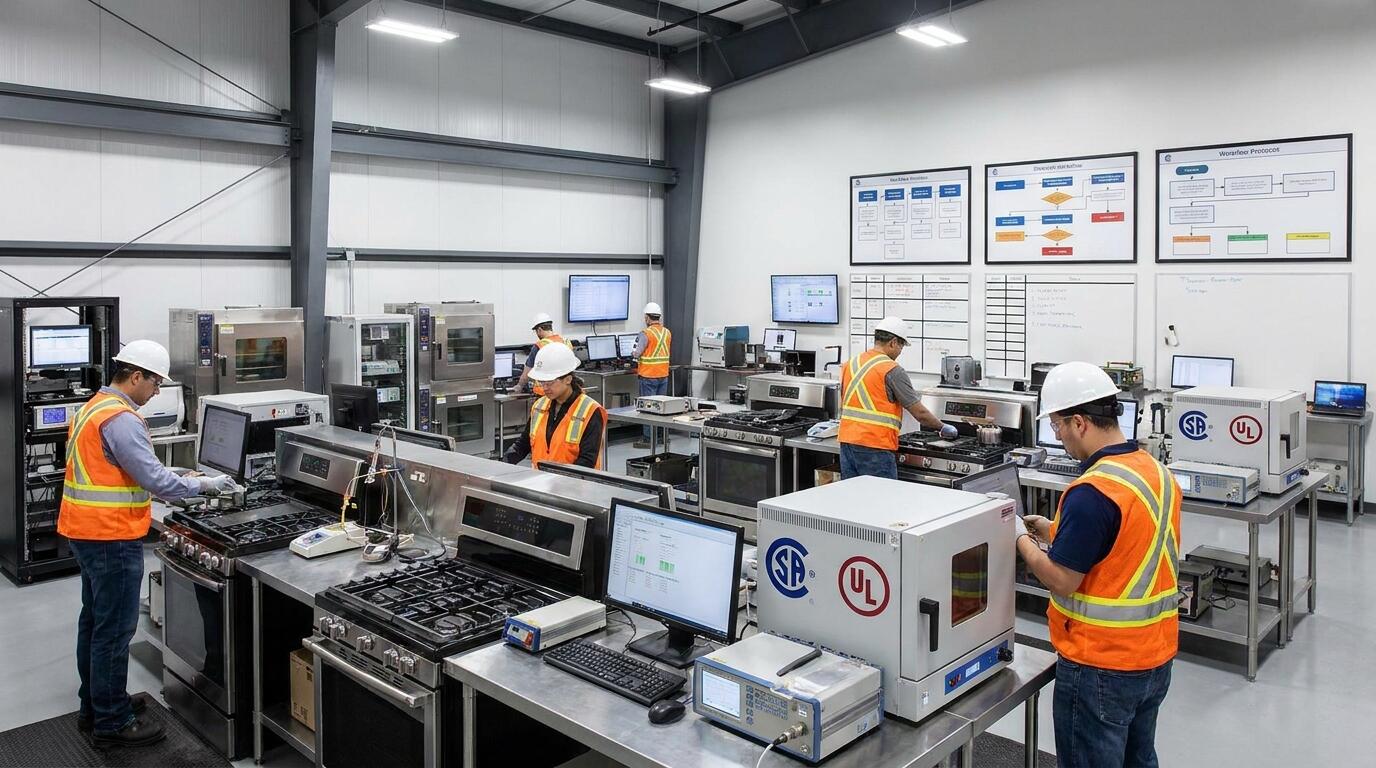
ALT: In-house CSA UL lab testing gas ranges and ovens to accelerate certification for B2B manufacturers
Why Certification Speed Is Now a Competitive Differentiator for Gas Appliance Manufacturers
A procurement manager at a mid-sized North American appliance retailer once described the experience of waiting on third-party certification as "losing a selling season" — the product was ready, the demand was real, but the launch calendar kept slipping. That story is not unusual. For global B2B buyers sourcing gas ranges and ovens from overseas manufacturers, certification timelines have historically been the single most unpredictable variable between a confirmed order and product hitting retail shelves.
Manufacturers with well-equipped in-house testing facilities may be able to identify potential compliance issues earlier in the product development process. When these facilities operate under a documented quality system and have the appropriate accreditation or recognition for their intended testing activities, they can support more efficient coordination with external certification bodies. For gas range and oven buyers, the key consideration is not simply whether a supplier has an in-house laboratory, but whether its testing capabilities, documentation, and certification arrangements align with the requirements of the target market.
The Current Landscape: How Gas Appliance Certification Got So Complex
Gas ranges and ovens sold in North American markets must meet safety standards established by recognized certification bodies — primarily CSA Group (which administers standards under the auspices of the American National Standards Institute, or ANSI) and Underwriters Laboratories. Gas cooking appliances sold in North America must meet the applicable product safety and certification requirements of their destination markets. For household gas cooking appliances, ANSI Z21.1 is a relevant U.S. standard, while CSA 1.1 is commonly referenced for the Canadian market. Buyers and manufacturers should verify the applicable standard edition, product scope, fuel configuration, and certification requirements for each specific model. Compliance documentation should be reviewed against the requirements of the intended sales jurisdiction rather than assumed to be interchangeable across markets.
Historically, the certification pathway worked in one direction: a manufacturer produced a prototype or pre-production sample, shipped it to an accredited third-party laboratory, waited for a testing slot, ran through a structured evaluation protocol, addressed any failures, and then awaited a formal certification report. The entire process could stretch across multiple months, compounded by queue times at busy independent labs, international shipping logistics for heavy cooking appliances, and iterative back-and-forth when test failures required design modifications.
The complexity increased as smart kitchen technology became a differentiating feature in the mid-to-premium appliance segment. Gas ranges with integrated electronic controls, Wi-Fi connectivity, or touch-panel interfaces may involve additional compliance considerations beyond conventional combustion and thermal safety testing. Depending on the product configuration and destination market, these may include electromagnetic compatibility, electrical safety, wireless communication, and software-related assessments. Manufacturers should identify the applicable requirements early in the development process to determine which tests are necessary for each model. A single product line now routinely involves coordinated testing across multiple standards, and each coordination point with an external lab adds elapsed time and administrative overhead.
The parallel rise of private-label and OEM/ODM sourcing from Asia added yet another layer of complexity. Buyers wanting to place their own brand identity on a gas range manufactured in China need to ensure that the product, as supplied, carries or is eligible for the certification marks that North American retail channels require. This created strong commercial pressure on manufacturers to internalize pre-compliance testing capability rather than treat it as a downstream responsibility passed to the buyer. For importers and retailers evaluating suppliers — a process well-covered in a comprehensive guide to kitchen appliance safety certifications for North American importers — understanding where a manufacturer's in-house capability begins and ends is now a standard due-diligence question.
Market forces have reinforced this trend. Lead times in global supply chains have tightened the tolerance for delays that lie outside a manufacturer's direct control. Retailers and distributors increasingly negotiate delivery windows that assume a fully certified, shelf-ready product. Any certification delay that pushes a launch past a seasonal window is a commercial loss that falls on the buyer as much as the manufacturer. In this environment, suppliers with integrated testing capability hold a structural advantage.
The Mechanism: How In-House CSA/UL Testing Capability Reduces Certification Lead Time
An in-house testing facility can support product development by conducting preliminary evaluations and identifying potential compliance issues before formal certification testing. Where a manufacturer's laboratory participates in a recognized certification body's authorized testing or data-acceptance program, the scope of permitted testing and documentation must be verified against the specific program requirements. The ability to conduct internal tests should not be interpreted as independent authority to issue CSA or UL product certifications.
Reduced Reliance on External Scheduling for Pre-Compliance
An in-house testing facility may reduce reliance on external laboratory scheduling for preliminary and development-stage evaluations. Because testing activities can be coordinated more closely with engineering and production schedules, manufacturers may identify and address potential issues earlier. However, formal certification timelines may still depend on the certification body's review process, required testing arrangements, documentation, and final approval procedures.
Concurrent Engineering and Test Integration
One potential advantage of in-house testing is the ability to conduct iterative pre-compliance evaluations during product design and prototyping. When engineers can access testing equipment within the same facility, they may identify design issues earlier and coordinate corrective actions more efficiently. This can reduce avoidable delays during subsequent formal certification activities. However, internal pre-compliance results do not guarantee that a product will pass its final certification tests, and the actual schedule improvement depends on product complexity, test scope, and the certification body's requirements.
Reduced Logistics Risk for Large, Heavy Appliances
Gas ranges and built-in ovens are heavy, fragile under transport stress, and expensive to ship internationally. Sending pre-production samples to a third-party laboratory overseas introduces transit damage risk, customs delays, and re-shipment costs if a sample fails and requires modification. Conducting preliminary testing within the manufacturing facility may reduce the need to repeatedly ship development samples to external laboratories. This can help limit certain transportation costs, handling risks, and coordination delays during product development. However, formal certification may still require samples, documentation, or on-site assessments in accordance with the certification body's procedures.
Faster Failure-Correction Cycles
When a test identifies a non-conformance — a burner that does not meet ignition reliability requirements, or a thermal cutoff that activates outside the specified range — the resolution path at an in-house facility is direct. The engineering team can inspect the failing component, consult with manufacturing immediately, and implement a correction within the same facility. At an external lab, the same cycle involves formal written communication, potential re-shipping of modified samples, and re-booking in the lab's queue. An in-house testing facility can help shorten the feedback loop between testing, engineering review, and corrective action. When an issue is identified, the manufacturer's engineering team may be able to inspect the affected component and coordinate design adjustments without waiting for samples to return from an external laboratory. The time required to resolve an issue will still depend on its technical complexity, the availability of replacement components, and any additional testing or certification review required.
Organizational Knowledge Concentration
An in-house testing team develops deep familiarity with the specific product families it tests repeatedly. An experienced in-house testing team can develop product-specific knowledge through repeated evaluation of the manufacturer's appliance designs. This experience may help engineers identify recurring technical issues and incorporate relevant findings into future design reviews. External certification laboratories also provide valuable independent expertise, so buyers should evaluate both the manufacturer's internal capabilities and its working arrangements with qualified certification providers. This knowledge feeds directly back into the OEM/ODM design process, creating a compounding efficiency advantage over time. For buyers exploring how a manufacturer's development model affects certification outcomes, the relationship between CSA and UL certification and in-house testing lab capability offers a useful frame for evaluating supplier maturity.
Comparison of In-House Testing and Different Certification Arrangements
The commercial case for in-house testing capability becomes clearest when examined across the full range of scenarios a sourcing professional encounters. The following comparison captures the key trade-offs across different approaches to gas appliance certification. The following table compares common testing and certification arrangements from a buyer's perspective. Actual project timelines and responsibilities depend on laboratory availability, the scope of testing, the certification program, and the coordination between the manufacturer and certification body. The comparison is illustrative rather than a guarantee of performance.
| Perspective / Approach | Strengths | Trade-offs | Best Fit |
|---|---|---|---|
| Manufacturer with in-house testing facilities | Convenient engineering feedback and early issue identification | Formal certification may still require external review or authorized testing | Manufacturers with ongoing product development |
| Manufacturer relying on external laboratories | Independent testing expertise and established certification procedures | Scheduling and sample transportation may affect project timelines | Manufacturers with limited internal testing infrastructure |
| Buyer-coordinated certification | Direct oversight of certification scope and laboratory selection | Requires clear coordination among buyer, manufacturer and certification body | Buyers with dedicated compliance resources |
| Shared testing facilities | Access to testing resources without maintaining a fully dedicated facility | Availability and scheduling depend on the shared arrangement | Manufacturers seeking flexible testing resources |
Integrating testing activities more closely with product development can improve coordination and help manufacturers identify potential compliance issues earlier. However, the predictability of the overall certification timeline also depends on the certification body's procedures, laboratory capacity, documentation readiness, and product-specific testing requirements. For procurement professionals whose primary exposure to this question is through supplier qualification, the right question to ask is not simply "are you certified?" but rather "where in your development process does testing happen, and what happens when a test fails?"
From a procurement perspective, closer coordination between a manufacturer's engineering team and its testing personnel may make technical communication more direct. Buyers should evaluate how testing results are shared, how corrective actions are documented, and how the manufacturer coordinates with the relevant certification body when issues arise. Pre-compliance testing schedules are more predictable, supporting smoother coordination during formal certification. Products that undergo systematic pre-compliance evaluations may have potential design issues identified before formal certification testing begins. This preparation can support better test readiness, although final certification outcomes still depend on the product's compliance with all applicable requirements and the results of the formal evaluation. For importers comparing gas and electric range sourcing, the certification pathway of a gas appliance — with its combustion, gas pressure, and ignition requirements — makes this structural advantage particularly pronounced. See how these factors play into broader product category decisions in this sourcing comparison of gas and electric ranges for distributors.
Outlook: Where In-House Testing Capability Is Heading and What It Means for Buyers
For manufacturers with ongoing product development and complex compliance requirements, integrated testing capabilities can be a useful operational advantage. However, maintaining a dedicated in-house laboratory is not the only way to support effective certification preparation. Buyers should evaluate the overall testing arrangement, including internal resources, external laboratory partnerships, documentation management, and coordination with certification bodies.
For buyers, the practical implication is that supplier qualification should explicitly include an assessment of testing infrastructure. Buyers should request the laboratory's current accreditation documentation, including its detailed scope of accreditation, applicable test methods, and relevant standard editions. If the supplier claims participation in a CSA or UL testing program, buyers should also verify the specific program authorization, permitted testing activities, and how the results are accepted within the formal certification process. Testing activities conducted outside the documented scope should be clearly identified.
The emergence of increasingly connected gas appliances — combining traditional combustion technology with electronic controls, app connectivity, and sensor-driven safety features — will only increase the complexity of certification test matrices. Manufacturers who have invested in integrated testing capability for their current product families are better positioned to absorb this added complexity without proportional increases in certification lead time.
From a cost-effectiveness standpoint, the ROI of sourcing from a manufacturer with in-house lab capability is not measured primarily in direct cost reduction — it is measured in schedule reliability. A supplier who can maintain a credible, internally managed pre-compliance and testing schedule—helping better prepare for formal certification reviews—reduces the buyer's exposure to the most expensive risk in product launches: late market entry. When the value of a launch window is quantified against the cost of holding alternative inventory or missing a retail contract, the premium — if any — attached to a manufacturer with integrated pre-compliance testing capability becomes straightforward to justify.
Actionable takeaways for procurement professionals:
- Include lab accreditation scope as a standard item in supplier RFQ documentation.
- Ask manufacturers to describe their test-to-correction cycle for gas appliances specifically, not just their certification track record.
- Request documentation showing which standards are tested in-house versus referred to external labs.
- Evaluate whether the manufacturer's in-house team actively participates in pre-compliance testing during product development, not just final certification submissions.
- Define the manufacturer's responsibilities, documentation milestones, internal testing schedule, and response times for corrective actions in the project agreement. Certification approval dates should be planned with consideration for external certification body procedures and other factors outside the manufacturer's direct control.
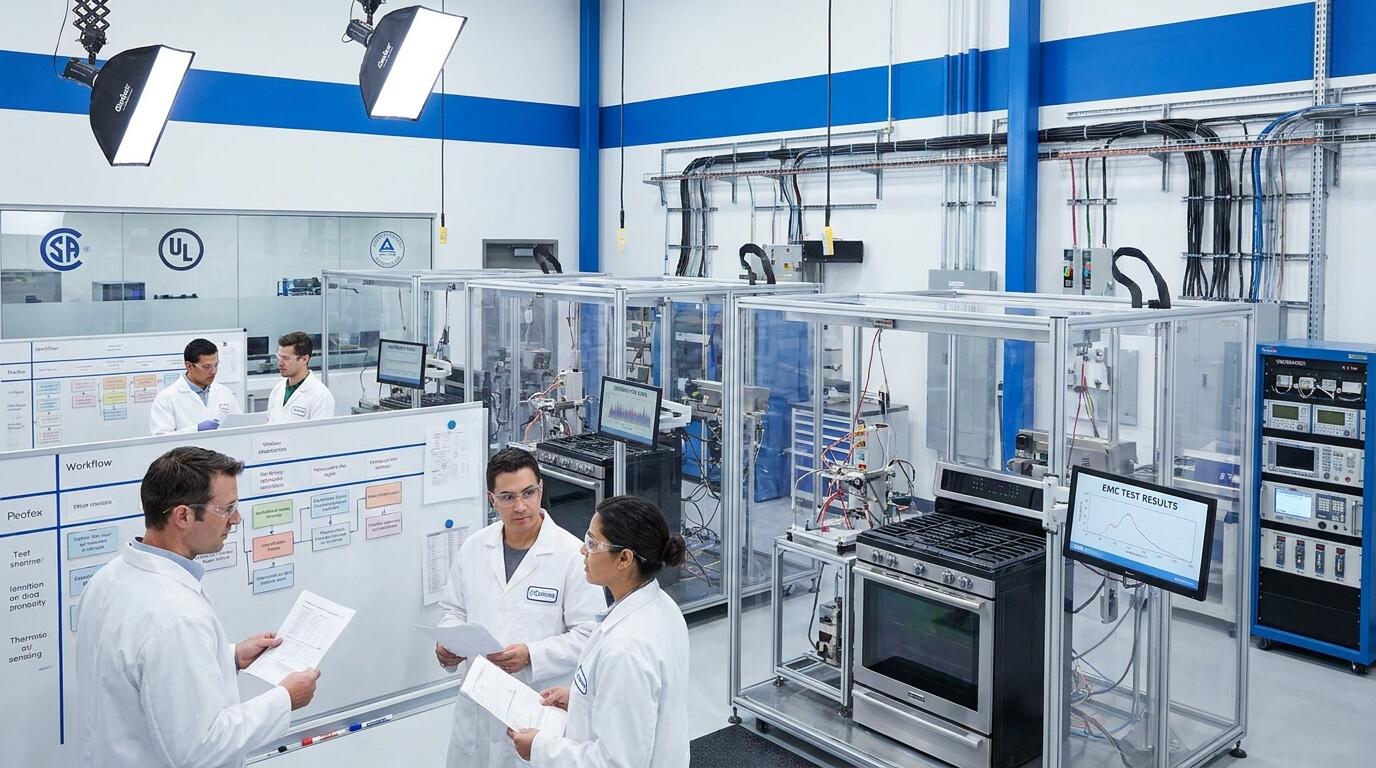
ALT: In-house CSA UL lab testing process for gas ranges and ovens at a smart kitchen appliance OEM manufacturer facility, showing test equipment and certification workflow
Frequently Asked Questions FAQ
Q1: How does an in-house testing facility support CSA or UL certification preparation?
An in-house testing facility allows a manufacturer to conduct product evaluations during the design and development process. These activities may include preliminary safety checks, functional testing, and pre-compliance evaluations against relevant product standards.
If a manufacturer's laboratory participates in a recognized certification body's authorized testing or data-acceptance program, the scope of its permitted activities should be verified through the relevant program documentation.
The main advantage of in-house testing is that potential issues can be identified earlier, allowing engineering teams to coordinate corrective actions more efficiently. However, internal testing alone does not authorize a manufacturer to issue CSA or UL certification marks. Formal product certification must follow the applicable certification body's procedures.
Q2: Do products tested in a manufacturer's in-house laboratory qualify for CSA or UL certification?
Products tested in a manufacturer's in-house laboratory may qualify for CSA or UL certification, depending on the testing arrangements and the requirements of the relevant certification program.
A manufacturer may conduct preliminary testing internally, while formal certification may require evaluation, review, or testing under the procedures of an authorized certification body. Certain certification programs may also permit qualified manufacturer facilities to conduct specific testing activities under defined oversight and documentation requirements.
Buyers should verify the certification body's authorization, the laboratory's applicable scope, and the final product certification documentation. The presence of an in-house testing facility alone does not establish that a product is certified or authorized to carry a CSA or UL mark.
Q3: How much time can in-house certification labs realistically save on a gas range or oven certification project?
The amount of time saved depends on product complexity, the scope of required testing, the number of design revisions, and the availability of external certification resources. In-house testing may reduce delays associated with preliminary evaluations, sample transportation, and repeated engineering feedback cycles.
However, it is not possible to provide a universal time-saving estimate without project-specific data. Formal certification timelines still depend on the applicable certification program, required testing activities, documentation review, and final approval procedures. Buyers should request actual project records when evaluating a supplier's certification timeline performance.
Key Takeaways
- In-house testing facilities can help reduce certain development-stage delays by enabling earlier product evaluations, more direct engineering feedback, and fewer unnecessary sample shipments to external laboratories.
- Early pre-compliance evaluations can help identify potential design issues before formal certification testing begins. Close coordination between testing personnel and engineering teams can improve the efficiency of corrective actions, regardless of whether they operate within the same facility.
- Certification timeline predictability is a commercial asset, not just an operational detail — it directly affects launch window reliability, retail contract compliance, and total sourcing ROI for importers and private-label brands.
- Supplier qualification should include explicit assessment of lab accreditation scope — understanding which standards are tested in-house versus outsourced distinguishes genuine capability from a marketing claim.
- Over time, a manufacturer's testing team may develop valuable product-specific knowledge through repeated evaluations. Documenting these findings and incorporating them into future design reviews can help address recurring technical issues and improve product development consistency.
For procurement professionals ready to act on these insights, the logical next step is to include testing infrastructure disclosure as a standard element of your supplier qualification process — and to engage directly with manufacturers whose in-house capabilities align with your target certification standards.
Looking for a kitchen appliance OEM/ODM manufacturing partner for your next project? Explore Hyxion's product range and discuss your product specifications, testing requirements, and target-market compliance needs with the team. You can also request further information about the available product testing arrangements and certification documentation for your selected models. Visit Hyxion's official website to explore product lines, request a custom quote, or connect with the Hyxion team to start your next OEM/ODM sourcing partnership.
Sources & Citations
- CSA Group. "Product Certification and Testing Services Overview".
https://www.csagroup.org - Underwriters Laboratories (UL). "Standards and Certification for Gas Appliances".
https://www.ul.com - American National Standards Institute (ANSI). "ANSI Standards Development and Gas Appliance Safety".
https://www.ansi.org
Note: Standards may be updated; please check the latest official documents or consult professional advisors.