
Gas Range vs. Electric Range: A Q4 2026 Sourcing Comparison for Distributors
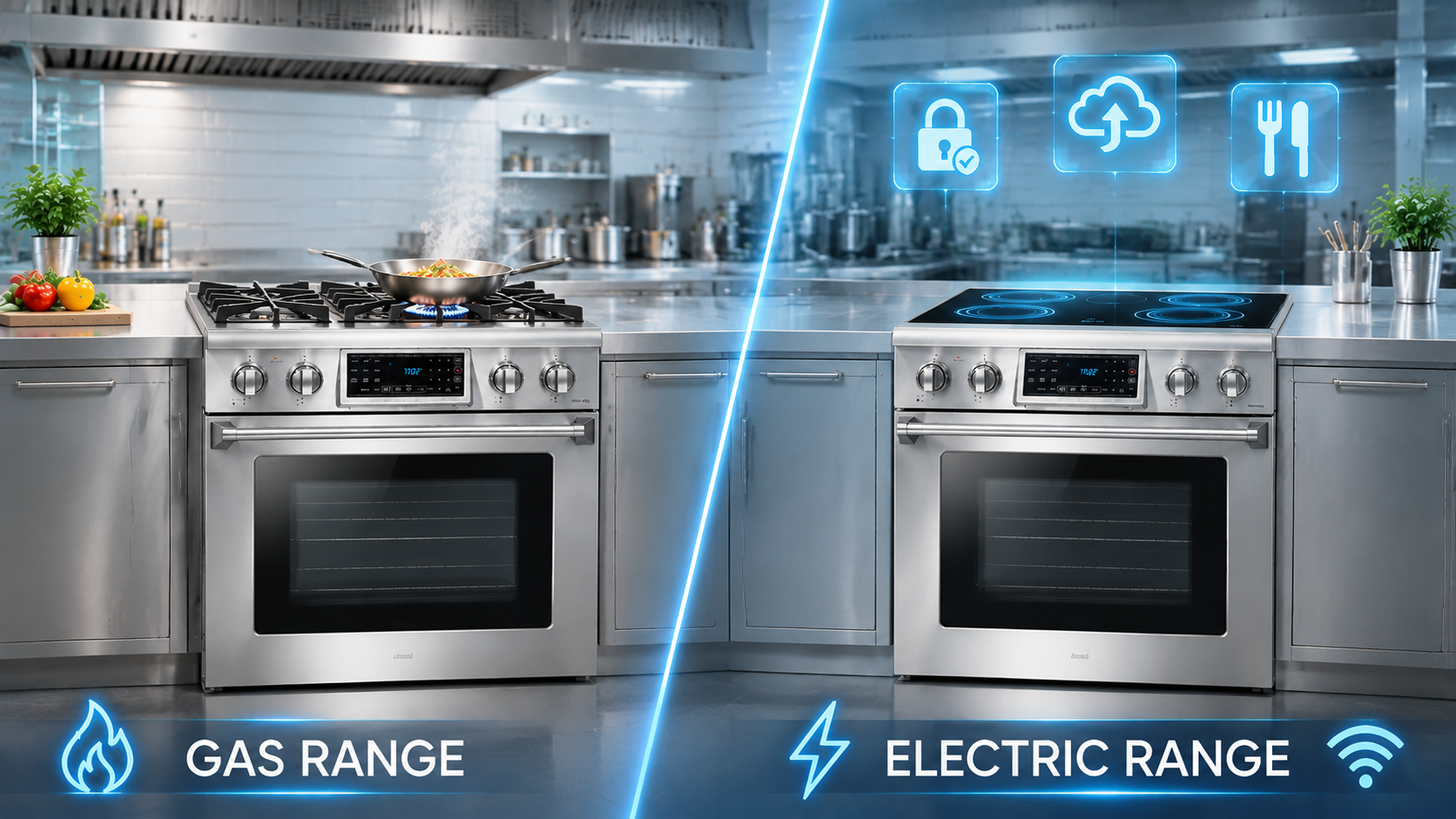
ALT: Gas range vs electric range sourcing comparison for B2B distributors and kitchen appliance importers in 2026
Gas Range vs. Electric Range: What Distributors Need to Know Before Sourcing in Q4 2026
For kitchen appliance distributors, the decision between sourcing gas ranges and electric ranges is not simply a matter of consumer preference — it is a procurement strategy that shapes inventory risk, regulatory compliance, margin potential, and long-term brand positioning. As global markets move into Q4 2026, the pressure on distributors to make the right sourcing call has intensified. Subject to verification of gas appliance restrictions, certification requirements, and market demand in each specific country or region.
This comparison evaluates gas ranges and electric ranges across the criteria that matter most to procurement managers and sourcing specialists: regulatory readiness, OEM/ODM customization flexibility, end-market demand signals, supply chain complexity, and total cost of ownership. The goal is to give distributors a clear, actionable framework for deciding how to allocate sourcing budgets and production commitments as the Q4 window approaches.
Evaluation Criteria That Define the Right Sourcing Decision
Choosing between gas and electric ranges at the distributor level requires a different lens than the consumer purchase decision. The following criteria form the basis of this comparison.
Regulatory and certification readiness is the first gate. Gas appliances are subject to combustion safety standards and increasingly to regional gas infrastructure policies, while electric ranges must meet their own electrical safety certifications and, in some jurisdictions, are actively favored by building codes that restrict new gas connections. Failing to anticipate these requirements before a production run can result in costly recalls or market access delays.
OEM/ODM customization scope determines how well a manufacturer can adapt a base platform to your brand's specifications — including control interfaces, smart connectivity features, finish options, and labeling. This matters because private-label distributors and regional brands cannot afford to source a commodity product that looks identical to a competitor's SKU.
End-market demand alignment reflects whether the product category you source will actually sell in your target geography. Demand patterns differ substantially between North America, Western Europe, Southeast Asia, and Australia subject to verification of gas appliance restrictions, certification requirements, and market demand in each specific country or region.
Supply chain and lead time predictability covers the reliability of component sourcing, production scheduling, and logistics for each product type. Some components specific to smart electric ranges — particularly control boards and induction elements — have experienced tighter supply in recent years, and distributors should account for this.
Margin and pricing dynamics at the factory-direct level affect landed cost and downstream competitive positioning. Gas range components tend to be more standardized, while electric and induction-based ranges can command premium pricing if positioned correctly.
After-sales serviceability is frequently underestimated by procurement teams. The complexity of smart electric systems versus traditional gas burner assemblies has direct implications for warranty cost, spare parts stocking, and distributor support obligations.
The Contenders: Gas Ranges and Electric Ranges in the OEM/ODM Market
Gas Ranges: Proven Demand, Evolving Regulatory Pressures
A gas range is a cooking appliance that uses natural gas or liquefied petroleum gas (LPG) as its fuel source, typically featuring open burners for stovetop cooking and a gas-fired oven cavity. In OEM/ODM manufacturing, gas ranges represent a mature product category with well-established component ecosystems and production processes.
For distributors, gas ranges continue to hold strong appeal in markets where gas infrastructure is well developed and consumer preference for flame cooking remains culturally entrenched — including parts of Southern Europe, Latin America, the Middle East, and many emerging markets in Asia. In professional foodservice supply channels, gas cooking remains the dominant standard.
However, gas ranges face a shifting headwind in some of the world's highest-value markets. Several North American jurisdictions and a growing number of European cities have implemented or are actively considering restrictions on new gas appliance installations in residential construction. Distributors sourcing gas ranges for these markets must conduct careful regulatory due diligence before committing to inventory, as mid-cycle policy changes can strand stock. From a manufacturing standpoint, gas ranges require combustion safety certifications — such as those issued under standards maintained by organizations including the American National Standards Institute (ANSI) and equivalent bodies in other jurisdictions — and these certification processes must be factored into OEM timeline planning.
The OEM/ODM customization potential for gas ranges is meaningful but somewhat more constrained than for electric models. Physical burner configurations, BTU outputs, and grate designs can be adapted, and smart ignition or connectivity features can be integrated, but the fundamental combustion architecture limits how dramatically a product can be differentiated at the platform level.
Electric Ranges: Smart-Ready, Policy-Aligned, and Increasingly Preferred
An electric range is a cooking appliance that uses electrical resistance or induction technology to generate heat, available in formats including traditional coil-top, smooth glass-ceramic radiant, and induction cooktops paired with an electric oven cavity. In OEM/ODM manufacturing, electric ranges — particularly those incorporating induction and smart control technologies — represent the fastest-evolving segment of the kitchen appliance category.
For distributors operating in markets where electrification policies are advancing, electric ranges offer a forward-compatible sourcing position. Products in this category increasingly integrate smart features such as Wi-Fi or Bluetooth connectivity, app-based control, voice assistant compatibility, and AI-assisted cooking programs. These features are central to the value proposition of smart kitchen appliance brands, and they are far more naturally embedded in electric platforms than in gas alternatives.
From an OEM/ODM perspective, electric and induction ranges offer significantly greater customization depth. Control panel interfaces, display types, smart home ecosystem integrations, power levels, and software features can all be tailored to a distributor's private-label specifications. This flexibility is a core reason why leading smart kitchen OEM/ODM suppliers — including Hyxion— have concentrated substantial R&D and manufacturing capacity around electric and induction-based cooking platforms.
The principal procurement risks for electric ranges relate to component lead times for advanced electronics and to the need for electrical safety certifications appropriate to the target market — including standards maintained by Underwriters Laboratories (UL) in North America, CE marking requirements in Europe, and equivalent bodies elsewhere.
Head-to-Head Comparison: Gas Range vs. Electric Range for Q4 2026 Sourcing
| Criterion | Gas Range | Electric Range (Radiant/Induction) |
|---|---|---|
| Regulatory trajectory | Under increasing restriction in select high-value markets | Favored by electrification policies in North America, Europe, Australia |
| OEM/ODM customization depth | Moderate — burner config, finish, smart ignition | High — controls, smart connectivity, AI features, full UI customization |
| Smart feature integration | Limited; add-on possible | Native;Specified product configuration |
| End-market demand breadth | Strong in emerging markets, foodservice, gas-infrastructure regions | Growing across all markets; dominant in policy-forward regions |
| Certification complexity | Gas safety (ANSI, CSA, CE gas directives) | Electrical safety (UL, CE, SAA, etc.); smart features add compliance scope |
| Component supply predictability | High; established supply ecosystem | Moderate; advanced electronics components subject to lead time variability |
| Average factory-direct pricing tier | Generally lower entry cost | Variable; induction and smart platforms command premium positioning |
| After-sales serviceability | Simpler mechanical systems; lower repair complexity | Higher complexity for smart systems; requires distributor support investment |
| Private-label differentiation potential | Moderate | High |
| Sustainability and ESG alignment | Lower; combustion-based | Higher; aligns with decarbonization and green procurement goals |
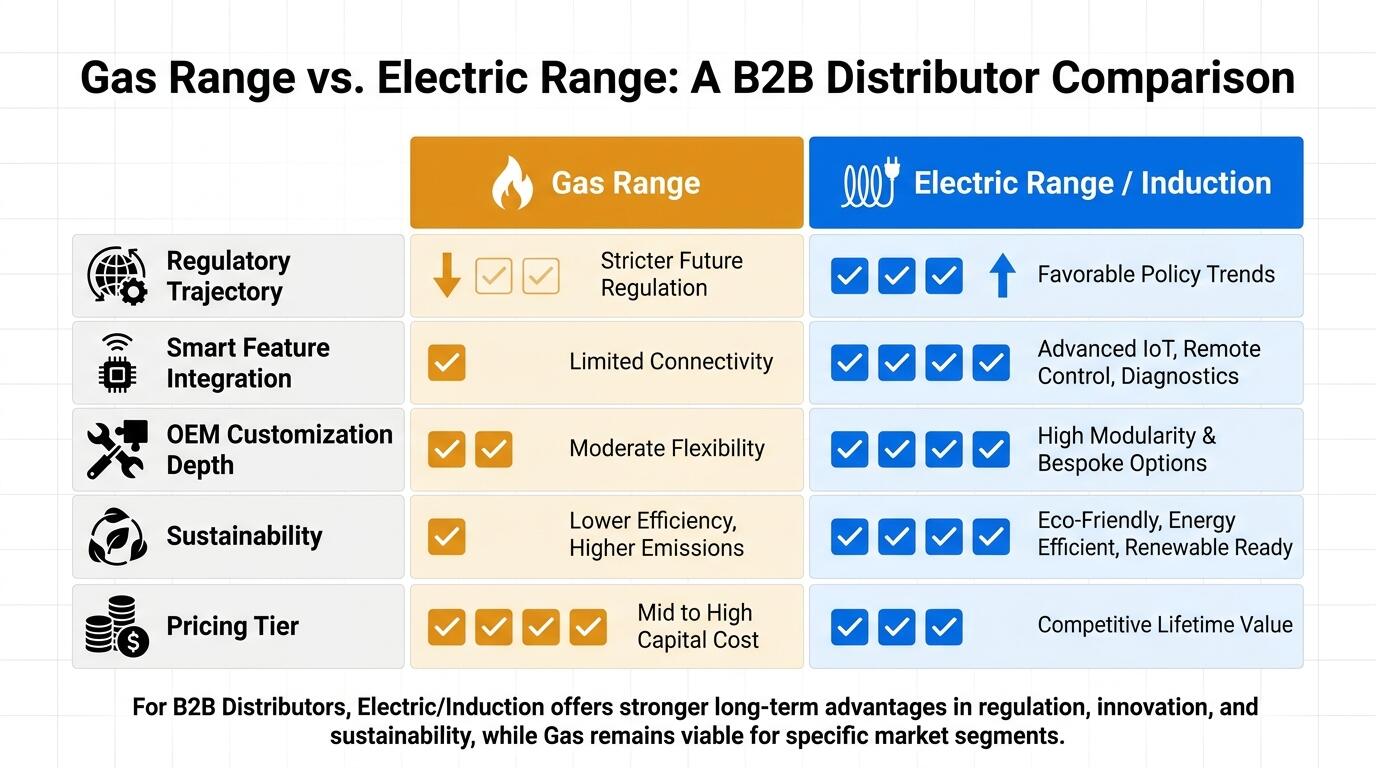
ALT: Side-by-side comparison of gas range and electric range features for kitchen appliance distributors sourcing OEM products in Q4 2026
The most consequential difference between these two categories, as this table makes clear, is not price or component availability — it is regulatory trajectory and smart integration potential. In our work with distributors sourcing for North American and European markets, a pattern we consistently see is that teams underestimate how quickly local building codes and electrification mandates can shift the demand landscape for gas appliances. By the time a gas-heavy inventory position becomes difficult to move, the production run is already committed.
Electric and induction ranges, particularly smart-enabled platforms, offer a genuinely stronger long-run positioning in markets where policy is moving toward all-electric construction. The tradeoff is higher OEM complexity — smart features require more rigorous pre-production planning, software coordination, and certification management. Distributors who lack experience managing smart appliance OEM programs frequently encounter schedule delays or specification drift when these coordination requirements are not addressed early in the sourcing process.
Gas ranges remain a commercially rational sourcing choice for distributors whose core markets have strong, stable gas infrastructure and where electrification mandates are not yet a near-term concern. The mature component ecosystem and simpler serviceability profile can make gas a lower-risk category for distributors with leaner after-sales support structures.
Which Should You Choose? Scenario Recommendations for Distributors
The right sourcing choice depends on your specific market footprint, end-customer profile, and product strategy. Here is a practical mapping of common distributor situations to the appropriate sourcing decision.
If you distribute primarily to residential builders or kitchen retailers in California, New York, the UK, or Australia, electric ranges — particularly induction-based smart models — are the strategically sound sourcing priority. Subject to verification of gas appliance restrictions, certification requirements, and market demand in each specific country or region.
If your end markets include foodservice distributors, restaurant supply chains, or markets in the Middle East, Southeast Asia, or Southern Europe where gas cooking is culturally dominant and infrastructure is robust, gas ranges remain a fully viable and commercially attractive sourcing category. In these contexts, the professional performance profile of gas — precise flame control, rapid heat response, familiarity to trained kitchen staff — continues to drive purchasing decisions. A well-specified OEM gas range with premium finishing and customized burner configurations can compete effectively in these channels.
If you operate a private-label brand targeting the premium residential or smart home segment, electric and induction ranges with deep OEM/ODM customization are the clear recommendation. The ability to embed proprietary smart features, design a distinctive control interface, and integrate with major smart home ecosystems creates sustainable brand differentiation that a commodity gas range cannot replicate.
If you are building a diversified catalog for multi-market distribution, a balanced sourcing strategy that includes both gas and electric SKUs is prudent — but it requires careful market-level inventory allocation and clear regulatory due diligence for each territory. A common and costly mistake is applying a one-size-fits-all product specification to markets with divergent regulatory environments.
Pros and cons summary:
Gas ranges — lower entry cost, simpler serviceability, strong demand in established gas markets, limited smart differentiation potential, increasing regulatory headwind in select markets.
Electric/induction ranges — higher customization and smart integration potential (subject to specific product configurations), strong regulatory alignment in policy-forward markets, premium pricing opportunity, higher OEM coordination complexity, component lead time variability.
Frequently Asked Questions FAQ
Q1: How do gas range and electric range certification requirements differ for export to North America and Europe?
Gas ranges exported to North America typically require certification against standards maintained by ANSI and the Canadian Standards Association (CSA), often through an accredited third-party laboratory. In Europe, gas appliances must comply with the Gas Appliances Regulation. Electric ranges for North America require UL or ETL listing, while European exports require CE marking under the Low Voltage Directive and Electromagnetic Compatibility Directive. Smart features add further compliance scope. Distributors should confirm target-market certification requirements with their OEM partner before finalizing product specifications.
Q2: Are smart features feasible to integrate into OEM gas ranges, or is this primarily an electric range capability?
Smart feature integration is technically possible in gas ranges — typically through electronic ignition systems, connected control panels, or smart safety shutoff mechanisms — but the depth of integration is inherently more limited than in electric platforms (subject to specific product configurations) . Electric and induction ranges allow for comprehensive smart home connectivity, AI cooking programs, real-time energy monitoring, and remote control capabilities that are native to the electrical architecture. For distributors seeking a genuinely differentiated smart kitchen product, electric or induction-based OEM platforms offer significantly greater customization scope.
Q3: How long does a typical OEM/ODM production run take for gas versus electric ranges, and what affects lead time?
Lead time for OEM/ODM kitchen range production varies based on order volume, customization complexity, and component availability — not solely on whether the product is gas or electric. In our experience working with clients, gas range programs with well-established specifications tend to move through production more predictably, while smart electric ranges with custom software features and advanced electronics require additional development and testing time. Distributors planning for Q4 delivery should initiate OEM discussions well in advance and confirm component availability for any smart or electronic subsystems before locking in timelines.
Key Takeaways
- Regulatory trajectory is the most consequential sourcing factor for Q4 2026. Gas ranges face active policy headwinds in high-value markets including California, New York, the UK, and Australia, Subject to verification of gas appliance restrictions, certification requirements, and market demand in each specific country or region.
- Smart integration potential strongly favors electric and induction platforms (subject to specific product configurations) . For private-label brands and premium-positioned distributors, the depth of OEM/ODM customization available on electric ranges — including AI cooking features, smart home connectivity, and custom control interfaces — creates differentiation that gas architectures cannot match.
- Gas ranges remain commercially rational for the right markets. Foodservice supply, emerging markets with robust gas infrastructure, and regions with strong cultural preference for flame cooking all represent valid and profitable demand channels for well-specified OEM gas products.
- Certification complexity and component lead times are the primary operational risks for distributors sourcing either category. These risks are manageable with early planning, but they are frequently underestimated by teams new to kitchen appliance OEM programs.
- A one-size-fits-all sourcing strategy is a common and avoidable mistake. The best distributors allocate gas and electric SKUs deliberately by market, with clear regulatory due diligence for each territory.
As a next step, procurement teams should map their primary target markets against current and anticipated electrification regulations, then engage an OEM/ODM partner capable of supporting both product categories with genuine customization depth and transparent certification guidance.
Ready to build a smarter, market-aligned kitchen appliance lineup with factory-direct flexibility? Explore product catalogues, request samples, or discuss a fully tailored OEM/ODM manufacturing partnership at the Hyxion website — where smart kitchen technology and competitive Dongguan-sourced manufacturing meet global B2B requirements.
Sources
- American National Standards Institute (ANSI). "Standards for Kitchen Appliances and Gas Appliance Safety".
https://www.ansi.org/ - International Electrotechnical Commission (IEC). "International Standards for Electrical Household and Similar Appliances".
https://www.iec.ch/ - U.S. Department of Energy. "Appliance and Equipment Standards: Cooking Products and Energy Efficiency".
https://www.energy.gov/
Note: Standards may be updated; please check the latest official documents or consult professional advisors.