CSA and UL Certification Explained: Why In-House Testing Labs Speed Up Market Entry
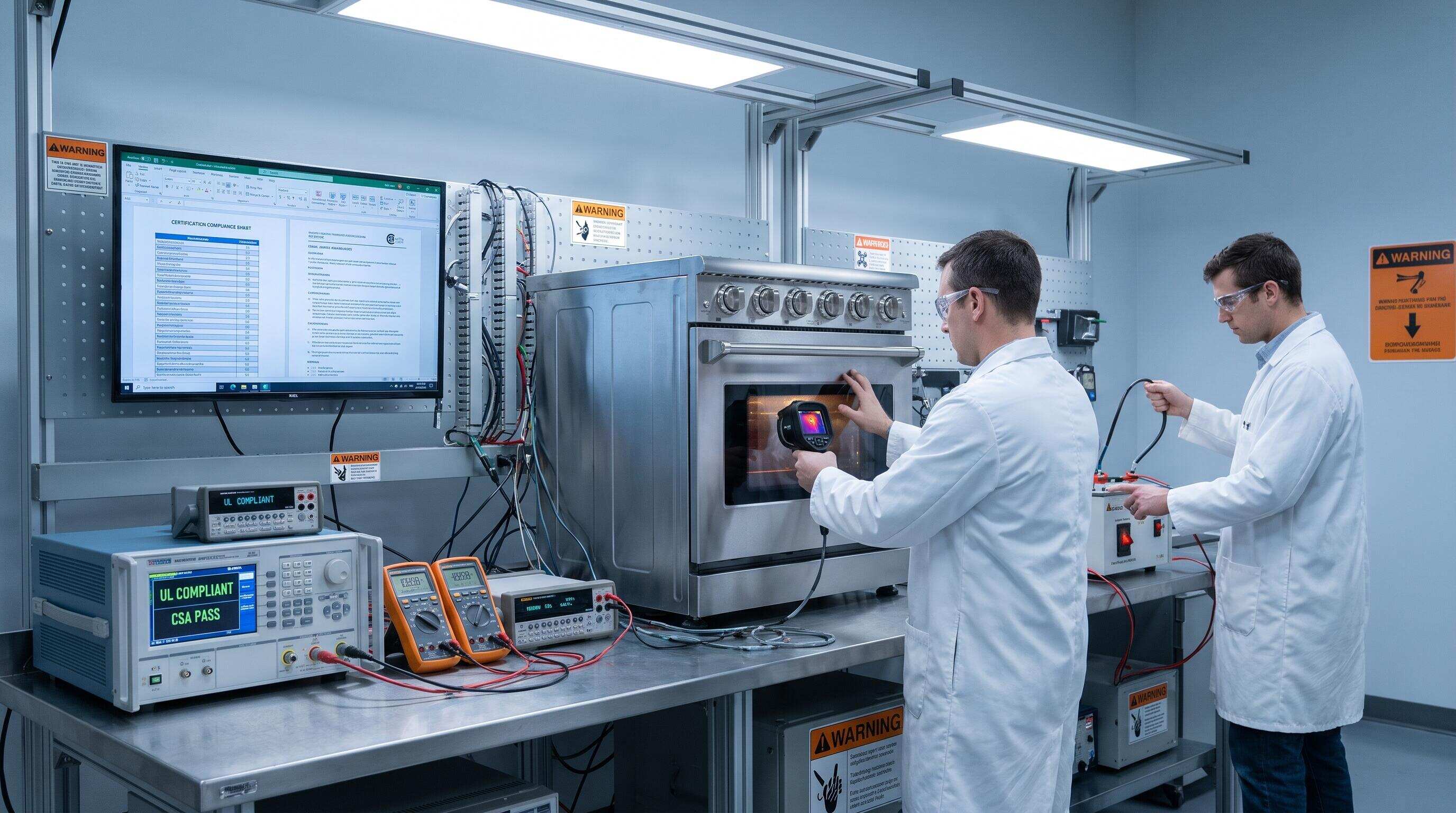
ALT: CSA and UL certification process for smart kitchen appliances with in-house testing lab equipment
Understanding CSA and UL Certification: The Standards That Open North American Markets
Key Conclusion: CSA (Canadian Standards Association) and UL (Underwriters Laboratories) certifications are the two most consequential safety marks for kitchen appliances entering North American markets. For OEM/ODM manufacturers and their global import partners, the difference between clearing these certifications in weeks versus months often comes down to a single structural advantage: in-house testing laboratories. Manufacturers who embed pre-compliance testing within their own facilities consistently reduce certification timelines, lower total project costs, and give their B2B partners a faster, more predictable route to market entry.
For kitchen appliance importers and procurement managers targeting the United States and Canada, CSA and UL certification are not optional considerations — they are market access prerequisites. Retailers, distributors, and regulatory bodies at the state and provincial level regularly require evidence of third-party safety compliance before a product can be listed, imported, or sold. Yet despite the critical importance of these marks, many B2B buyers still encounter costly delays and budget overruns during the certification process — not because the standards are inherently slow, but because the manufacturing partner they have chosen lacks the internal infrastructure to move efficiently through testing and remediation cycles.
This article examines how CSA and UL certification actually work, why the testing laboratory model at the manufacturer's facility changes the economics of certification so dramatically, and what procurement decision-makers should look for when evaluating OEM/ODM suppliers on this dimension.
The Current Landscape of Product Safety Certification for Kitchen Appliances
CSA certification is a conformity assessment mark issued by the Canadian Standards Association, an accredited Standards Development Organization (SDO) recognized across North America. UL certification (now technically operating under the UL Solutions brand, though the UL mark remains the globally recognized identifier) is administered by Underwriters Laboratories, one of the oldest independent safety science organizations in North America. Both marks signal that a product has been tested and evaluated against published safety standards relevant to its category — for kitchen appliances, this typically includes electrical safety, thermal performance, and material durability requirements.
Historically, manufacturers exporting from Asia to North American markets treated certification as a final-stage administrative step — something to be organized after product development was essentially complete. That approach made sense in an era when product categories were simpler and standard cycles were slower. Today, it creates serious market entry risk.
The kitchen appliance category has become considerably more complex. The rise of smart kitchen technology — appliances incorporating wireless connectivity, touchscreen interfaces, embedded sensors, and software-driven control systems — has introduced new testing dimensions. Connected appliances may need to satisfy not only mechanical and electrical safety standards but also electromagnetic compatibility (EMC) requirements and, increasingly, cybersecurity-adjacent considerations. For smart ranges, smart ovens, and connected cooktops, the certification file is simply larger than it was for analog predecessors.
At the same time, North American retail and distribution channels have raised their compliance expectations. Major retail chains and regional distributors now require completed certification documentation as part of their vendor onboarding process, not as a post-onboarding formality. This means delays in certification directly translate into delayed purchase orders, missed seasonal windows, and lost shelf-space opportunities.
In our work with global kitchen appliance importers and private-label brands, a pattern we consistently see is that buyers systematically underestimate the time cost of certification iterations — that is, the cycles of testing, failure identification, design modification, and re-testing that are almost always required before a final mark is issued. Each iteration that is managed through an external third-party testing laboratory adds scheduling delays and coordination overhead that an in-house lab can often compress significantly.
How CSA and UL Certification Work — and Where In-House Labs Change the Equation
The Standard Certification Pathway
CSA and UL certification follows a broadly similar workflow regardless of the certifying body. A manufacturer or applicant submits a product for evaluation, the laboratory tests the product against the applicable standard, a report is generated documenting results, and — if the product passes all required tests — the mark is authorized for use. Products that fail any element of testing must be modified and re-submitted.
The applicable standards for kitchen appliances are typically drawn from the ANSI/UL and CSA C22.2 series, which cover domestic cooking equipment, rangetops, ovens, and related appliances. These standards specify minimum requirements for electrical safety, insulation, grounding, temperature limits, and structural integrity under defined test conditions. For smart appliances with wireless features, additional standards from bodies such as the Federal Communications Commission (FCC) in the United States may apply concurrently.
The External Lab Model and Its Structural Limitations
Under the external lab model, a finished or near-finished prototype is shipped to an accredited third-party testing facility. The facility schedules the product into its testing queue — a process that, depending on the lab's workload, can introduce wait times of several weeks before testing even begins. Once testing commences, any identified non-conformances are reported back to the manufacturer, who must then modify the product at their own facility, produce a corrected sample, and return it to the lab for re-testing. Each round-trip iteration consumes calendar time that is entirely outside the manufacturer's control.
For smart kitchen appliance categories, which frequently require multiple distinct test sequences (electrical safety, thermal, EMC, durability), the cumulative iteration cost under an external model can be substantial. This is not a theoretical risk — it is a pattern that emerges consistently across the industry when manufacturers lack pre-compliance infrastructure.
The In-House Lab Advantage: Compression, Control, and Cost Efficiency
An in-house testing laboratory at the manufacturing facility fundamentally restructures this dynamic. When pre-compliance testing capabilities are embedded within the factory, the engineering team can conduct preliminary evaluations of a design before it ever enters the formal certification queue. Non-conformances are identified early, when they are cheapest to correct — a circuit modification or insulation adjustment at the prototype stage costs a fraction of what it costs when discovered after tooling is committed.
The practical consequences of this model are significant for B2B partners:
- Design iterations happen within days rather than weeks, because the feedback loop is internal rather than crossing international logistics and third-party scheduling systems.
- Engineers and test technicians can work collaboratively in real time, rather than exchanging written reports across organizational boundaries.
- Pre-compliance data builds a more complete, organized submission package for the certifying body, which reduces back-and-forth during formal evaluation.
- Manufacturers who have invested in in-house testing infrastructure generally develop deeper institutional familiarity with the applicable standards — meaning they anticipate requirements earlier in the design process rather than discovering them during testing.
The Financial Logic for Importers and Distributors
From a procurement perspective, the value of a manufacturing partner with in-house testing capability is not abstract. It translates directly into measurable outcomes: shorter time-to-market, reduced risk of missed launch windows, and more predictable project costs. When certification delays push a product launch past a key retail buying season, the revenue cost can dwarf whatever savings were achieved by selecting a lower-cost manufacturer without testing infrastructure. The implication is clear — evaluating a supplier solely on unit price without accounting for certification capability is an incomplete analysis.
Comparing Certification Approaches: Evidence and Trade-Offs
The debate between external-only certification reliance and manufacturer-embedded pre-compliance testing is well-documented across the industry. Organizations including Met Laboratories and industry commentary platforms like Control Engineering have noted that manufacturers investing in internal compliance infrastructure consistently compress certification cycles relative to those relying exclusively on third-party labs. UL Solutions has itself introduced expedited and fast-track program options — recognition, in effect, that timeline compression is a genuine market need among product manufacturers seeking to accelerate North American market entry.
The table below summarizes the structural trade-offs of each approach from the perspective of a B2B buyer evaluating a manufacturing partner:
| Perspective / Approach | Strengths | Trade-offs | Best Fit |
|---|---|---|---|
| External lab only | Access to fully accredited facilities; no capital investment by manufacturer | Longer scheduling queues; iteration delays; reduced communication speed; costs scale with iteration rounds | Low-volume, simple products; manufacturers with stable, well-established designs |
| In-house pre-compliance + external formal certification | Faster iterations; early non-conformance detection; lower total project cost; more predictable timelines | Requires manufacturer capital investment in equipment and expertise | Smart appliances with complex test requirements; B2B partners needing fast market entry |
| Fully integrated in-house certification (manufacturer-accredited lab) | Maximum control; potential for direct certification without external lab for some categories | Significant infrastructure investment; accreditation maintenance burden | High-volume, multi-SKU manufacturers with ongoing certification pipeline |
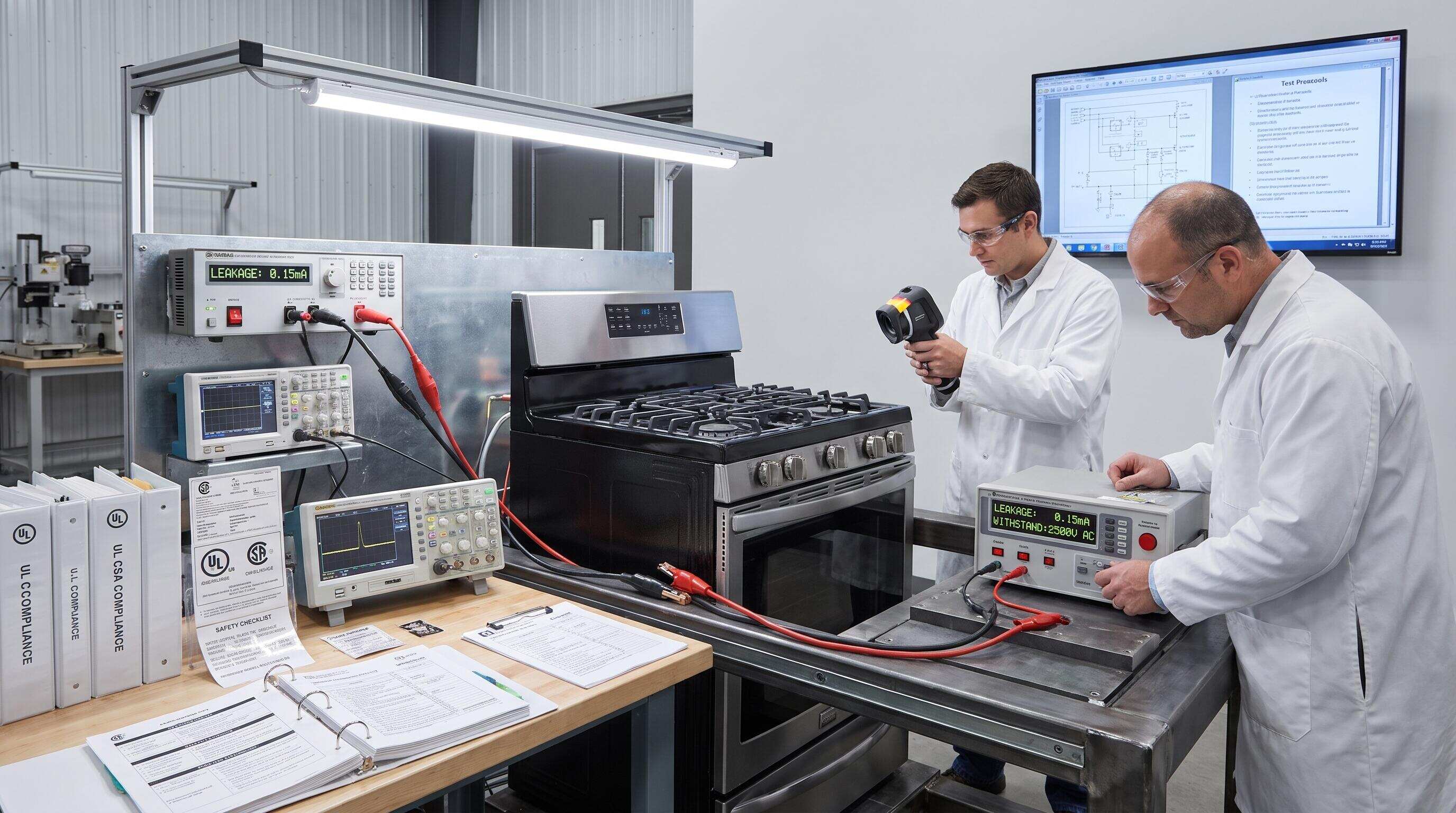
ALT: In-house testing laboratory at a smart kitchen appliance manufacturer validating UL and CSA certification compliance for North American market entry
For smart kitchen appliances — a category defined by component complexity, connectivity features, and high iteration frequency — the in-house pre-compliance model offers the most favorable risk-adjusted economics for importers and distributors. The upfront manufacturing partnership cost may appear higher, but the total cost of market entry, when certification timelines and iteration risk are factored in, is typically lower and more predictable.
It is also worth noting that CSA certification, while sometimes treated as secondary to UL by North American importers focused primarily on the U.S. market, carries significant weight for Canadian distribution and is increasingly recognized by retailers operating across both markets. A manufacturing partner with experience navigating both CSA and UL requirements — and the internal infrastructure to prepare for both simultaneously — eliminates a step that would otherwise require separate project tracks.
Where Certification Strategy Is Heading and What It Means for Buyers
The trajectory of North American safety certification for kitchen appliances points clearly toward greater complexity, not less. As appliance intelligence increases — more embedded electronics, more wireless functionality, more software integration — the scope of applicable standards continues to expand. Regulatory and retail channels are applying certification requirements earlier in the product development cycle, treating compliance as a design-stage consideration rather than a launch-stage formality.
For global B2B buyers, this trend has a direct implication for supplier selection. A manufacturing partner without in-house testing capability is increasingly a bottleneck risk in a market environment where speed-to-shelf is a competitive variable. Conversely, a manufacturer who has invested in pre-compliance infrastructure — and who has institutional experience with CSA and UL standards as they apply to smart kitchen appliances — becomes a genuine competitive asset for the import and distribution business built around them.
Practically, procurement managers evaluating OEM/ODM suppliers should ask specific questions during due diligence:
- Does the manufacturer maintain dedicated pre-compliance testing equipment relevant to the applicable CSA and UL standards for the product category?
- Has the manufacturer successfully guided products through CSA and/or UL certification, and can they describe the testing process they follow internally before formal submission?
- What is the manufacturer's documented process for managing non-conformances identified during testing?
- Can the manufacturer support concurrent CSA and UL evaluation on a single product, reducing overall project timelines?
These questions shift the evaluation from a price-per-unit comparison to a total-cost-of-market-entry comparison — the analysis that experienced procurement managers recognize as the more accurate basis for supplier selection.
The broader takeaway for the smart kitchen appliance sourcing market is this: manufacturers who invest in in-house testing laboratory capability are not simply offering a service feature. They are fundamentally reducing the market entry risk that their B2B partners carry. For importers and distributors whose business model depends on reliable, timely product launches in North America, that risk reduction is a tangible financial benefit.
Frequently Asked Questions FAQ
Q1: How does in-house pre-compliance testing differ from formal CSA or UL certification?
In-house pre-compliance testing is conducted by the manufacturer using their own laboratory equipment to evaluate a product's likely performance against published safety standards — such as the ANSI/UL and CSA C22.2 series — before formal submission to an accredited certifying body. The resulting data is not equivalent to a certified mark but enables engineers to identify and correct non-conformances early. Formal certification, issued by an accredited body such as UL Solutions or CSA Group, is what authorizes the safety mark for use on a finished product sold in North American markets.
Q2: Is CSA certification required for all kitchen appliances exported to Canada?
CSA certification is not universally mandated by federal law in Canada, but it is effectively a market access requirement in practice. Provincial electrical inspection authorities, major retail chains, and commercial distribution networks across Canada routinely require evidence of recognized safety certification — most commonly a CSA or cUL mark — before permitting a product to be sold or installed. Manufacturers and importers who lack a recognized mark face significant barriers at the retail and distribution level, making CSA compliance a practical necessity for meaningful Canadian market presence.
Q3: How long does the CSA or UL certification process typically take, and can in-house labs shorten it?
Formal CSA or UL certification timelines vary depending on product complexity, applicable standards, and the certifying body's current workload, and can range from several weeks to several months for complex smart appliances. In-house pre-compliance testing compresses the overall timeline by resolving design non-conformances before formal submission, resulting in cleaner submission packages and fewer iteration rounds with the certifying body. Industry observers, including UL Solutions, have recognized fast-track program options as a response to demand for shorter timelines. Manufacturers with strong internal testing capability consistently deliver more predictable and compressed total certification schedules.
Summary
CSA and UL certification represent the gatekeeping requirements for smart kitchen appliance market access in North America, and the manufacturing partner a buyer selects determines how efficiently and cost-effectively those gates are cleared. Three core points define the value analysis:
First, certification complexity for smart kitchen appliances is increasing, driven by the integration of connectivity, software control, and advanced electronics — meaning the testing and documentation burden is higher than it has historically been for simpler analog products.
Second, in-house pre-compliance testing laboratories at the manufacturer's facility compress iteration cycles, reduce total certification costs, and produce more predictable market entry timelines — advantages that translate directly into commercial benefit for importers, distributors, and private-label brands.
Third, evaluating a manufacturing partner on unit price alone systematically undervalues the certification and compliance infrastructure that determines real-world time-to-market and total project cost. The correct analysis includes certification capability as a core supplier evaluation criterion.
For procurement managers and sourcing specialists targeting North American market entry with smart kitchen appliances, the actionable recommendation is clear: qualify manufacturing partners on their testing laboratory capability and certification track record as a prerequisite — not an afterthought — in the supplier selection process.
Ready to bring certified, smart kitchen appliances to North American and global markets with confidence? Visit Hyxion's official website to explore our smart kitchen appliance product range, request samples, or start a conversation about a fully customized OEM/ODM manufacturing partnership — built around your brand's compliance, timeline, and market entry requirements.
Sources
- Met Laboratories. "Consumer Product Testing Capabilities".
https://metlabs.com/industries/consumer-products/consumer-product-testing-capabilities/ - Control Engineering. "UL Launches 'Fast-Track' Programs for U.S. and Canadian Product Certification".
https://www.controleng.com/ul-launches-fast-track-programs-for-u-s-and-canadian-product-certification/ - Krayer. "When Is CSA Certification Useful?".
https://krayer.de/en/ul-wissen/ul-blog/when-is-csa-certification-useful/
Note: Standards may be updated; please check the latest official documents or consult professional advisors.