
What to Look for When Sourcing Stainless Steel Dishwashers in Bulk

Stainless Steel Dishwashers in Bulk: What Every B2B Buyer Should Compare Before Placing an Order
When sourcing stainless steel dishwashers in bulk, B2B buyers need to look beyond appearance and unit price. Evaluating material specifications, washing performance, market-specific requirements, customization options, and after-sales support can help buyers determine whether a product and supplier are suitable for their intended application. The direct answer is that bulk dishwasher sourcing is not a simple price-per-unit exercise — it is a multi-dimensional evaluation covering material integrity, washing performance, certification compliance, customization flexibility, and after-sales support. Getting this evaluation right separates brands that build lasting market share from those that cycle through suppliers every few years.
This article is structured as a head-to-head comparison of the most consequential sourcing criteria, mapping each one against the main supplier models available to global B2B buyers: direct OEM/ODM factory partnerships, trading companies, and third-party platform aggregators. The goal is to provide procurement managers, product sourcing specialists, and distributors with a practical framework for comparing supplier models, understanding sourcing requirements, and identifying the factors that may affect bulk dishwasher procurement decisions.
Why Sourcing Criteria for Bulk Stainless Steel Dishwashers Demand Rigorous Evaluation
Evaluating bulk stainless steel dishwasher sourcing involves more than comparing the initial unit price. Buyers should also consider transportation, material specifications, product performance, applicable market requirements, warranty arrangements, and after-sales support. These factors may affect the overall cost of ownership and should be reviewed alongside the quoted purchase price.The six criteria below define the dimensions this comparison is judged on, and each one carries direct financial or reputational weight for the buyer.
Material and Build Quality — Stainless steel grade varies meaningfully across suppliers. Interior tub material, door panel construction, and spray arm composition all influence corrosion resistance and longevity. Stainless steel dishwashers may use different materials across their components. Buyers should identify the material specifications for key parts, including the interior tub, exterior panels, racks, and spray arms, rather than assuming that every component uses the same steel grade. Where material grade is a purchasing requirement, request the relevant product specifications and supporting material documentation for the specified components.
Washing Performance and Energy Efficiency — Rack capacity, cycle options, water consumption per cycle, and drying effectiveness are important evaluation criteria for residential dishwashers. For retail brands, these specifications influence everyday usability and customer satisfaction.
For foodservice distributors, buyers should first confirm that the specific dishwasher model is designed and approved for the intended commercial application. Relevant considerations may include throughput capacity, operating frequency, sanitation requirements, and applicable safety standards. Residential dishwasher models should not be assumed suitable for commercial foodservice use unless their specifications and intended-use documentation explicitly support that application.
Regulatory Certification and Market Compliance — Market-specific compliance requirements should be checked according to the destination country, appliance category, and exact product model. For the United States and Canada, buyers should identify the applicable product safety standards and verify whether the proposed model has the required certification or listing coverage. UL and ETL are examples of certification or listing marks, rather than interchangeable product standards. For the European Union, buyers should review the applicable legislation, conformity assessment requirements, and the manufacturer's EU Declaration of Conformity. Any existing compliance documentation should be checked against the proposed model, configuration, and brand arrangement before being relied upon for a private-label order. Additional testing, documentation, or registration may be necessary depending on the applicable requirements. Understanding the certification landscape is a prerequisite for any bulk order conversation — buyers targeting North America should be especially thorough on this point, as outlined in resources like a 2026 guide to kitchen appliance safety certifications for North American importers.
Customization Capability — Retail brands and private-label distributors require OEM or ODM flexibility: custom panel finishes, control interfaces, packaging, and documentation localized to their markets. Not all suppliers can deliver this — and among those who claim they can, execution quality varies sharply.
Minimum Order Quantities and Lead Times — Bulk sourcing economics depend on MOQ alignment with the buyer's inventory model and predictable production lead times. Mismatch here creates either excessive inventory carrying costs or stockout risk during peak demand periods.
After-Sales Support and Parts Availability — Replacement parts availability, technical documentation, warranty arrangements, and communication channels are important factors to consider when evaluating long-term supplier support. Buyers should clarify how replacement parts can be requested, what documentation is available, and how product issues will be handled under the agreed warranty terms.
The Contenders: Supplier Models Available for Bulk Dishwasher Procurement
OEM/ODM Factory Partners — Direct Manufacturing Relationships
An OEM/ODM factory partner is a manufacturer that produces appliances either to a buyer's provided specifications (OEM) or develops the product design itself and licenses it for private labeling (ODM). China-based appliance manufacturers, including Hyxion, may offer OEM or ODM arrangements for B2B buyers seeking private-label dishwasher products. The available customization options, production responsibilities, pricing structure, and quality control arrangements should be confirmed with the specific manufacturer and documented in the supply agreement.
Direct OEM/ODM arrangements allow buyers to communicate with the manufacturing partner responsible for the agreed production scope. However, tooling ownership, component sourcing, assembly operations, and quality inspection responsibilities may involve different entities or subcontractors. Buyers should clarify which activities are performed in-house, which are outsourced, and how responsibilities are allocated under the supply agreement. For buyers placing larger orders, direct factory sourcing may provide more opportunities to discuss production arrangements, customization requirements, and order-specific pricing. The overall cost advantage depends on order volume, supplier capabilities, component sourcing, logistics, and the commercial terms agreed between the parties.
The trade-off is due diligence burden. Buyers must verify factory credentials, audit quality management systems, and confirm that claimed certifications are genuinely held rather than borrowed or misrepresented. Experienced sourcing teams use third-party factory audits, documentation review, and sample testing to close this gap before committing to volume.
Trading Companies and Import Agents
A trading company is an intermediary that sources goods from multiple factories and resells them to overseas buyers under a consolidated service model. For buyers without the internal resources to manage direct factory relationships — particularly those ordering smaller quantities across multiple product categories — trading companies offer convenience.
When sourcing through a trading company, buyers should clarify how product traceability, factory communication, and corrective actions are managed. The trading company's ability to coordinate manufacturing changes or resolve quality issues depends on its relationship with the production facility and the responsibilities defined in the supply agreement. Buyers should also confirm how production schedules and delivery updates are communicated.
Third-Party B2B Platform Aggregators
Platforms that aggregate supplier listings — connecting buyers with manufacturers through a marketplace interface — provide broad sourcing visibility but limited quality assurance. The platform itself does not manufacture the product and cannot guarantee that individual supplier listings accurately represent factory capabilities.
Third-party B2B platforms can help buyers discover suppliers and compare available product listings. However, platform listings alone do not establish a supplier's manufacturing capabilities, product specifications, or compliance status. Before placing a bulk order, buyers should communicate directly with the selected supplier, verify relevant product documentation, clarify manufacturing responsibilities, and agree on quality and delivery terms.
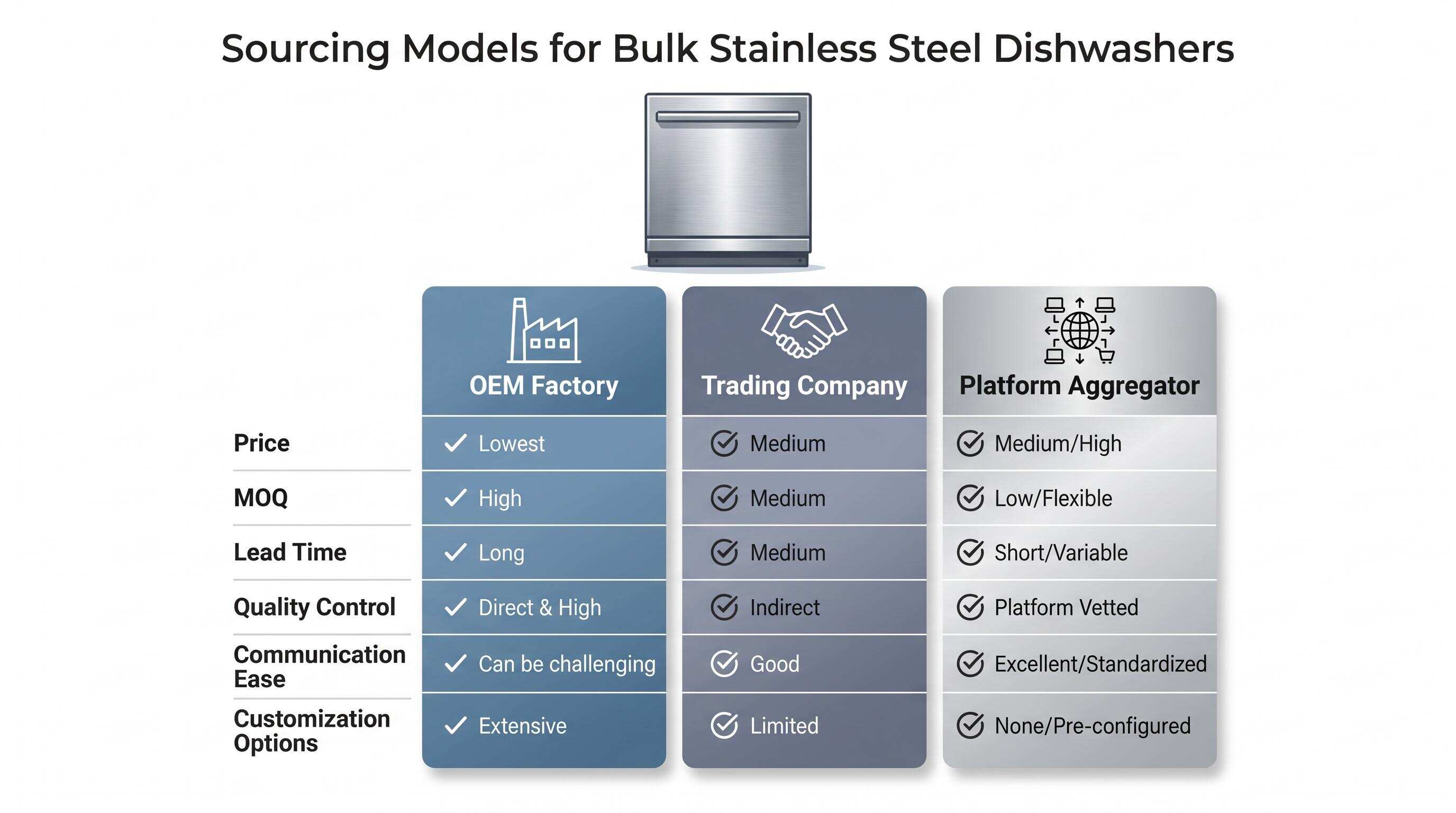
ALT: Comparison table showing OEM factory, trading company, and platform aggregator sourcing models for bulk stainless steel dishwashers
Head-to-Head Comparison: OEM/ODM Factory vs. Trading Company vs. B2B Platform
| Criterion | OEM/ODM Factory Partner | Trading Company | B2B Platform Aggregator |
|---|---|---|---|
| Material Traceability | Documentation availability depends on the supplier and product; steel grade verifiable | Material documentation availability depends on the supplier and factory; buyers should verify traceability records for the specified components. | Varies by listing;Requires verification with the individual supplier. |
| Washing Performance Specs | Specifications can be discussed and confirmed with the manufacturer | Specified at order but not controlled post-sale | Product specifications are provided by individual suppliers; buyers should verify performance claims through documentation, sample testing, or independent inspection where appropriate. |
| Certification Authenticity | Model-specific coverage and brand arrangements require confirmation | May hold certificates;Coverage and documentation depend on the issuing body and product scope. | Varies; self-reported by individual suppliers |
| Customization Capability | Customization options depend on factory capabilities and project scope.; panels, controls, branding | Customization options depend on the factory's capabilities, existing product platforms, and specific project requirements. | Varies by individual supplier and product listing. |
| MOQ Flexibility | Subject to order volume and supplier terms; discuss with provider | MOQ requirements depend on the supplier, product specifications, and order conditions; aggregated across clients | MOQ varies by supplier and product; production consistency and repeat-order arrangements should be confirmed directly with the manufacturer. |
| Lead Time Reliability | Depends on confirmed production capacity and scheduling | Variable; dependent on sub-supplier scheduling | Consult provider |
| After-Sales Support | Support and parts availability depend on the agreed service arrangements | After-sales support depends on the agreed service arrangements, communication channels, and coordination with the manufacturing partner. | Support arrangements vary by supplier and platform; buyers should confirm warranty coverage, parts availability, communication channels, and post-sale responsibilities before ordering. |
| Landed Cost at Scale | May offer cost advantages depending on order volume and total sourcing costs | Total sourcing costs should be evaluated based on product specifications, order volume, service scope, and the actual quoted terms. | Total cost depends on supplier pricing, product quality, logistics, and service arrangements when accounting for rejects |
The comparison highlights the different responsibilities and sourcing arrangements associated with each supplier model. Buyers considering direct factory partnerships should clarify production responsibilities, quality inspection arrangements, delivery terms, and applicable compliance obligations before placing an order. The level of supplier verification and documentation required depends on the product category, project scope, and purchasing requirements.
Trading companies fill a legitimate need for buyers who lack the volume or internal procurement infrastructure to manage direct factory relationships. Trading companies may be suitable for buyers seeking consolidated sourcing support, particularly when managing smaller orders or multiple product categories. As purchasing requirements evolve, buyers can compare the benefits of continuing with an intermediary against establishing direct factory relationships. The appropriate arrangement depends on order volume, product complexity, supplier coordination needs, and total procurement costs.
B2B platforms can serve as both supplier discovery channels and sourcing communication tools. For bulk dishwasher orders involving specific material requirements and long-term parts support, buyers should conduct additional supplier-level verification and establish clear contractual arrangements before proceeding with production.
It is also worth noting that the choice between OEM and ODM within the direct factory model is itself a meaningful decision. For brands entering a new product category, an ODM arrangement may provide access to an existing product platform for private labeling. Depending on the degree of customization, this approach may reduce certain new product development activities. However, changes to product specifications, tooling, components, or market-specific requirements may still involve additional development costs and time. Buyers should also clarify design ownership, usage rights, and future modification rights in the contract. The OEM vs. ODM comparison for kitchen appliances is worth reviewing before entering supplier negotiations, as it clarifies which model preserves the most design control for your specific situation.
Which Should You Choose? Scenario Recommendations for Bulk Dishwasher Buyers
The right supplier model for bulk stainless steel dishwasher procurement depends on your volume, your brand strategy, and your internal procurement capabilities.
If you are a retail brand launching a private-label dishwasher line, a direct OEM/ODM factory partnership may be worth considering, particularly when you require closer coordination on product specifications, branding, and production arrangements. The suitability of this model depends on your order volume, customization requirements, and internal procurement resources. You need control over exterior finish, branding, packaging, and regional certification documentation. When comparing factory partners, buyers should clarify account management arrangements, customization capabilities, production responsibilities, and the manufacturer's experience coordinating applicable product compliance requirements. Testing and certification activities may involve external laboratories or certification bodies, depending on the product and destination market. When evaluating factory partners for this scenario, prioritize suppliers with demonstrated experience managing the specific market certifications required for your distribution regions.
If you are a regional distributor sourcing dishwashers for commercial foodservice accounts, performance specs and throughput reliability take precedence. For regional distributors sourcing dishwashers for commercial foodservice applications, buyers should pay particular attention to product capacity, wash cycle options, material specifications, water consumption, and the performance requirements relevant to the intended operation. Whether these specifications can be customized depends on the manufacturer's product platform and engineering capabilities. Buyers should document the required parameters and confirm them with the party responsible for production.
If you are a small importer testing a new SKU category with limited initial volume, Niche trading companies can be a suitable sourcing option for small importers, depending on their product requirements, order volumes, and service needs. Buyers should evaluate each sourcing model based on supplier capabilities, purchasing conditions, and long-term business requirements. For small importers testing a new dishwasher category with limited initial volume, a trading company may offer a convenient starting point. As demand develops, buyers can reassess sourcing options by comparing direct factory quotations, minimum order quantities, logistics arrangements, and ongoing support costs. Any change in sourcing model should be based on the overall commercial requirements rather than order volume alone.
If you are conducting supplier discovery for an upcoming tender or category review, B2B platforms are a legitimate starting point for building a supplier longlist. Convert that longlist to a shortlist through direct factory engagement, documentation review, and sample evaluation — not through platform reviews or aggregated ratings.
Pros and Cons Summary:
OEM/ODM Factory Partner: Offers opportunities for direct production coordination and product customization, subject to the manufacturer's actual capabilities, project scope, and contractual arrangements.
Trading Company: Provides sourcing coordination and access to multiple suppliers, while manufacturing responsibilities and quality-related communication should be clearly defined.
B2B Platform Aggregator: Supports supplier discovery and product comparison, but individual supplier capabilities, product documentation, and order responsibilities require independent verification.
For a thorough framework covering how to structure the full supplier selection process, the OEM/ODM kitchen appliance manufacturer selection checklist provides a structured methodology applicable to dishwasher sourcing specifically.
Questions & Answers
Q1: How do I verify that a supplier's stainless steel dishwasher actually meets the material grade claimed in their product listing?
Request mill certificates and material test reports from the factory, specifying the steel grade designation for both the interior tub and exterior panels. Buyers can request material specifications, mill certificates where available, and relevant material test reports for the components covered by the purchasing requirements. The documentation should identify the applicable steel grade and the specific parts to which it relates, such as the interior tub or exterior panels. If the requested documentation is unavailable, buyers should clarify the reason and discuss alternative verification methods before proceeding with the order. Where additional verification is required, buyers may arrange independent material testing or inspection based on an agreed sampling plan. The inspection scope, test methods, and acceptance criteria should be defined in advance, and the results should be interpreted in relation to the specific materials and components tested.
Q2: Are certifications obtained by the factory automatically transferable to a private-label buyer's brand name?
Certification transferability depends on the certifying body, the product scope, and the contractual terms negotiated with the factory. For some bodies, the certificate is held by the manufacturing entity and can only be re-issued in the buyer's brand name through a formal application process. Factory-held certification or listing documentation does not automatically cover a buyer's private-label brand. The applicable arrangement depends on the certification body, product model, configuration, and approved brand information. Some certification programs may provide procedures for additional brand listings or related documentation, subject to the certification body's requirements. Buyers should confirm the exact model and brand coverage directly with the relevant certification body before placing a bulk order.
Q3: What lead times should a B2B buyer plan for when sourcing stainless steel dishwashers directly from a Chinese factory?
Lead times for bulk dishwasher orders from OEM/ODM factories in China vary based on order volume, customization requirements, and existing production schedules. Lead times for bulk stainless steel dishwasher orders depend on order volume, product configuration, component availability, customization requirements, and the manufacturer's production schedule. Buyers should request a project-specific timeline that clearly identifies the starting point and expected completion stage, including production, inspection, packaging, and shipment preparation. Ocean freight and customs clearance should be planned separately according to the destination market and shipping arrangement. Buyers should build buffer time into their planning cycles, particularly when sourcing products requiring market-specific certifications or custom tooling. Confirm lead time estimates directly with the factory during the RFQ stage and request milestone-based production schedules.
Wrapping Up
Sourcing stainless steel dishwashers in bulk is a decision with material consequences for product quality, regulatory standing, and long-term supplier economics. The evaluation framework in this article is designed to help procurement professionals move beyond surface-level price comparisons toward the kind of structured assessment that holds up across a multi-year supply relationship.
Key Takeaways:
- Material traceability is non-negotiable: always request mill certificates and confirm steel grade for both internal and external components before placing a bulk order.
- Certification authenticity and transferability must be verified in writing, not assumed from product listings or supplier claims.
- OEM/ODM factory partnerships may offer advantages for buyers seeking direct production coordination and customization. Their suitability depends on the manufacturer's capabilities, order requirements, quality arrangements, and contractual terms.
- The choice between OEM and ODM should consider customization requirements, existing product platforms, development responsibilities, and the intended level of product differentiation. Design ownership, tooling rights, usage permissions, and future modification rights should be explicitly defined in the supply agreement rather than assumed from the sourcing model.
- After-sales support and parts availability are as important as upfront unit specifications; include both in your supplier evaluation criteria from the outset.
The next step for any buyer ready to move from evaluation to action is to initiate direct factory conversations — bringing a documented specification package, a clear certification requirement list, and a realistic volume and timeline commitment to the table.
Ready to source stainless steel dishwashers directly from a trusted OEM/ODM manufacturing partner? Explore product catalogs, request a custom quote, or connect with the B2B partnership team at Hyxion — a China-based smart kitchen appliance manufacturer delivering factory-direct solutions tailored to your brand's specifications and market requirements.
References
- Wasserstrom. "Commercial Dishwasher Buying Guide".
https://www.wasserstrom.com/blog/2019/09/24/commercial-dishwasher-buying-guide/?srsltid=AYCX9vKniFBLFwryy_bFyial4lz6wieJRgYFFhTtGzN2Rmq_PeYiuy3B - Maxima. "A Guide for Choosing the Right Commercial Dishwasher".
https://maxima.com/en/blogs/maxima/a-guide-for-choosing-the-right-commercial-dishwasher/ - Henrietta Restaurant Supply. "Commercial Dishwasher Buying Guide: Types, Sizing & Cost".
https://henriettarestaurantsupply.com/resources/commercial-dishwasher-buying-guide-rochester - YouTube. "Considerations for Purchasing a Dishwasher".
https://www.youtube.com/watch?v=hsdxNqnLTAM - Aldevra. "Commercial Dishwashers Guide".
https://www.aldevra.com/buying-guides/how-to-choose-the-right-commercial-dishwasher-for-your-kitchen
Note: Standards may be updated; please check the latest official documents or consult professional advisors.