
What a Nearly 100-Person Design and R&D Team Means for Product Customization Capability
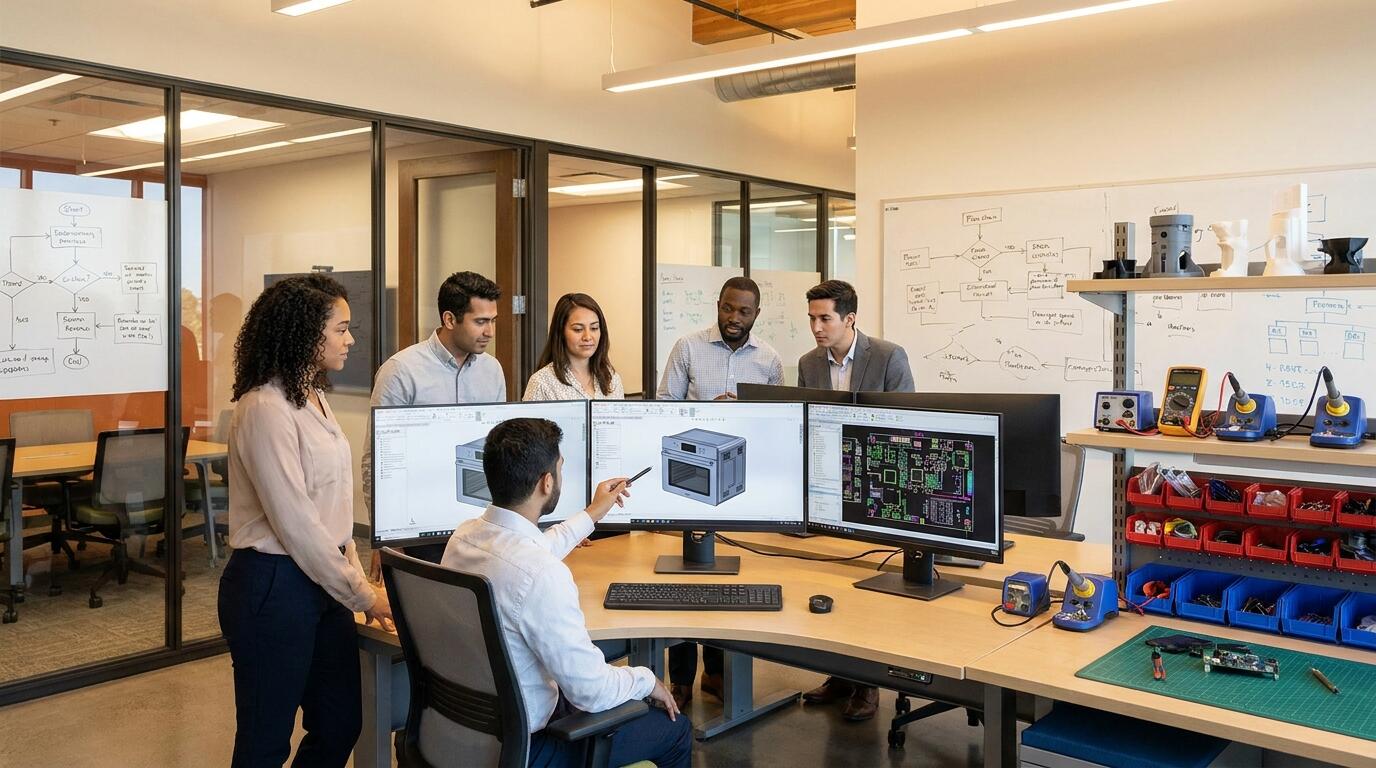
ALT: Hyxion in-house engineering team driving smart kitchen appliance customization capability for global B2B buyers
Why In-House Engineering Depth Defines Smart Kitchen Appliance Customization Capability
Key Conclusion: A manufacturer's in-house engineering capability — including the size, specialization, and practical experience of its engineering team — is an important factor in evaluating its ability to support complex, market-specific smart kitchen appliance customization. For B2B buyers evaluating OEM/ODM partners, understanding how a design and R&D team of nearly 100 professionals across domestic and overseas operations is organized and contributes to daily project execution provides valuable insight into a manufacturer's product customization capabilities.
When procurement managers begin evaluating kitchen appliance manufacturers for private-label or OEM/ODM programs, they typically compare price sheets, audit factory floor sizes, and review ISO certification documents. These are all valid inputs. But a pattern we consistently see — across conversations with sourcing specialists and buyers across North America, Europe, and Australia — is that the factors determining whether a customization project actually succeeds often come down to something less visible: the engineering team sitting behind the production floor.
A dedicated in-house engineering team, organized across disciplines such as mechanical design, electrical engineering, and firmware development, can provide a broader technical resource base for product customization projects. For buyers, understanding the team's actual structure, responsibilities, and project experience is more meaningful than evaluating headcount alone. It is a structural decision about where a manufacturer places its strategic investment. For buyers seeking genuine product differentiation, faster iteration cycles, and reliable compliance with regional standards, understanding what that engineering depth enables — and what its absence prevents — is essential to making the right sourcing partnership decision.
Who This Analysis Is Intended For
Applicable Scenarios:
- Importers and retailers developing private-label smart kitchen appliance lines who need to modify product features, dimensions, control interfaces, or compliance certifications for specific markets
- Procurement managers evaluating OEM/ODM partners and trying to distinguish between factories with genuine design capability versus those that only assemble off-the-shelf components
- Brand owners launching or expanding a kitchen appliance SKU portfolio who want faster time-to-market without sacrificing product quality or regulatory readiness
Not Applicable/Cautions:
- Buyers sourcing fully standardized, catalog-spec products at commodity price points with no customization requirements — in-house engineering depth adds cost structure that may not align with that procurement model
- Organizations that have locked in a fixed product specification and are purely seeking the lowest-cost assembler — engineering-heavy partners are optimized for development partnership, not pure contract manufacturing
The Structural Reality of Customization in Smart Kitchen Appliance Manufacturing
Product customization in the kitchen appliance sector has grown considerably more complex over the past decade. What once meant selecting a color finish or adjusting a burner BTU rating now encompasses firmware customization for smart connectivity features, compliance adaptation for safety certifications in multiple jurisdictions, industrial design modifications for regional kitchen dimensions, and software integration with third-party smart home platforms.
This complexity has widened the gap between manufacturers that can genuinely deliver custom products and those that only appear to offer customization in their marketing materials. Manufacturers may rely on different combinations of in-house engineering resources, component suppliers, and external design partners to implement product changes. The effectiveness of each approach depends on the technical capabilities of the parties involved, project coordination, and resource availability. Development costs and timelines should therefore be evaluated based on the specific project scope and cooperation arrangements.
The global kitchen appliance market continues to expand, with smart and connected appliances representing one of the fastest-growing categories according to industry analysis from organizations such as the International Electrotechnical Commission (IEC), which oversees the technical standards governing much of this equipment. As buyers demand more sophisticated products and shorter development cycles, the engineering infrastructure behind a factory becomes a competitive differentiator — not just for the manufacturer, but for every B2B brand that sources from them.
For buyers navigating the difference between OEM and ODM models for kitchen appliances, engineering team depth is a central consideration: a true ODM offering requires the manufacturer to hold the design capability in-house, while a pure OEM arrangement depends on the buyer supplying the design. Understanding how a factory's engineers bridge these models in practice reveals the true scope of what a customization partnership can deliver.
What A Nearly 100-person Design and R&D Team Actually Enable
Three Dimensions of Engineering Capability That Directly Affect Your Product
Step 1: Establish the Scope of Customization Early
The first thing an in-house engineering team enables is a structured, rigorous scoping process at the start of a new product project. In our work with clients entering new regional markets, this stage — which typically happens during initial technical briefings — determines whether a customization brief is feasible within a target cost and timeline, what trade-offs exist between design complexity and production efficiency, and which regulatory requirements will affect the development path. Factories with limited on-site engineering resources may involve external technical specialists or design partners during the initial project scoping stage. The depth of technical assessment and the potential for subsequent design revisions depend on the expertise involved, communication efficiency, and the clarity of project requirements.
Step 2: Execute Iterative Design and Prototyping In-House
An engineering team with expertise across mechanical design, electrical systems, and firmware development may coordinate related workstreams in parallel when project requirements and resource availability allow. This approach can help improve development coordination and reduce sequential handoffs between separate teams. However, the actual development schedule and overall costs depend on project complexity, resource allocation, and the level of external support required.
Step 3: Maintain Ongoing Engineering Support Through Production
Product development does not end at the sample approval stage. An in-house team can provide ongoing engineering support through tooling finalization, production line setup, first-article inspection, and quality assurance. When production issues arise, the original design engineers can participate in analyzing the causes and supporting corrective actions, drawing on their familiarity with the product's design and technical specifications. However, actual response times and resolution efficiency depend on the nature of the issue, resource availability, and coordination arrangements. This continuity between the design team and the production environment can be a valuable advantage of an established in-house engineering structure.
Comparing Customization Capability Across Manufacturer Types
The table below frames the key differences between manufacturer types that buyers frequently encounter when sourcing smart kitchen appliances. Understanding where a prospective supplier sits in this matrix helps procurement managers set realistic expectations and ask the right questions during factory evaluations.
| Comparison Dimension | Trading Company / Agent | Contract Assembler (Limited Engineering) | Manufacturer with a Nearly 100-Person Design and R&D Team |
|---|---|---|---|
| Ability to modify product specifications | Depends on the upstream manufacturer's engineering capabilities and project arrangements. | Customization capabilities depend on the assembler's internal technical resources and access to external engineering support. | Product design modification supported within the manufacturer's engineering capabilities and project requirements. |
| Firmware and smart feature customization | Depends on available technical resources and cooperation with software or engineering partners. | Requires external software vendor | Supported by an in-house firmware team, subject to product architecture and project requirements. |
| Regional compliance adaptation (UL, CSA, CE, etc.) | Support may vary depending on the supplier's technical resources and project scope. | Partial support, external labs required | Regional compliance adaptation: In-house engineering support for reviewing applicable market requirements and coordinating product adjustments and external testing, subject to model-specific requirements. |
| Prototyping and sample turnaround | Depends on supplier coordination, design complexity, and resource availability. | Depends on design access, technical resources, and project arrangements. | Depends on engineering resource allocation, design complexity, and internal project scheduling. |
| IP protection and design ownership | Depends on contractual agreements covering design ownership, usage rights, and information confidentiality. | Moderate — limited internal design | Depends on contractual agreements covering design ownership, usage rights, and transfer conditions. |
| Communication efficiency | May involve additional coordination among the buyer, trading company, and manufacturing partner. | Moderate direct access | Direct access to design and project engineers |
| Cost transparency | Depends on pricing arrangements, supplier relationships, and the level of cost breakdown provided. | Moderate transparency | Factory-direct cost structure |
The Engineering Specializations That Matter for Smart Appliance Customization
Mechanical and Industrial Design Engineering
Mechanical engineering is the foundation of any kitchen appliance customization project. Changes to cabinet dimensions, burner configurations, door hinge mechanisms, drawer systems, or ventilation pathways all require mechanical engineers who understand both the functional requirements and the manufacturing constraints of the production process. When Hyxion's engineering team works through a new rangetop or outdoor kitchen cabinet project, the mechanical engineers are involved from the first design brief through tooling sign-off — ensuring that design intent survives translation into manufacturable geometry.
Electrical and Power Systems Engineering
Smart kitchen appliances integrate induction heating systems, electronic ignition controls, variable fan motors, LED lighting arrays, and power management circuits that must meet the electrical safety standards of the target market. Electrical engineers within an in-house team can design systems around applicable market requirements and product performance specifications. Depending on the target market and product model, additional evaluation, testing, and certification through qualified external organizations may be required. Early engineering involvement helps identify potential compliance considerations during product development.
For buyers focused on North American market entry, understanding how CSA and UL certification processes interact with in-house testing capability provides important context for how engineering-driven manufacturers compress compliance timelines.
Firmware and Embedded Software Engineering
A firmware engineering team working closely with hardware engineers can coordinate software development and validate software builds against physical prototypes during the development process. External engineering partners may also support these activities, depending on their technical capabilities and project coordination arrangements. The overall development efficiency, costs, and timelines depend on the project scope, resource allocation, and level of collaboration between the teams involved.
Regulatory Compliance Engineering
Compliance engineers can participate in design reviews, identify potential regulatory issues before tooling decisions are finalized, and coordinate with qualified testing laboratories where required. Integrating compliance considerations into the development process helps manufacturers prepare for applicable market requirements, while final testing and certification remain subject to the relevant product, standards, and certification procedures.

ALT: Hyxion in-house engineers reviewing smart kitchen appliance customization designs, firmware, and regulatory compliance documentation for global B2B clients
Advanced Considerations: When Engineering Depth Becomes a Strategic Sourcing Advantage
Handling Complexity That Smaller Engineering Teams Cannot Absorb
A common misconception among buyers is that engineering team size matters primarily for large-volume, high-complexity programs and that smaller SKU counts or simpler customizations can be handled just as well by factories with minimal internal engineering. For small-to-medium volume programs, a larger in-house engineering team may offer greater flexibility in allocating specialized resources to customization projects. However, the ability to accommodate additional requests depends on current project commitments, team availability, engineering specialization, and the complexity of each project. Buyers should evaluate a manufacturer's actual resource allocation and project scheduling arrangements rather than relying on team size alone.
Factories with smaller engineering teams may need to prioritize resources based on existing project commitments and production requirements. For buyers with specialized customization needs, it is important to understand how engineering resources are allocated and whether sufficient capacity is available to support the proposed project schedule.
Misconception: Larger Engineering Teams Mean Slower Decision-Making
Some procurement managers assume that larger in-house engineering organizations introduce bureaucratic friction — more sign-offs, slower responses, more internal meetings. The well-structured engineering organizations we observe in leading manufacturers operate with clear project ownership structures: a dedicated project engineer serves as the single point of contact for each client program, drawing on specialist resources within the broader team as needed. A well-organized engineering team with clear project ownership can facilitate communication and coordination. A dedicated project engineer may serve as the main point of contact for each client program, coordinating specialist resources across the broader team as needed. Actual response times and decision-making efficiency depend on internal workflows, team availability, and project requirements.
Relationship Between Engineering Capability and Certification Readiness
Manufacturers with deep in-house engineering capability — particularly those with compliance engineers embedded in the development process — are consistently better positioned to support buyers through multi-market certification programs. For buyers planning to distribute a base product across multiple regional markets, considering applicable compliance requirements during the early design stage can help identify potential design adjustments before tooling and production decisions are finalized. The feasibility, testing requirements, and associated costs should be evaluated separately for each target market and product model. Those evaluating manufacturers against a structured checklist will find this dimension covered in resources such as a comprehensive OEM/ODM manufacturer evaluation guide for kitchen appliance buyers.
Questions & Answers
Q1: How does a large in-house engineering team specifically reduce product development timelines for OEM/ODM clients?
A large in-house engineering team can support parallel execution across mechanical design, electrical development, firmware integration, and compliance reviews where appropriate. This may reduce coordination steps between external parties and improve communication efficiency. The actual impact on development timelines depends on product complexity, project scope, testing requirements, and resource availability.
Q2: Is it realistic to expect a China-based OEM/ODM manufacturer to handle compliance engineering for North American safety certifications in-house?
Yes. A China-based OEM/ODM manufacturer can maintain in-house engineering resources to support compliance planning for North American markets. These responsibilities may include reviewing applicable UL and CSA requirements, identifying potential product design considerations, preparing technical documentation, and coordinating with qualified external testing laboratories. Buyers should verify the manufacturer's actual engineering responsibilities, relevant project experience, and model-specific testing arrangements rather than assuming that all certification activities are completed in-house.
Q3: What does working with a manufacturer that has a nearly 100-person design and R&D team mean for overall project costs, and how should buyers evaluate the value?
A manufacturer with a design and R&D team of nearly 100 professionals across domestic and overseas operations may have a different resource allocation and cost structure from a factory focused primarily on contract assembly. However, buyers should evaluate the total program cost rather than comparing unit prices alone. Relevant factors include engineering resource allocation, tooling requirements, prototype development, external testing, production adjustments, and potential rework. Whether the available design and R&D resources justify the overall project cost depends on the specific customization scope, order volume, and project requirements.
Summary
The size and specialization of a manufacturer's in-house engineering team are important factors when evaluating its product customization capabilities. However, buyers should also consider relevant project experience, engineering responsibilities, resource availability, and demonstrated performance in previous customization programs. These factors together provide a more comprehensive understanding of a manufacturer's ability to support specific product development requirements. For B2B buyers developing or expanding smart kitchen appliance programs, three core conclusions should guide sourcing evaluation:
First, in-house engineering resources can support coordinated product development across mechanical design, electrical systems, and firmware, helping teams manage technical requirements throughout the project.
Second, involving compliance specialists during the design process can help identify potential regulatory considerations earlier, allowing manufacturers to evaluate necessary adjustments before tooling and production decisions are finalized.
Third, direct access to relevant engineering specialists throughout a project can improve technical communication and provide continuity from initial product scoping through production support.
For procurement managers evaluating OEM/ODM partners for smart kitchen appliance programs, the practical next step is to ask pointed questions during factory visits: How many engineers work in-house? How are they organized by discipline? Who is the client's direct engineering contact throughout a program? The answers to these questions, together with relevant project experience, engineering responsibilities, and resource allocation, help buyers develop a more comprehensive understanding of a manufacturer's product customization capabilities.
Ready to explore what a partnership with an engineering-driven smart kitchen appliance manufacturer looks like in practice? Visit Hyxion's website to explore product lines across smart ranges, ovens, cooktops, rangetops, dishwashers, and outdoor kitchen cabinets — or connect directly with the team to discuss your customization requirements, request a factory capability briefing, or initiate a custom quote for your next OEM/ODM program.
References
- International Electrotechnical Commission (IEC). "Standards for Household and Similar Electrical Appliances".
https://www.iec.ch - Underwriters Laboratories (UL). "Product Safety Certification and Testing Standards".
https://www.ul.com - CSA Group. "Certification and Testing Standards for Kitchen Appliances".
https://www.csagroup.org - International Organization for Standardization (ISO). "Quality Management and Manufacturing Standards".
https://www.iso.org - Hyxion. "OEM vs. ODM for Kitchen Appliances: Which Model Fits Your Brand in 2026?".
https://www.hyxion.com/articles/oem-vs-odm-for-kitchen-appliances-which-model-fits-your-brand-in-2026
Note: Standards may be updated; please check the latest official documents or consult professional advisors.