
Smart Kitchen Appliance Trends to Watch in Q4 2026
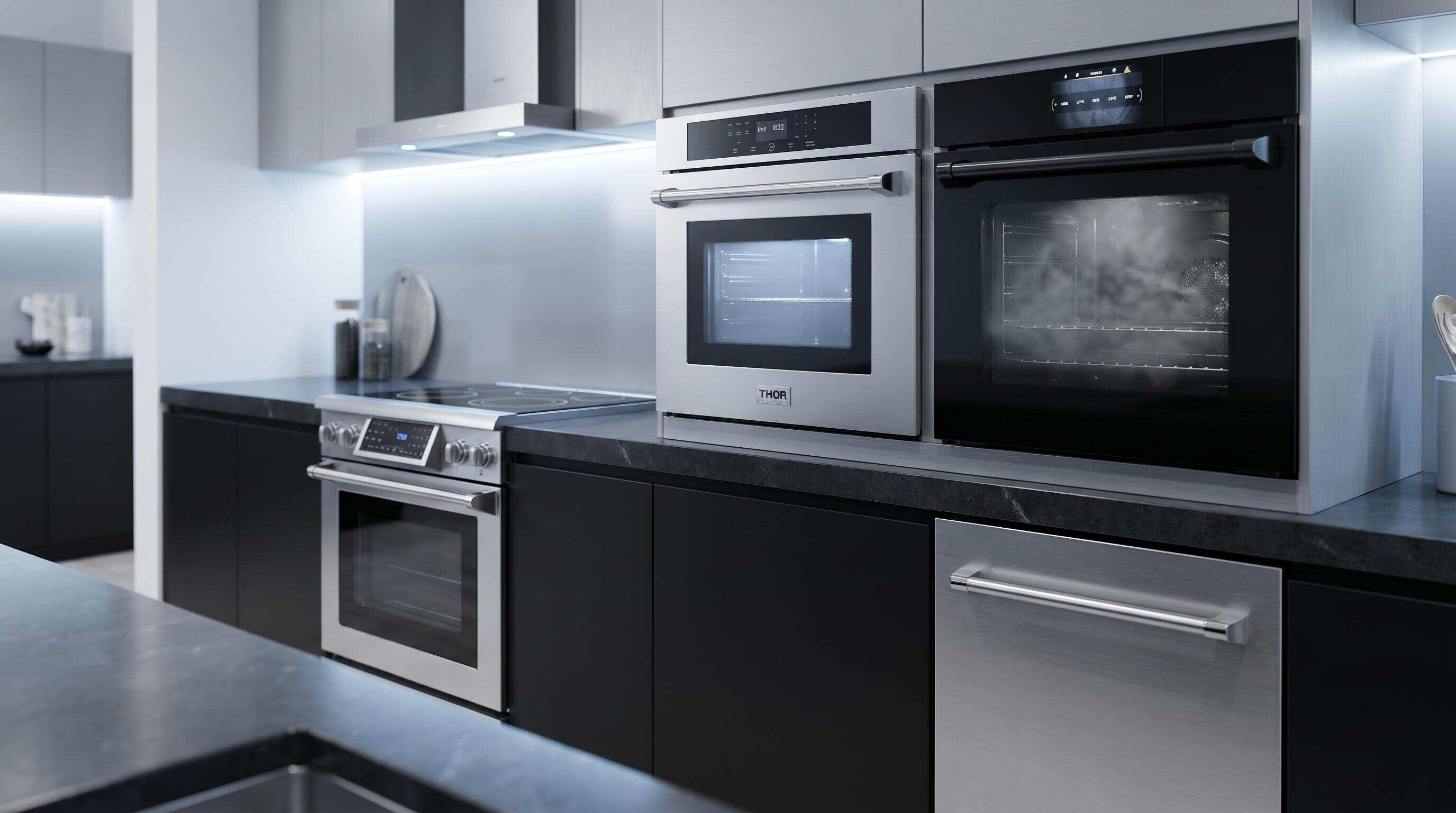
ALT: Smart kitchen appliance trends Q4 2026 OEM ODM manufacturing innovations for global B2B buyers
What Global Buyers and Distributors Will Gain from Understanding Smart Kitchen Appliance Trends in Q4 2026
Key Conclusion: Smart kitchen appliance trends heading into Q4 2026 are defined by AI-assisted cooking intelligence, voice and app connectivity, energy-efficient induction technology, and the growing demand for modular outdoor kitchen solutions. For B2B buyers, importers, and private-label brands, understanding these shifts early means securing advantageous manufacturing partnerships, faster product launches, and product lines that resonate with increasingly tech-savvy end consumers.
The smart kitchen appliance market is evolving faster than many procurement teams expect. Consumer expectations — shaped by smart home ecosystems, sustainability priorities, and post-pandemic home cooking habits — are placing new demands on the products that distributors and retail chains need to deliver. This guide is written specifically for procurement managers, product sourcing specialists, and brand owners who want a clear, practical picture of what Q4 2026 will look like, what trends will drive purchasing decisions, and how to position your sourcing strategy to stay ahead of the curve.
Before You Start: What You Need to Know Before Reading the Trend Landscape
Navigating trend intelligence as a B2B buyer is a different exercise than reading a consumer review. The goal is not simply to know what is popular — it is to translate that popularity into sourcing decisions, OEM/ODM briefs, and product development timelines that can realistically hit shelves or distribution channels in time to matter.
Before diving into the trends themselves, it helps to have a few foundational elements in place.
A working understanding of your target market's regulatory landscape is essential. Smart kitchen appliances destined for North America, Europe, or Australia carry different certification requirements. Products entering the US market typically require UL or ETL listing; Canadian distribution requires CSA compliance; European markets reference CE marking and ErP directive compliance. Knowing which standards apply to your channels before you brief a manufacturer saves significant time and cost.
You should also have a clear sense of your brand's current product tier — whether you are sourcing entry-level, mid-tier, or premium smart appliances — because the trends discussed here affect each tier differently. A private-label brand targeting cost-conscious consumers in emerging markets will apply the AI connectivity trend differently than a premium kitchen equipment importer in Western Europe.
Finally, have a sense of your production lead-time flexibility. Many of the Q4 2026 trends require components — smart chipsets, energy management modules, Wi-Fi or Bluetooth connectivity hardware — that have their own supply chain dynamics. Understanding your required delivery windows before you begin sourcing discussions puts you in a far stronger negotiating position.
Checklist before starting:
- Confirm target markets and their applicable certification requirements (UL, CSA, CE, SAA, etc.)
- Identify your brand's product tier and price positioning for the Q4 2026 lineup
- Establish your target retail or distribution window and work backward to your required manufacturing start date
- Align internally on whether you are pursuing private-label, fully custom OEM, or white-label ODM for each product category
- Assess your freight and logistics strategy, particularly given ongoing changes in transoceanic shipping costs and timelines
A Step-by-Step Guide to Reading and Acting on Smart Kitchen Appliance Trends for Q4 2026
Step 1: Understand What "Smart" Actually Means in Today's Kitchen Appliance Market
The word "smart" in kitchen appliances is a spectrum, not a single feature. At the most basic level, smart means Wi-Fi or Bluetooth connectivity that allows an appliance to be controlled or monitored through a smartphone app. At a more advanced level, it includes AI-driven functionality — ovens that recognize food type and auto-adjust cooking programs, ranges that learn usage patterns and suggest preheating schedules, or rangetops with built-in diagnostics that notify users of maintenance needs.
For B2B buyers, understanding where on this spectrum your target consumer sits — and where your competitors' products sit — is the starting point for every other sourcing decision. In our work with clients across North America and Europe, a pattern we consistently see is that buyers underestimate how quickly the connectivity baseline shifts. What counted as a premium smart feature two years ago is now a table-stakes expectation in many retail environments.
Tip: When briefing an OEM/ODM manufacturer, specify your connectivity requirements explicitly: Wi-Fi generation, app compatibility standards (Alexa, Google Home, Apple HomeKit), and whether you need local network control as a fallback. Vague briefs lead to mismatched components.
Step 2: Identify the Five Defining Trends Shaping Q4 2026
The smart kitchen appliance landscape heading into Q4 2026 is shaped by five converging forces. Each one represents both a market opportunity and a sourcing consideration.
AI-Integrated Cooking Assistance is the dominant trend. Smart ovens and ranges increasingly ship with onboard or cloud-connected AI that can recognize ingredients via built-in cameras, suggest recipes, and auto-execute multi-stage cooking programs. This is no longer confined to luxury brands. Mid-market buyers are requesting AI functionality at competitive price points, and manufacturers with the hardware-software integration experience to deliver it at scale are in high demand.
Induction and Electromagnetic Cooking Dominance is accelerating. Regulatory pressure in Europe and voluntary energy efficiency goals in North America are pushing consumers and commercial buyers alike toward induction cooktops and rangetops. Induction technology is also inherently more compatible with smart controls — precise temperature management, programmable heat curves, and integration with smart home energy management systems are all easier to implement on induction platforms than on gas.
Voice and Ecosystem Connectivity continues to mature. The major voice assistant platforms — Amazon Alexa, Google Assistant, and Apple's Siri via HomeKit — have each expanded their kitchen appliance compatibility. Appliances that integrate seamlessly with these ecosystems command a meaningful retail premium, and buyers sourcing for the premium tier should ensure their OEM/ODM partner has the firmware licensing and certification pathway experience to support this.
Outdoor and Modular Kitchen Expansion is one of the fastest-growing product categories entering Q4 2026. Post-pandemic lifestyle shifts permanently elevated interest in outdoor entertaining spaces, and the demand for weather-resistant, smart-capable outdoor kitchen cabinets, grills, and integrated cooking stations has not subsided. For distributors and retail chains serving the home improvement or outdoor living segment, this category represents a significant new line opportunity.
Sustainability and Energy Transparency is becoming a purchasing criterion, not just a marketing claim. End consumers — particularly in Northern Europe and Australia — are increasingly demanding energy consumption data from their appliances. Smart appliances that can display real-time energy usage, integrate with home energy management platforms, and carry recognized energy efficiency credentials are gaining clear shelf advantage.
Tip: Do not try to build one product that addresses all five trends simultaneously. A focused, well-executed product that leads clearly on one or two trends will outperform an unfocused product that gestures vaguely at all of them.
Step 3: Map Each Trend to a Specific Product Category in Your Lineup
Trends become actionable when you match them to specific SKUs. Here is a practical mapping for common B2B buyer product categories:
For smart ranges and rangetops, the most relevant trends are AI-integrated cooking assistance and induction dominance. If your current lineup is gas-only, now is the time to evaluate whether adding a smart induction rangetop — or a dual-fuel option — aligns with your Q4 targets.
For smart ovens, AI cooking programs and ecosystem connectivity are the primary value drivers. Buyers sourcing for the premium tier should ask their manufacturer whether the oven's control board supports over-the-air (OTA) firmware updates — this feature is increasingly expected by both consumers and retail partners, and it allows the appliance to gain new features after sale without a service call.
For cooktops, induction technology and energy transparency are the key differentiators. Cooktops with built-in energy monitoring displays or app-reportable consumption data are well-positioned for European retail environments.
For dishwashers, the smart trend is expressed through app-based cycle management, soil sensing that adjusts water and energy use automatically, and integration with smart home routines (run when off-peak electricity rates apply, for example). These features are becoming standard expectations at mid-to-premium price points.
For outdoor kitchen cabinets and stations, the emphasis is on weather resistance, modularity, and connectivity-ready construction — meaning the cabinet system is designed to accommodate smart cooking appliances and power management components from the outset, rather than as an afterthought.
Tip: When reviewing samples from a potential OEM/ODM partner, test the app connectivity experience on actual consumer devices, not just in a controlled factory environment. App latency, ease of onboarding, and stability across different Wi-Fi network configurations are common pain points that only surface in real-world conditions.
Step 4: Evaluate Your OEM/ODM Manufacturing Partner Against These Trend Requirements
Not all manufacturers are equally positioned to deliver on the Q4 2026 smart appliance trend requirements. Evaluating a manufacturing partner specifically against these trends requires asking pointed questions.
Does the manufacturer have an in-house software and firmware development team, or do they rely on third-party module suppliers? In-house software capability is a significant advantage for buyers who need custom app integration or proprietary voice assistant compatibility.
Does the manufacturer have direct experience with the certification pathways required for your target markets? Smart appliances — particularly those with Wi-Fi, Bluetooth, or other wireless communication — require additional radio frequency certifications (FCC in the US, IC in Canada, CE RED in Europe) on top of standard product safety certifications. Working with a manufacturer who has already navigated these pathways, rather than one doing it for the first time on your project, reduces risk substantially. Understanding how in-house testing labs accelerate certification is a practical starting point for any buyer evaluating this dimension.
Can the manufacturer demonstrate rapid sample production capability? Q4 2026 is a compressed timeline. A partner who can move from a confirmed brief to a physical prototype quickly gives you meaningful review and iteration time before tooling commitments. How rapid sample production works in practice is worth understanding in detail before you commit to a manufacturing timeline.
Does the manufacturer have experience with outdoor kitchen products specifically, if that category is in your scope? Weather-resistant materials, marine-grade hardware, and the specific construction tolerances required for outdoor use are distinct competencies from indoor appliance manufacturing.
Tip: Ask for reference products — not just a factory tour. Seeing finished, market-ready products that the manufacturer has already produced for other B2B clients, particularly products with smart connectivity features, tells you far more than a list of claimed capabilities.
Step 5: Develop Your Q4 2026 Sourcing Brief with Trend-Informed Specifications
A sourcing brief that explicitly references trend requirements is a more effective communication tool than a generic specification sheet. When you have mapped your target trends to your product categories and evaluated your preferred manufacturing partners, the next step is building a brief that is specific enough to be actionable.
Your brief should specify the connectivity standard (Wi-Fi generation, communication protocol), the voice assistant platforms you want to support, the energy efficiency targets you are working toward, and the certification marks required for each target market. It should also specify your packaging and labeling requirements for smart features — many retail environments require clear, standardized smart feature iconography on packaging.
For OEM products, your brief will additionally include brand identity requirements — color, logo placement, interface language options, and any proprietary app or platform integration instructions. For ODM products, you will be selecting from an existing product portfolio and specifying only the customization elements within that platform.
For buyers sourcing across multiple product categories for a Q4 2026 launch, consolidating your brief into a single manufacturing partnership — where feasible — typically produces better alignment between products and reduces the coordination overhead of managing multiple suppliers. As a practical guide, how to choose an OEM/ODM kitchen appliance manufacturer in Q4 2026 offers a structured checklist for evaluating and selecting the right partner.
Tip: Build a feedback loop into your brief timeline. Plan for at least one sample review cycle with enough calendar time to request modifications before production tooling is finalized. Changes made at the sample stage are far less costly than changes discovered during pre-production inspection.
Step 6: Plan Your Q4 Market Entry and Contingency Timeline
Q4 2026 refers to the October-through-December retail and distribution window — a period that includes major purchasing events across North America, Europe, and Australia. Working backward from a desired shelf or distribution date, procurement teams should map each upstream milestone: production completion, quality inspection, freight transit, customs clearance, and warehouse receiving.
Smart appliances with wireless communication components are subject to customs documentation requirements related to radio frequency certification that standard non-connected appliances do not face. Building time into your logistics plan for these documentation requirements — particularly for first-time imports of a new connected product — is a practical contingency that many first-time smart appliance importers overlook.
Tip: Confirm with your freight forwarder or customs broker which FCC, IC, or CE RED certificates need to accompany your shipment documentation before the goods leave the factory, not after they arrive at port.
Common Mistakes and Troubleshooting When Sourcing Smart Appliances for Q4 2026
| Symptom | Likely Cause | How to Fix |
|---|---|---|
| Product fails wireless certification testing in target market | Manufacturer used an un-approved radio module or did not complete FCC/IC/CE RED testing | Confirm radio module certification status at brief stage; require manufacturer to show existing module certifications before production begins |
| App connectivity is unreliable in consumer testing | App was developed for the manufacturer's domestic market and not localized for North American or European network environments | Require real-world connectivity testing in target market conditions; specify app performance standards in the sourcing brief |
| Smart features do not function with stated voice assistant platforms | Firmware compatibility was not verified against the latest version of the platform's integration requirements | Ask manufacturer to demonstrate live integration with Alexa, Google Home, or HomeKit on a production sample, not just a development unit |
| Outdoor kitchen products show corrosion or material degradation in sample inspection | Indoor-grade materials were substituted in the prototype without disclosure | Specify material grades explicitly (Verify the outdoor suitability of materials and models based on salt exposure, surface finish, drainage, and maintenance conditions); require material certifications with samples |
| Production timeline slips past Q4 deadline | Component lead times for smart chipsets or connectivity modules were not factored into the production schedule | Confirm component availability and lead times before confirming your production start date; build a buffer into your planned milestone dates |
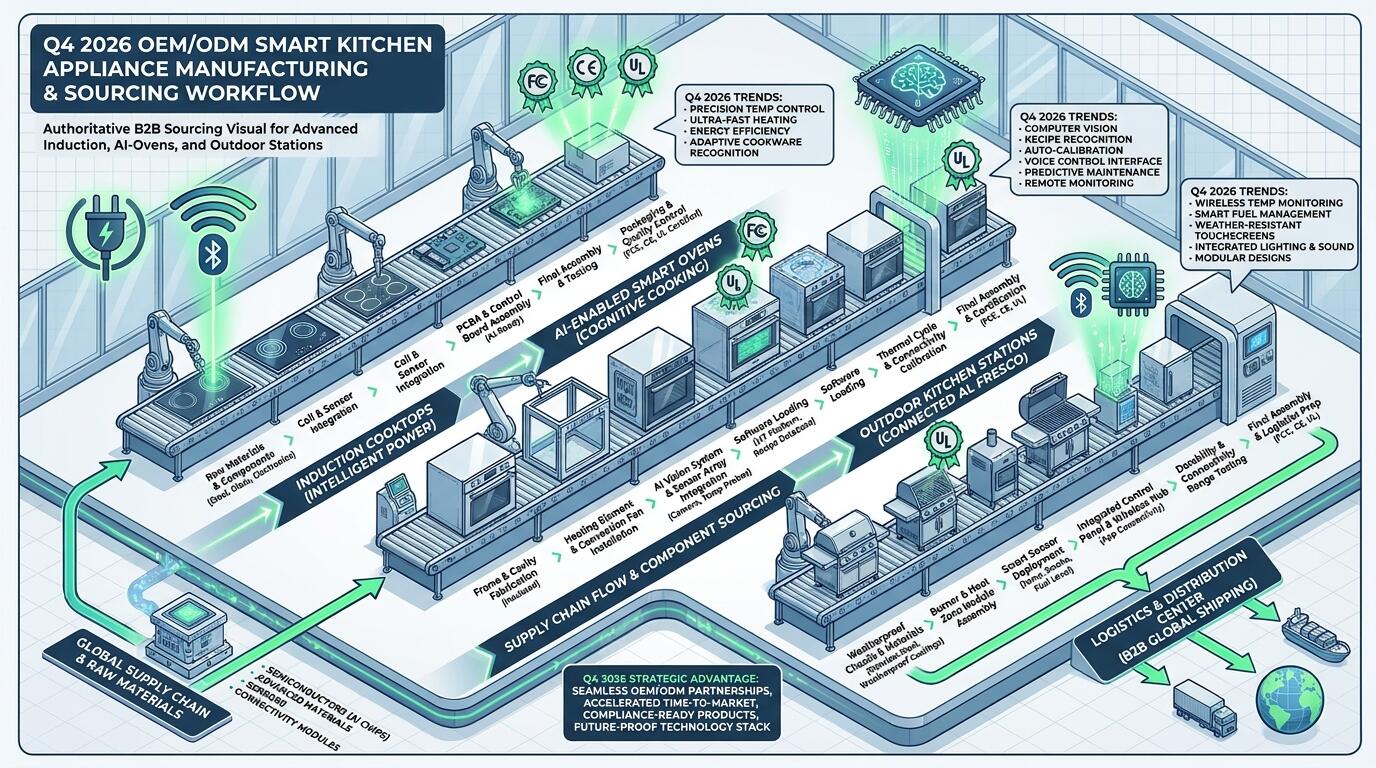
ALT: OEM ODM smart kitchen appliance manufacturing trends Q4 2026 induction AI connectivity outdoor kitchen sourcing for global B2B buyers
Pro Tips for Better Results When Acting on Q4 2026 Smart Appliance Trends
Prioritize manufacturers with software co-development capability. The differentiating factor in smart kitchen appliances is increasingly the user experience — the app, the voice integration, the AI logic — not just the hardware. A manufacturer who can collaborate with you on user experience design, not just execute a hardware specification, is a more valuable partner for the long term.
Think about the full smart ecosystem, not just the appliance. End consumers increasingly evaluate appliances based on how well they fit their existing smart home setup. If your target consumer is an Amazon Echo household, an appliance that works seamlessly with Alexa is meaningfully more attractive than one that requires a standalone app. Build this into your sourcing brief from the outset.
Do not neglect the energy transparency opportunity. A common misconception in the market is that sustainability features are only relevant for European buyers. In reality, the appetite for energy-conscious products is growing across all major markets, including North America and Australia. Products that can display real-time or historical energy consumption data to the end user are well-positioned across geographies.
Build platform flexibility into your firmware roadmap. The major smart home ecosystems evolve their integration requirements regularly. Working with a manufacturer who commits to firmware update capability — either OTA or via scheduled update releases — means your product can maintain platform compatibility over its commercial lifespan, not just at launch.
Treat outdoor kitchen as a category, not an add-on. Buyers who approach outdoor kitchen cabinets and cooking stations as an extension of their indoor range lineup consistently underestimate the design and engineering distinctions. Outdoor products require a dedicated sourcing brief, a different set of material specifications, and often a different set of end-consumer personas. Treat the category with that level of specificity, and your product development will reflect it.
Frequently Asked Questions FAQ
Q1: How should a first-time smart appliance importer approach OEM versus ODM for a Q4 2026 launch?
OEM manufacturing means you are providing the product design and the manufacturer executes it; ODM means the manufacturer provides an existing, proven design that you brand as your own. For a first-time importer targeting Q4 2026 with a compressed timeline, ODM is typically the lower-risk path — you are working with a product that already has established tooling, tested connectivity features, and existing certification pathways. OEM makes more sense when you have proprietary design requirements that existing ODM platforms cannot accommodate.
Q2: Are AI-integrated cooking features genuinely in demand at mid-market price points, or are they still a premium-only feature?
AI-assisted cooking features — particularly auto-program selection based on food recognition or preset recipe execution — are actively moving into mid-market products. Retail buyers and distributors in North America and Europe consistently report that connected cooking features are now expected by consumers at mid-tier price points, not just premium tiers. The key variable is execution quality: mid-market buyers will accept a more limited AI feature set, but they will not accept a connected feature that is unreliable or difficult to set up.
Q3: How long does it typically take to get a new smart appliance from initial brief to Q4 2026 delivery?
The timeline from initial sourcing brief to delivery-ready product varies significantly based on the complexity of the product and the degree of customization involved. For ODM products requiring only branding and minor configuration changes, a relatively short development and production cycle is achievable. For fully custom OEM products with proprietary connectivity features and new tooling, the process is considerably longer. Wireless certification testing — including FCC, IC, or CE RED requirements — may affect the overall development timeline, depending on the specific product configuration, applicable certification requirements, and testing scope. Any buyer targeting Q4 2026 delivery should be in active sourcing discussions now.
Key Takeaways
- Smart kitchen appliance trends for Q4 2026 center on five forces: AI-integrated cooking intelligence, induction technology dominance, voice and ecosystem connectivity, outdoor kitchen expansion, and energy transparency — and each trend maps to specific product categories and sourcing requirements.
- For B2B buyers and distributors, the most common sourcing mistake is treating connectivity as a hardware-only requirement. The firmware, the app experience, and the ecosystem compatibility are equally important procurement considerations.
- Wireless certification (FCC, IC, CE RED) is a mandatory step for smart appliances with Wi-Fi or Bluetooth, and it requires explicit planning in the production and logistics timeline — not an afterthought.
- OEM/ODM manufacturers with in-house software development capability, existing certification track records, and outdoor kitchen experience represent meaningfully stronger partners for Q4 2026 product launches than hardware-only suppliers.
- Outdoor kitchen cabinets and smart cooking stations are one of the fastest-growing categories entering Q4 2026 — buyers with the right manufacturing partnership can capture a meaningful first-mover position in this segment.
The next step for procurement teams ready to move from trend awareness to sourcing action is to consolidate your product category priorities and begin manufacturer evaluation conversations now, with enough lead time to build in sample review and certification cycles before your Q4 deadline.
Ready to build your Q4 2026 smart kitchen appliance lineup with a manufacturing partner who combines intelligent technology, flexible OEM/ODM capability, and factory-direct pricing? Visit Hyxion's website to explore product catalogues across smart ranges, ovens, cooktops, rangetops, dishwashers, and outdoor kitchen cabinets — or to start a conversation about a fully customized manufacturing partnership built around your brand's specific requirements.
Sources & Further Reading
- Kitchen Appliance Trends For 2026. "Kitchen Appliance Trends For 2026".
https://www.youtube.com/watch?v=tcWyb4BQuQo - Appliance Trends for 2026: What's New in the Kitchen and Beyond. "Appliance Trends for 2026: What's New in the Kitchen and Beyond".
https://www.google.com/goto?url=CAESsQEBxCJF1-MDA3GKgkrk45QCP0L8ijc8daMqACqZPxYMlVHojbBJnFCFxLUYS2CGPgN6IYn7pT96AOAc4wkeiiasLAr18n1rtm8KltZ5yA-cR6w_wJ-HBDChZuE7g9_vZJZ9na_VBWZkKiXrQUT-ZvOhADB9uU7RAnfUF74zelXMKF0bFUzVtmp8AS1JE9AknGQLeZsn-GZmc5TpFBWGsTujf6hsSZ8yQg_mfhZXQkzpkbs - Mark's Appliance. "6 Kitchen Appliance Trends Homeowners Love in 2026".
https://marksappliance.com/blog/6-kitchen-appliance-trends-homeowners-love-in-2026/?srsltid=AYCX9vLbII4sFZoixEo0O-qiMak2ta6nbboH71wM-BkX5nIi1QTUQRTA
Note: Standards and market conditions may be updated; please check the latest official documents or consult professional advisors for the most current guidance.