From Idea to Reality in 15 Days: How Rapid Sample Production Works
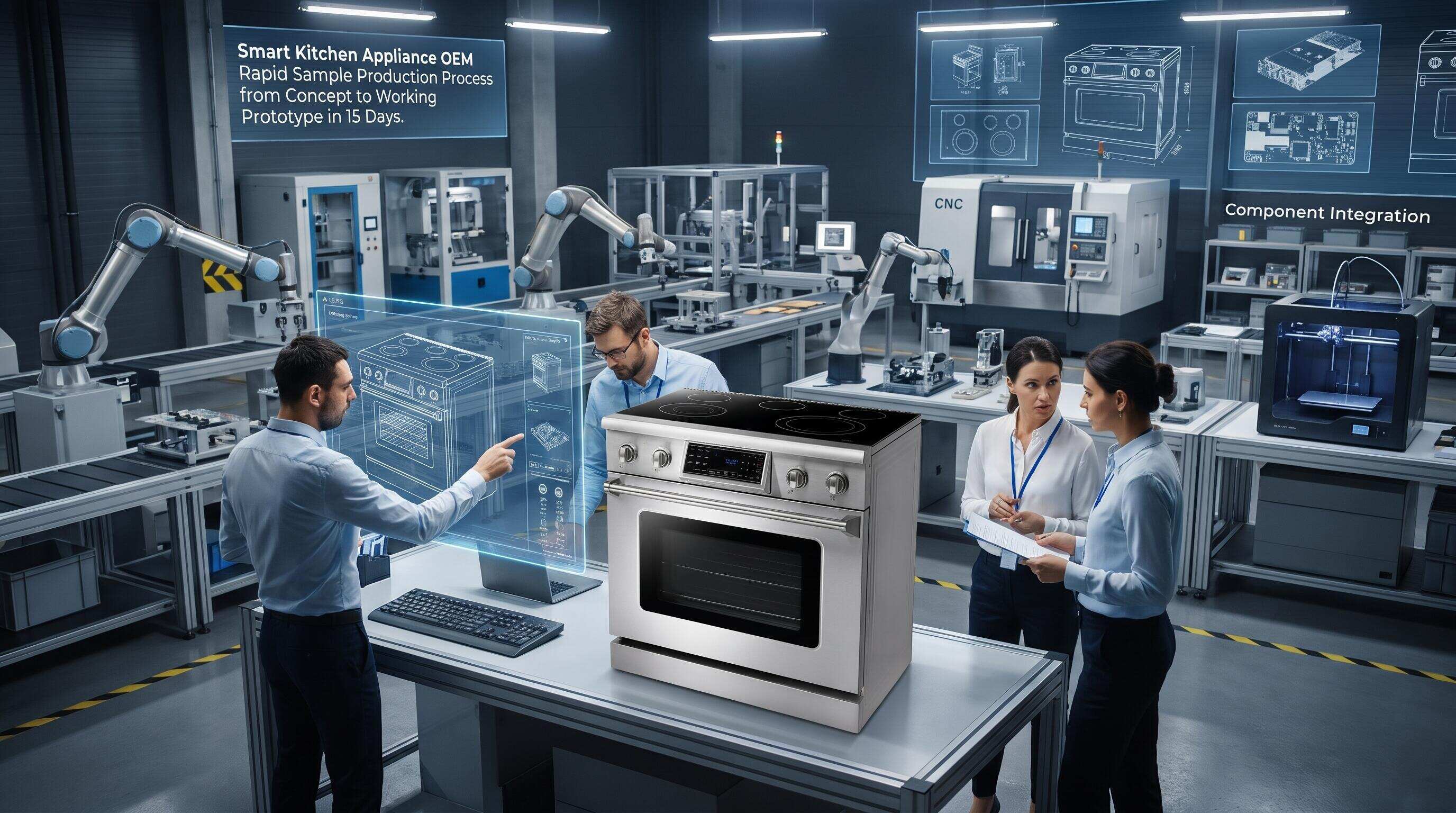
ALT: Smart kitchen appliance OEM rapid sample production process from concept to prototype takes 15 business days
Why Rapid Sample Production Is Redefining the Kitchen Appliance Sourcing Cycle
Key Conclusion: Rapid sample production in the smart kitchen appliance industry means compressing the journey from a buyer's initial product concept to a physical, testable prototype into as few as 15 business days — without sacrificing engineering precision or customization depth. For global OEM/ODM buyers sourcing smart ranges, ovens, cooktops, or outdoor kitchen systems, this accelerated timeline is now a competitive differentiator that directly influences time-to-market, capital efficiency, and new product launch success.
The traditional sample development cycle in kitchen appliance manufacturing has long been a source of frustration for procurement managers and product sourcing specialists. Delays between design submission and physical sample delivery — often stretching to six weeks or more — create downstream bottlenecks in approvals, compliance testing, and final production scheduling. A pattern we consistently see in our work with global B2B clients is that timeline uncertainty at the sample stage is the single biggest risk factor in new product launch projects.
What has changed is the convergence of integrated factory infrastructure, digital design tooling, and cross-functional team coordination. When these three elements operate in sync, the rapid sample production process becomes a structured, repeatable system rather than an aspirational target. This article explains how that system actually works, what it requires from both manufacturer and buyer, and where the genuine trade-offs lie.
Who This Applies To — and Who Should Reconsider
Applicable Scenarios:
- Importers and distributors launching a new private-label smart kitchen appliance line who need a physical sample before committing to a minimum order quantity
- Retail chains and buying groups evaluating competing product concepts and requiring side-by-side prototypes within a defined review window
- Established brands adding a new SKU — such as a smart rangetop or outdoor kitchen cabinet module — to an existing product family and needing fast design validation
Not Applicable / Cautions:
- Products requiring entirely novel mechanical subsystems with no existing tooling baseline at the manufacturing facility; these inherently require longer engineering lead times and should not be scoped against a 15 business days target
The Market Pressure Behind Faster Prototyping
The global smart kitchen appliance market is experiencing sustained demand growth across North America, Europe, and the Asia-Pacific region. Buyers at trade shows and in sourcing negotiations increasingly cite speed-to-sample as a shortlisting criterion when selecting OEM/ODM manufacturing partners. This is not merely impatience — it reflects a structural shift in how retail and import businesses manage product development risk.
Prototyping timelines in manufacturing have traditionally varied widely depending on product complexity, tooling requirements, and factory coordination capacity. Industry references on rapid prototyping methodology note that well-structured processes with clear design inputs can dramatically reduce sample lead times compared with less coordinated approaches. The gap between a 15 business days capable manufacturer and a 45 business days manufacturer, when compounded across multiple development cycles per year, represents a material competitive disadvantage in securing shelf space and import contracts.
For smart kitchen appliances specifically, the complexity layer is higher than for conventional appliances. Products like smart ovens with integrated connectivity modules, smart ranges with touch-control interfaces, or outdoor kitchen cabinets with weatherproofing requirements each involve multiple engineering disciplines that must move in parallel, not in sequence, to achieve compressed timelines. This parallel execution is the operational core of rapid sample production — and it is what separates manufacturers with genuine 15 business day capability from those who quote the number without the infrastructure to deliver it.
The transition from prototype to production also carries its own logic: a sample that faithfully represents production tooling and materials reduces the risk of rework at scale. This is why the sample stage is worth compressing but not skipping, and why the quality of that compressed process matters enormously.
How the 15 business Days Sample Cycle Actually Works
Three Steps That Define the Rapid Production Process
Step 1: Design Lock and Engineering Translation (Days 1–3)
The first phase is design lock — the process of converting a buyer's concept, reference images, or engineering brief into a fully specified manufacturing document set. This includes 3D modelling, material selection confirmation, component sourcing decisions, and identification of any existing tooling that can be adapted. In our work with clients, the most common cause of timeline slippage is ambiguity at this stage: a buyer provides aesthetic references but no dimensional constraints, or specifies a finish without confirming supply chain availability. Experienced OEM/ODM teams handle this by running a structured intake review on day one, flagging all open questions, and securing buyer sign-off on a consolidated design specification before tooling or procurement is initiated. Locking design cleanly within three days is non-negotiable if the 15 business days target is to hold.
Step 2: Component Procurement and Tooling Preparation (Days 4–9)
With design locked, procurement and tooling teams move simultaneously rather than sequentially. Standard components — motors, control boards, heating elements, cabinet hardware — are sourced from verified supplier networks within the manufacturer's existing ecosystem. Dongguan-based manufacturing clusters, where Hyxion operates, offer particular advantage here: proximity to deep component supplier networks compresses local procurement lead times significantly. Custom tooling modifications or new jig preparation run in parallel with incoming component delivery. This parallel-track approach is the structural reason a 15 business days window is achievable: it eliminates the sequential wait that inflates timelines in less integrated facilities.
Step 3: Assembly, Functional Testing, and Sample Delivery (Days 10–15)
Assembly begins as soon as components are confirmed and tooling is validated. For smart appliances, this phase includes not only mechanical assembly but also firmware loading, interface calibration, and connectivity validation where applicable. Functional testing against the agreed specification is completed in-house before the sample ships — not after. A sample that arrives at a buyer's facility without prior functional verification creates costly re-verification cycles. The final two days of the 15 business days window are reserved for quality inspection, photography documentation, and packaging for international shipment. This buffer exists precisely because real production environments encounter unexpected variables, and absorbing them within the window rather than extending the deadline is a hallmark of a mature rapid production process.
Comparing Rapid Sample Approaches: What the Options Actually Mean for Buyers
Buyers evaluating OEM/ODM partners for smart kitchen appliance development typically encounter three distinct sample production models. Understanding the trade-offs between them is essential for setting realistic expectations and selecting the right partner structure.
| Comparison Dimension | Standard Factory Sample | Accelerated OEM Sample | Fully Integrated Rapid Sample |
|---|---|---|---|
| Typical timeline | 30–45 business days | 20–30 business days | 12–18 business days |
| Design input required | Often factory-standard spec | Partial customization supported | Full buyer-spec customization |
| Tooling reuse | High — uses existing moulds | Moderate — partial tooling adaptation | Varies — existing tooling leveraged where possible |
| Parallel workflow execution | Sequential | Partial | Full parallel-track |
| Smart appliance capability | Limited | Moderate | Full integration supported |
| Buyer involvement during process | Low | Moderate | Active — structured check-ins |
| Suitability for private label | Limited | Moderate | High |
The fully integrated rapid sample model — which is the basis of the 15 business days capability — requires the manufacturer to maintain an in-house engineering team, a live component procurement network, and cross-functional project management. It also requires the buyer to be responsive: design questions that sit unanswered for 48 hours on the buyer side do not pause the clock on the factory side, and experienced procurement managers account for this in their internal workflows.
What Separates a Genuine 15 business Days Capability from a Marketing Claim
Rapid sample production is a phrase that appears frequently in OEM/ODM supplier communications, but the underlying capability varies considerably. Several concrete indicators distinguish manufacturers with genuine compressed-timeline capacity.
First, the depth of their existing tooling library matters. A manufacturer with extensive existing mould and jig assets for smart appliance product categories — including standard rangetop configurations, oven cavity geometries, and cabinet framing systems — can adapt rather than originate, which is the primary timeline accelerator. Building tooling from scratch for a new product category cannot realistically be completed within 15 business days; adapting proven tooling assets can be.
Second, the engineering team's co-location with the production floor matters. When the engineers responsible for design translation are physically present alongside the assembly team, resolution of production questions happens in minutes rather than via email threads that span time zones and add days. This is a structural advantage of integrated Dongguan factory operations that is difficult to replicate through outsourced or geographically distributed models.
Third, the supplier network depth matters. A manufacturer that sources components from verified, frequently-used supply partners — rather than initiating new supplier relationships for each project — benefits from established lead time agreements, credit terms, and quality precedent. For smart kitchen appliances, this is particularly significant because electronic components and connectivity modules require supply partners who understand specification tolerance, not merely price-per-unit.
Fourth — and often underestimated — buyer readiness matters as much as factory capability. The process from concept to prototype takes 15 business days. Buyers who arrive at the engagement with well-documented product requirements, clear finish and material preferences, and delegated decision-making authority for rapid-response questions will consistently achieve shorter total project timelines than those whose internal approval processes introduce delays between factory questions and buyer answers.
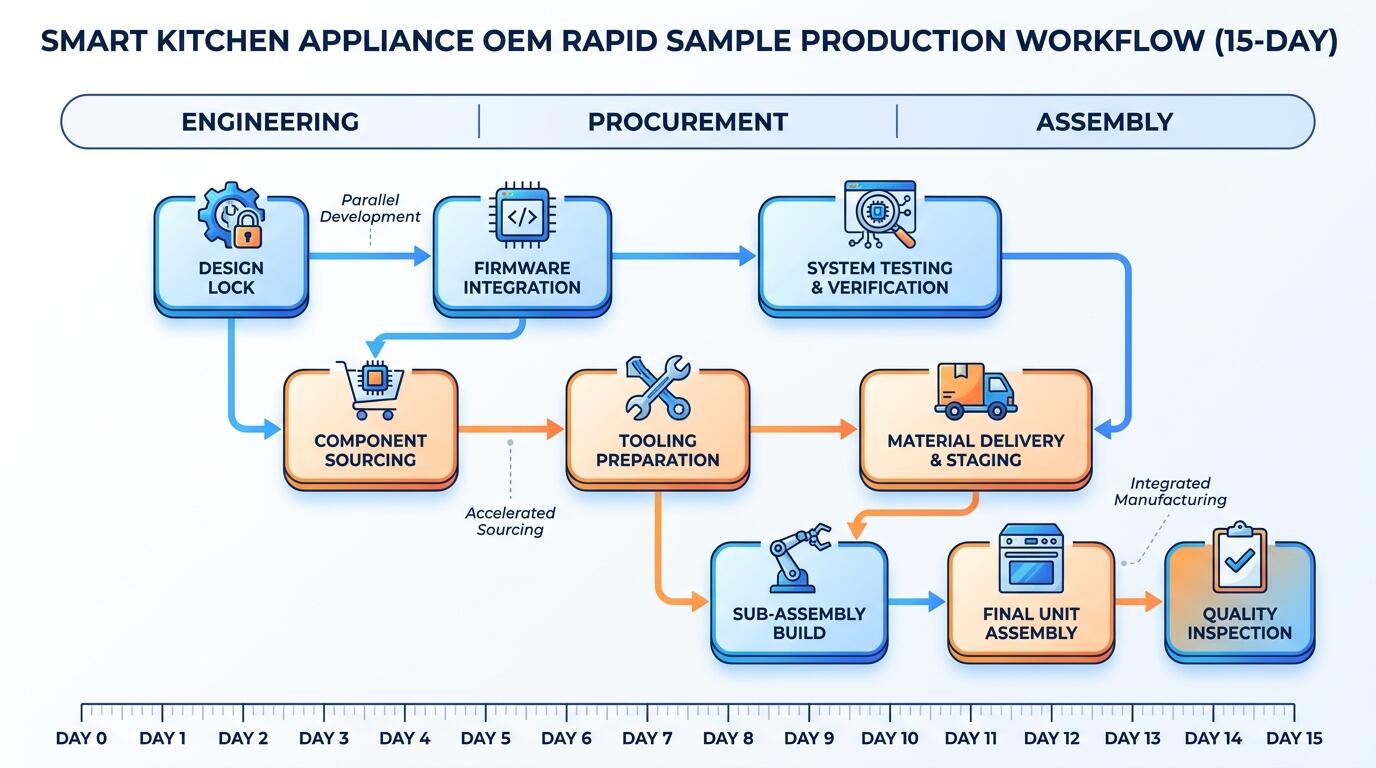
ALT: Hyxion OEM smart kitchen appliance rapid sample production workflow showing parallel engineering, procurement, and assembly tracks for business days delivery
Advanced Considerations: Where the 15 business days Model Gets More Complex
Managing Smart Technology Integration Within Compressed Timelines
Smart kitchen appliances — by definition — incorporate connectivity, sensing, or interface technology that conventional appliances do not. Integrating a touchscreen control interface into a custom rangetop, or embedding a Wi-Fi module into an oven cavity design, introduces firmware dependencies that sit outside the mechanical and fabrication workflow. In our experience, the most common advanced complication in rapid smart appliance samples is the firmware-hardware synchronization point: physical assembly may be complete on day 12, but functional validation of the smart interface requires firmware that is build-validated against the specific hardware revision.
Manufacturers with genuine smart appliance capability maintain pre-validated firmware modules for common connectivity and control configurations. This modular firmware approach means that for most buyer configurations, the software layer does not add time to the sample cycle — it runs in parallel with hardware assembly. The cases where it does add time are when buyers require entirely novel interface logic or proprietary connectivity protocols not previously implemented. These cases require honest scoping conversation at the brief stage, not discovery on day 13.
Common Misconceptions That Create Buyer-Side Risk
One misconception we address frequently is the assumption that a faster sample necessarily means lower quality or reduced customization. The logic of rapid production is not to reduce what is done — it is to restructure when things are done and by whom, so that parallel execution replaces sequential waiting. The quality standard applied to a 15 business days sample and a 45 business days sample should be identical; the difference is organizational efficiency, not inspection depth.
A second misconception concerns the relationship between sample approval and production tooling. For some product categories, the rapid sample is built using adapted or bridge tooling that approximates — but does not exactly replicate — final production tooling. Buyers should confirm with their manufacturer which tooling basis underpins the sample, because dimensional tolerances in a bridge-tooled sample may differ slightly from those in mass production. Sophisticated buyers request a tooling basis disclosure as part of the sample documentation package.
Common Questions
Q1: How does a buyer's level of technical documentation affect the 15 business days sample timeline?
The process from concept to prototype takes 15 business days. Buyers who provide detailed technical drawings, material specifications, and reference samples at project initiation enable the fastest possible start. Those with only mood-board-level references require an additional engineering consultation phase before the clock meaningfully starts. In practice, buyers with strong technical documentation consistently achieve shorter total lead times, while those with less defined briefs should plan for a pre-sample design alignment phase.
Q2: Are rapid samples produced under the same quality standards as full production runs?
Rapid samples at a genuinely capable OEM/ODM manufacturer are subject to the same functional and dimensional inspection standards as production units — the difference lies in batch size and tooling basis, not inspection protocol. A well-structured rapid sample process includes in-house functional testing, dimensional verification, and finish inspection before shipment. Buyers should request a sample inspection report as standard documentation, confirming that the sample was tested against the agreed specification before dispatch.
Q3: What is the realistic cost premium for a rapid sample versus a standard timeline sample?
Rapid sample production does carry a cost premium relative to standard-timeline sampling, primarily because it requires priority resource allocation, potential expedited component procurement, and dedicated project management bandwidth. The premium varies by product complexity and the degree of customization required, so buyers should request an itemized quotation. In our work with clients, most procurement managers consider the premium well-justified against the opportunity cost of delayed market entry or a stalled product launch timeline, particularly for time-sensitive retail season deadlines.
Wrapping Up
Rapid sample production — the process from concept to prototype takes 15 business days — is not an aspirational marketing position. It is a structured operational capability that requires integrated factory infrastructure, a deep component supply network, parallel-track project execution, and active buyer participation.
Three points are worth carrying forward. First, the capability is differentiating: manufacturers who can consistently deliver within this window offer genuine commercial value to importers, distributors, and private-label brands competing on launch speed.Second, the sample quality standard must match production intent — a faster sample that misrepresents final production quality creates downstream risk that erases the timeline benefit.
For procurement managers and sourcing specialists evaluating OEM/ODM partners for smart kitchen appliance development, the rapid sample capability should be treated as a qualifying criterion, not an optional feature — and validated through transparent questions about tooling basis, parallel workflow structure, and smart technology integration depth.
If you are ready to move a product concept forward with a manufacturing partner built for speed and precision, explore what a fully integrated rapid sample process looks like for your specific product category.
Discover Hyxion's full smart kitchen appliance OEM/ODM capabilities, request a sample, or begin a customization conversation by visiting the Hyxion website today.
Sources & Citations
- Black Creek Works. "How Long Does Rapid Prototyping Take: A Timeline Guide".
https://www.blackcreekworks.com/blogs/in-the-works/how-long-does-rapid-prototyping-take?srsltid=AYCX9vJAlDg8f4qJYY21geX6wgLeXq4pJmlYBvWtXnIBvROoF9JZN267 - Makerverse. "From Prototype Manufacturing to Production".
https://www.makerverse.com/resources/insights-and-trends/from-prototype-manufacturing-to-production/ - Prototype Lab. "Prototype In 30 Days: How To Go From Idea To A Working Prototype".
https://prototyperlab.com/prototype-in-30-days/
Note: Standards and industry practices may be updated; please check the latest official documents or consult professional advisors for current guidance.