Open-Flame vs. Glass Ceramic Cooktops: A Sourcing Comparison
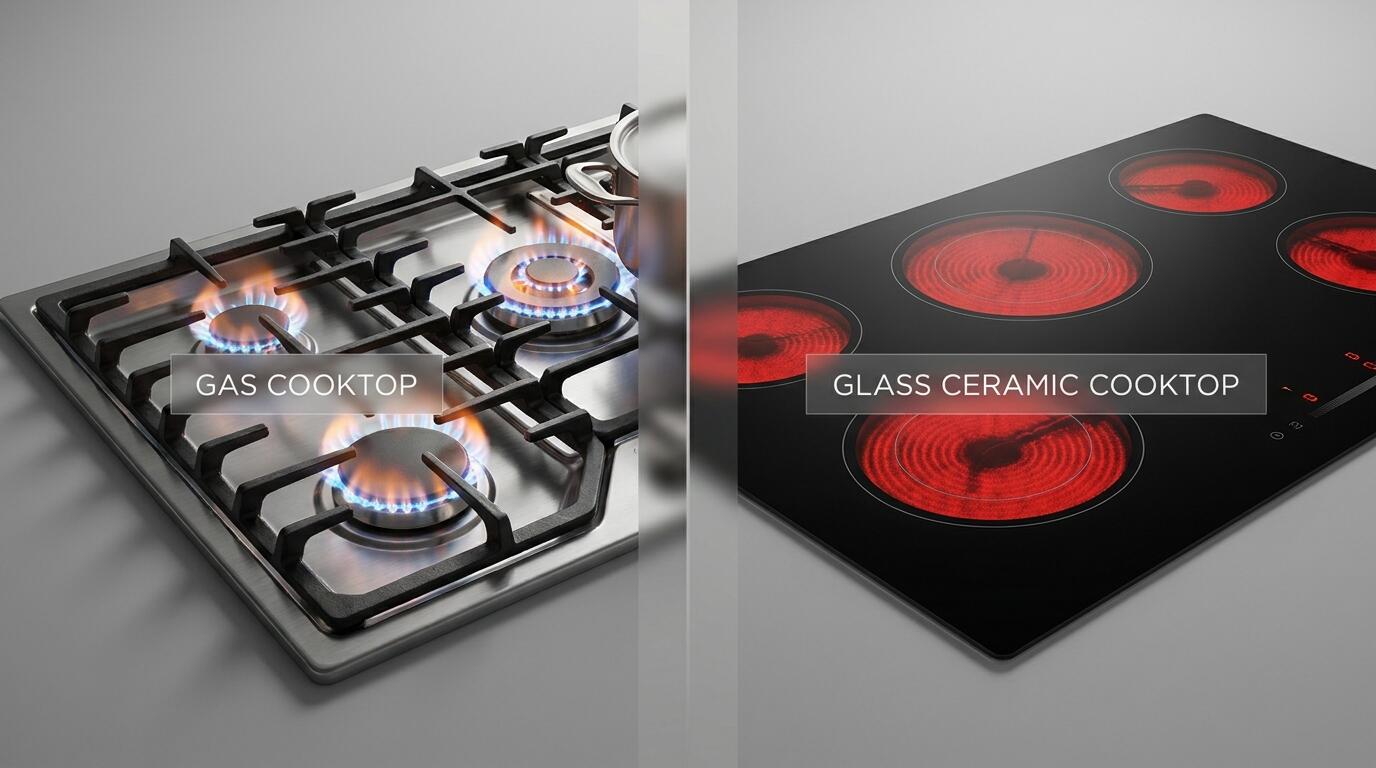
ALT: Open-flame gas burner cooktop versus glass ceramic electric cooktop sourcing comparison for B2B buyers
Open-Flame vs. Glass Ceramic Cooktops: Sourcing Criteria, Trade-offs, and the Right Choice for Your Market
Key Conclusion: Open-flame gas cooktops and glass ceramic electric cooktops represent fundamentally different manufacturing propositions, regulatory requirements, and end-user experiences. For B2B buyers and private-label brands, the sourcing decision hinges on target market gas infrastructure, applicable safety certifications, OEM customization depth, and consumer cooking culture. Neither technology universally outperforms the other — the right choice is determined by where the product sells, who buys it, and what brand experience you are building.
Procurement managers and product sourcing specialists evaluating cooktop categories for import or private-label programs frequently face a deceptively simple choice: open-flame (gas) or glass ceramic (electric radiant or induction-ready) surfaces. In practice, the distinction runs far deeper than aesthetics or cooking performance. It shapes tooling requirements, compliance pathways, logistics risk, warranty complexity, and the kind of consumer your product will serve. This comparison examines both cooktop types across the criteria that matter most to global B2B buyers, drawing on the kind of factory-floor and sourcing experience that only comes from working with international clients across multiple regulatory jurisdictions.
Why the Sourcing Criteria You Choose Define the Outcome
Selecting the right evaluation framework for cooktop sourcing is as important as evaluating the cooktops themselves. A comparison that only considers unit price will consistently mislead procurement decisions, because a lower-cost gas cooktop may carry substantially higher compliance and logistics costs in certain destination markets.
The criteria used in this comparison were chosen because each one directly affects landed cost, speed to market, and product viability in the buyer's target region:
Manufacturing complexity and customization flexibility matter because OEM and ODM clients typically need to differentiate on design, feature sets, and private-label branding. The two cooktop types involve fundamentally different manufacturing disciplines — gas valve engineering, burner casting, and flame-failure device integration on one side; glass-ceramic panel sourcing, electronic touch-control integration, and radiant element calibration on the other.
Regulatory compliance and certification burden is a decisive factor for any importer. Gas appliances face a distinct set of standards from electric appliances, and the applicable standards, testing protocols, and documentation requirements vary by destination country. Gaps in compliance preparation may delay market entry, with the actual impact depending on the scope of required modifications, testing procedures, and approval processes.
Supply chain and logistics risk reflects the reality that gas cooktops involve more mechanical components — burner caps, ignition electrodes, gas valves, thermocouples — each of which can become a quality or logistics bottleneck. Glass ceramic tops involve fragile panel materials with their own packaging and breakage risk profile.
Market fit and consumer demand determines whether a technically excellent product will actually sell. Market preferences for gas and glass ceramic electric cooktops vary by country and region. Factors such as residential gas availability, electricity infrastructure, local regulations, housing construction practices, energy costs, and consumer cooking preferences can all influence product demand. Buyers should evaluate these factors using market-specific data before selecting a product category.
After-sales serviceability affects return rates, warranty cost exposure, and retailer satisfaction — all of which ultimately influence the buyer's total cost of ownership, not just the purchase price.
Long-term scalability and innovation trajectory reflects where each technology is heading. Understanding the regulatory and infrastructure tailwinds or headwinds behind each type helps buyers make sourcing decisions that remain viable over multiple product generations.
The Contenders: Understanding Each Cooktop Type
Open-Flame Gas Cooktops
An open-flame gas cooktop is a surface cooking appliance that generates heat by combusting natural gas or liquefied petroleum gas (LPG) through one or more burners, producing direct radiant and convective heat that the cook controls in real time by adjusting fuel flow. Gas cooktops are defined by their mechanical nature: the burner assembly, gas valve, ignition system, and flame-failure safety device (thermocouple or flame-sensing electrode) are all discrete components that must be sourced, assembled, and tested as a system.
For B2B buyers, gas cooktops represent a mature product category with well-established supply chains, particularly in China, where a large ecosystem of component suppliers supports high-volume OEM production. Customization options are extensive: burner count, burner power ratings, grate material (cast iron vs. steel), surface material (tempered glass, stainless steel, enamel), and ignition type (battery ignition vs. mains-powered) can all be specified. The design language can range from professional-style heavy-duty configurations for the premium segment to compact two-burner units for the mid-market.
Open-flame gas cooktops remain an important product category in markets where residential gas infrastructure is widely available and consumers prefer gas-based cooking. However, demand varies across countries and customer segments. B2B buyers should assess local sales data, installation conditions, and consumer preferences before determining the appropriate product mix.
The principal sourcing challenge with gas cooktops is regulatory fragmentation. Gas cooktop compliance requirements vary by destination market, product type, and configuration. Before sourcing, buyers should identify the applicable local standards, conformity assessment procedures, certification or registration requirements, and installation rules for each target country. They should also verify that the relevant certification documents cover the exact product model, brand, and configuration being purchased. Managing simultaneous compliance across multiple destination markets requires careful coordination between the OEM factory and the buyer's compliance team. As detailed in a comprehensive guide to kitchen appliance safety certifications for North American importers, understanding which certifications apply to which product category is a prerequisite for avoiding costly delays.
Glass Ceramic Electric Cooktops
A glass ceramic electric cooktop uses a smooth, heat-resistant glass-ceramic surface panel installed above the heating system. The specific panel material and supplier may vary by product model and manufacturer. The smooth surface is both the aesthetic and the functional identity of the product: it communicates cleanliness, modernity, and ease of maintenance to the end consumer.
From a manufacturing perspective, glass ceramic cooktops divide into two distinct sub-types: radiant electric (which heats through resistance elements beneath the glass) and induction (which uses electromagnetic coils to generate heat directly in compatible cookware). Both share the glass ceramic panel and smooth-top aesthetic, but their internal engineering, component sourcing, and consumer requirements differ meaningfully. Induction models carry additional electronic complexity — the inverter board, coil assembly, and power management circuitry — which affects both unit cost and quality-control requirements.
For B2B buyers, glass ceramic cooktops are the preferred product in markets where new residential construction is predominantly electric, where consumers prioritize visual minimalism in kitchen design, and where regulatory trends are moving away from gas appliances in domestic settings. Northern Europe, Australia's urban markets, and an increasing share of North American premium residential construction fall into this category. Retail buyers and private-label brands in these regions frequently cite the glass ceramic surface as a primary driver of consumer purchase intent.
The sourcing complexity of glass ceramic cooktops is concentrated in panel supply and electronics. The glass ceramic panel itself is sourced from a small number of global material suppliers, which can create supply chain concentration risk. Electronic control boards require robust quality management, particularly for induction models where inverter reliability is a key warranty driver. At Hyxion, we see clients increasingly specifying smart connectivity features — Wi-Fi or app-based controls — in glass ceramic designs, which adds software qualification to the certification checklist.
Head-to-Head Comparison
| Criterion | Open-Flame Gas Cooktops | Glass Ceramic Radiant | Glass Ceramic Induction |
|---|---|---|---|
| Manufacturing complexity | Moderate — mechanical assembly dominant | Moderate — panel + element integration | High — electronics, coil, and inverter assembly |
| Component sourcing risk | Moderate — broad supplier base for mechanical parts | Moderate — panel supply concentration | Higher — panel + specialized electronics |
| OEM customization depth | High — burners, grates, finishes, power ratings | High — panel design, control interface, element config | High — coil config, smart controls, power levels |
| Examples of applicable standards and compliance requirements | Depend on the destination market, gas type, product configuration, applicable gas appliance standards, and local conformity assessment procedures. | Depend on the destination market, electrical specifications, applicable appliance safety standards, and local conformity assessment procedures. | Depend on the destination market, electrical specifications, induction-specific product requirements, and applicable conformity assessment procedures. |
| Compliance Considerations | Verify gas type, inlet pressure, burner configuration, applicable safety standards, and local installation requirements. | Verify rated voltage, frequency, power, electrical safety requirements, and applicable installation rules. | Verify rated voltage, frequency, power, electromagnetic compatibility requirements where applicable, and model-specific safety requirements. |
| Logistics and packaging risk | Moderate — robust mechanical components, glass surface variant | Higher — glass panel fragility in transit | Higher — glass panel fragility + electronics sensitivity |
| Relative OEM Cost | Depends on burner configuration, materials, ignition system, tooling, and order volume. | Depends on glass panel specifications, heating elements, control systems, tooling, and order volume. | Depends on glass panel specifications, inverter electronics, coil assemblies, control systems, and order volume. |
| Consumer cleaning/maintenance | Moderate — grates and burner caps require cleaning | Low — smooth wipe-clean surface | Low — smooth surface; induction-compatible cookware required |
| Warranty/after-sales complexity | Evaluate burner, ignition, gas valve, and control-component reliability, along with spare-parts availability. | Evaluate heating-element, control-system, and glass-panel reliability, along with replacement costs. | Evaluate inverter, coil, control-system, and glass-panel reliability, along with repair procedures and replacement costs. |
| Innovation trajectory | Stable — incremental improvements in efficiency | Growing — smart connectivity adoption accelerating | Strong — energy transition tailwinds, smart home integration |
The table above makes clear that no single cooktop type dominates across all sourcing criteria. Open-flame gas cooktops involve established mechanical designs and component supply chains that experienced OEM factories can handle with confidence. However, their regulatory requirements may vary significantly across destination markets, creating additional compliance coordination for multi-market importers. Glass ceramic radiant models present a balanced middle ground — broad regulatory alignment with international electrical standards and a consumer-friendly surface — while induction adds electronic complexity that demands tighter quality control but delivers the strongest alignment with current energy and smart-home trends.
A pattern consistently observed in multi-market sourcing programs is that buyers who attempt to rationalize their SKU count by selecting a single cooktop technology across all destination markets frequently encounter compliance mismatches. A gas cooktop approved for one national gas pressure standard may require re-testing or hardware modification for another. Conversely, a glass ceramic induction model targeting premium North American retail is often over-engineered and over-priced for mid-market Southeast Asian distribution. Market-specific sourcing — even within a shared OEM partnership — consistently yields better outcomes than a one-size-fits-all approach.
The packaging and logistics dimension deserves particular attention for glass ceramic products. The glass-ceramic panel, while engineered for thermal shock resistance in use, is vulnerable to mechanical impact during shipping. Buyers specifying glass ceramic tops should discuss corner-protection engineering, foam insert specifications, and drop-test protocols with their OEM partner before finalizing packaging design. This is a detail that experienced manufacturers address proactively; it is a signal of quality management maturity worth evaluating during factory audits.
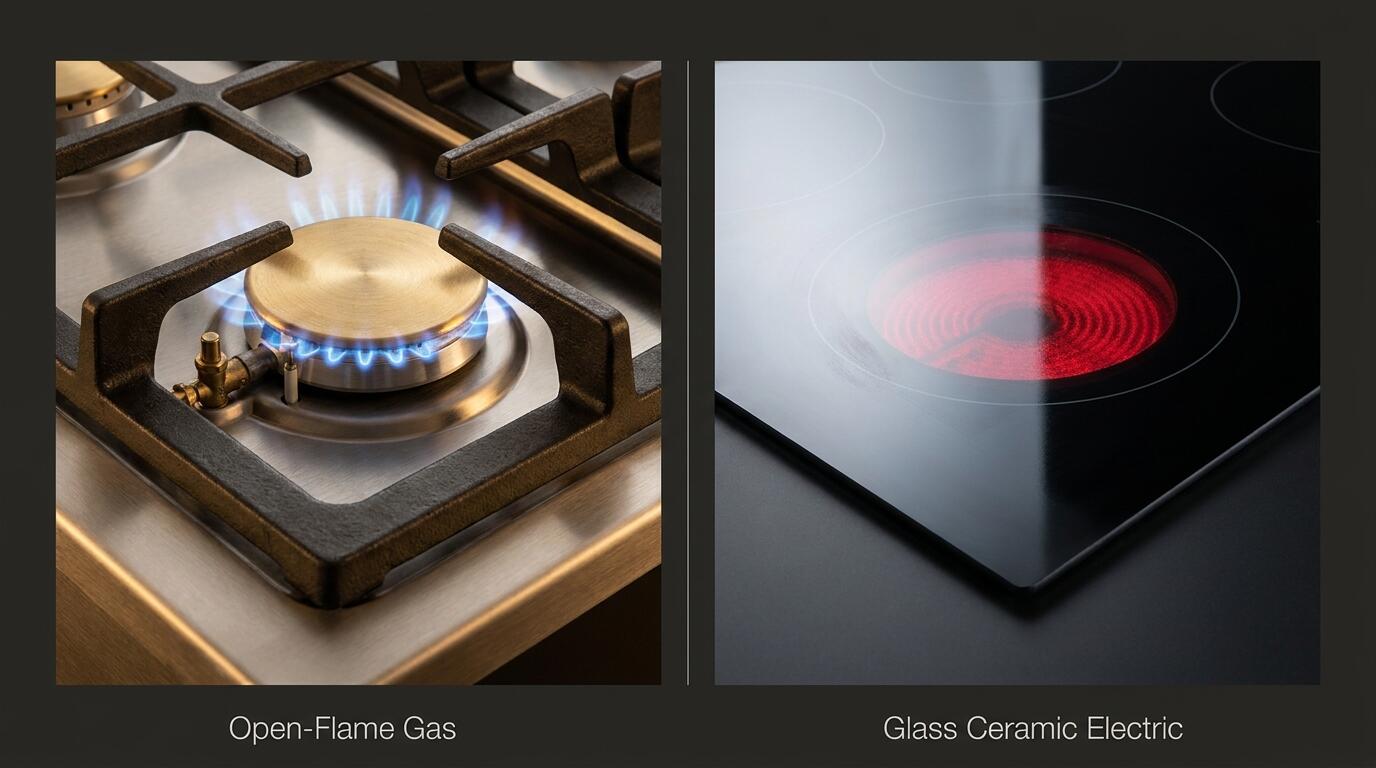
ALT: Side-by-side comparison of open-flame gas cooktop burners and smooth glass ceramic electric cooktop surface for sourcing evaluation
Which Should You Choose? Scenario Recommendations for B2B Buyers
Matching cooktop technology to market context is the core skill of an effective sourcing specialist. The following scenarios map real procurement situations to the most appropriate technology choice.
If your target market has established residential gas infrastructure and strong consumer demand for gas cooking, open-flame gas cooktops may be a suitable option. Before finalizing the product selection, evaluate local gas supply conditions, applicable safety standards, installation requirements, and customer preferences.The compliance ecosystem is mature, consumer demand is proven, and the OEM supply chain in China is deep and competitive. Focus your differentiation on burner power configuration, surface material, and ignition reliability.
For private-label programs targeting design-oriented retail segments, glass ceramic cooktops may be worth considering where consumers value smooth surfaces, modern aesthetics, and ease of cleaning. Buyers should compare radiant and induction models based on target customer preferences, electrical infrastructure, cookware compatibility, product specifications, and pricing requirements.
In markets where energy efficiency and environmental considerations influence purchasing decisions, buyers should compare gas, radiant electric, and induction cooktops using product-specific performance data. The evaluation should consider energy consumption, local electricity generation sources, operating conditions, and applicable energy-efficiency requirements. Induction cooktops heat compatible cookware through electromagnetic induction. Their energy performance should be evaluated using comparable test methods and operating conditions. Buyers comparing induction, radiant electric, and gas models should review product-specific efficiency data where available. Be prepared for a more intensive electronics qualification process and ensure your OEM partner has demonstrated induction-specific quality control capability.
If you are managing a multi-market import program and need to minimize the number of certification programs you run simultaneously, glass ceramic electric models are generally the more practical choice. Electrical appliance compliance requirements may share certain international standards, but the applicable standards, conformity assessment procedures, registration requirements, and documentation still vary by destination market. Buyers should evaluate the compliance scope and associated costs for each product and target country separately. For buyers weighing broader manufacturing partnership questions, understanding the difference between OEM and ODM models for kitchen appliances is an equally important step in structuring the right manufacturing relationship.
If unit cost is the primary constraint and you are serving a price-sensitive retail channel in a gas-infrastructure market, open-flame gas cooktops offer the most accessible entry point for private-label programs, with strong manufacturing capacity in China and a broad range of price-to-specification configurations.
Pros and cons summary:
- Open-flame gas:Offers direct flame-based cooking and flexible burner configurations. Buyers should evaluate gas compatibility, local compliance requirements, installation conditions, and component reliability.
- Glass ceramic radiant: Features a smooth cooking surface and electric heating elements beneath the panel. Buyers should assess heating performance, panel specifications, electrical requirements, and replacement costs.
- Glass ceramic induction: Uses electromagnetic induction and requires compatible cookware. Buyers should evaluate inverter and coil quality, electronic controls, cookware compatibility, and product-specific performance data.
Frequently Asked Questions FAQ
Q1: How do gas appliance certifications differ from electric cooktop certifications for export markets?
Gas and electric cooktops follow different compliance pathways depending on the destination market, product category, and model configuration. For gas cooktops, buyers should verify the applicable gas appliance standards, fuel type, pressure requirements, conformity assessment procedures, and local installation rules. For electric cooktops, the review should cover applicable electrical safety standards, rated voltage and frequency, product-specific requirements, and local compliance procedures. In both cases, buyers should confirm that the relevant documents cover the exact model, brand, and configuration being sourced.
Q2: Are glass ceramic induction cooktops compatible with all cookware sold in my target market?
Induction cooktops generally require cookware with a ferromagnetic base, such as cast iron or magnetic stainless steel. Aluminum and copper cookware may also be compatible when designed with a suitable magnetic base layer. Compatibility should be confirmed based on the cookware's base material, construction, and bottom dimensions, which must meet the cooktop manufacturer's specifications. A simple magnet test can help identify magnetic cookware, but buyers should also verify compatibility requirements for each specific cooktop model. In markets where cast iron and magnetic stainless steel are already the dominant cookware materials — much of Europe, for example — the transition is straightforward. In markets where non-magnetic aluminum cookware is prevalent, induction adoption may face more consumer resistance.
Q3: How does the choice between gas and glass ceramic affect lead times and tooling costs in OEM manufacturing?
Tooling costs and initial setup expenses for both gas and glass ceramic cooktops depend on existing factory molds, the scope of customization, and order volume. Utilizing standard platforms—such as existing burner assemblies, grates, glass panel dimensions, or control interfaces—can minimize upfront investment, whereas custom burner castings, bespoke panel cutouts, or specialized electronic and smart control programming will require additional tooling and engineering fees. OEM lead times for gas and glass ceramic electric cooktops depend on product specifications, tooling requirements, component availability, sample approval, testing scope, and destination-market compliance procedures. Gas models may require additional coordination around burner and gas-system configurations, while radiant and induction models may involve different panel, heating-element, or electronic development requirements. Buyers should establish project-specific timelines with the manufacturer and relevant testing or certification providers before confirming production schedules. Buyers managing the selection of an OEM/ODM kitchen appliance manufacturer should factor certification timelines explicitly into their project schedules.
Key Takeaways
Three conclusions consistently emerge from evaluating open-flame gas cooktops against glass ceramic electric alternatives through a rigorous B2B sourcing lens.
First, technology selection must follow market context, not manufacturing convenience. The cooktop type with the strongest cost profile at the factory level is not necessarily the right choice for a given destination market. Gas infrastructure, local consumer cooking habits, and applicable regulatory frameworks must be mapped before a sourcing decision is finalized.
Second, regulatory compliance should be considered early in cooktop sourcing projects. Gas and electric models may involve different standards, testing procedures, documentation, and installation requirements depending on the destination market. Buyers should assess these requirements before finalizing product specifications, pricing, and production schedules.
Third, glass ceramic induction cooktops require careful evaluation of electronic control systems, inverter design, coil assemblies, and cookware compatibility. Buyers should assess the manufacturer's engineering capabilities, component sourcing, and model-specific quality-control procedures before selecting an OEM partner.
The practical next step for any procurement manager or brand owner evaluating these categories is to align technology choice with a clearly defined target market profile, build certification timelines into project planning from day one, and select an OEM partner whose manufacturing capability matches the technical demands of the chosen product type.
Ready to source cooktops — gas, radiant, or induction — that are engineered for your target market and built to your brand specification? Explore Hyxion's full range of smart kitchen appliance manufacturing capabilities and request a custom quote by visiting the Hyxion smart kitchen website to connect with the team and start your sourcing partnership.
References
- International Electrotechnical Commission. "IEC 60335 — Household and Similar Electrical Appliances — Safety Standards".
https://www.iec.ch - CSA Group. "CSA and ANSI Standards for Gas and Electrical Appliances".
https://www.csagroup.org - Hyxion Smart Kitchen. "A 2026 Guide to Kitchen Appliance Safety Certifications for North American Importers".
https://www.hyxion.com/articles/a-2026-guide-to-kitchen-appliance-safety-certifications-for-north-american-impor - Hyxion Smart Kitchen. "OEM vs. ODM for Kitchen Appliances: Which Model Fits Your Brand in 2026?".
https://www.hyxion.com/articles/oem-vs-odm-for-kitchen-appliances-which-model-fits-your-brand-in-2026 - International Organization for Standardization. "ISO Standards for Consumer Products and Safety".
https://www.iso.org
Note: Standards may be updated; please check the latest official documents or consult professional advisors.