
How OPP Burner Technology Improves Precision Cooking Performance
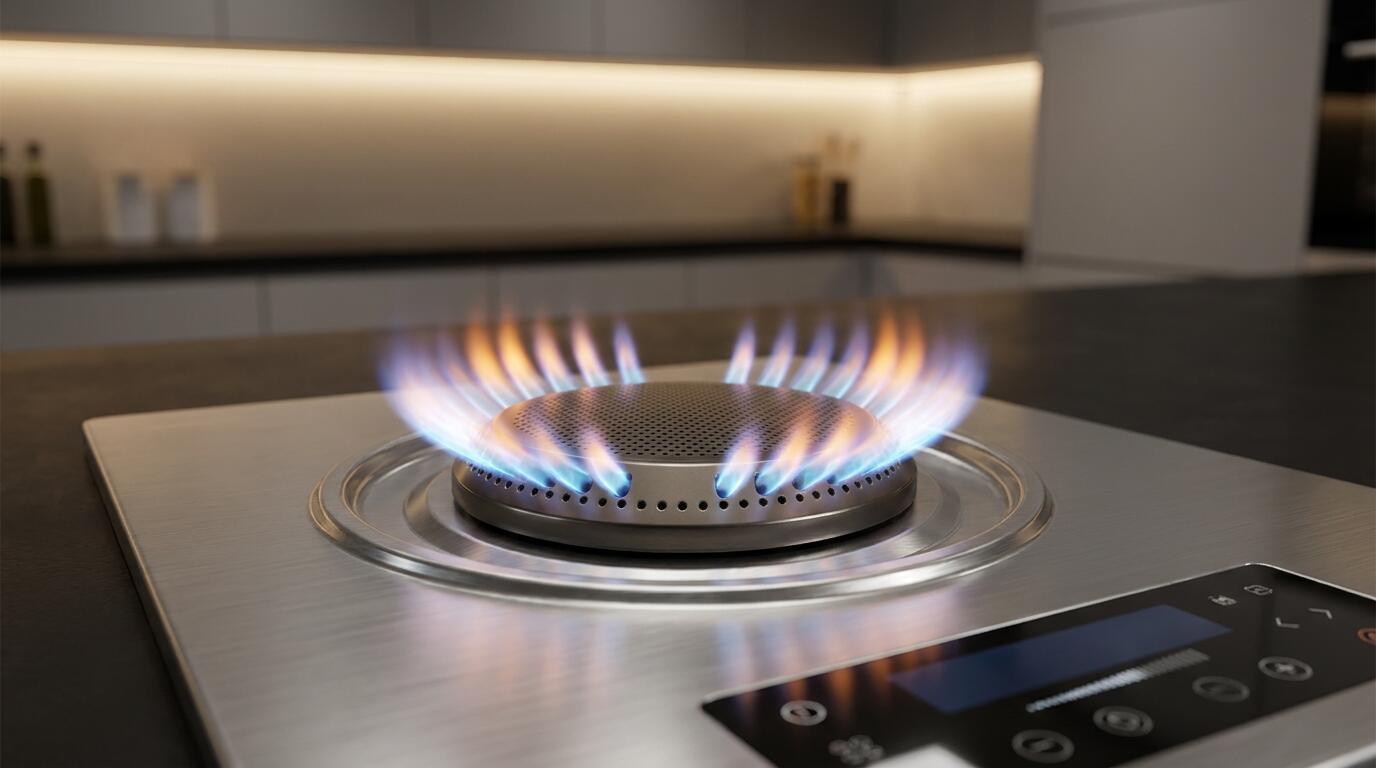
ALT: OPP burner technology delivering precision cooking performance in a smart kitchen appliance
Why OPP Burner Technology Is Redefining What Precision Cooking Means
OPP (Optimal Precision Performance) burner technology is designed to support precision cooking performance in gas cooking appliances. Its specific design characteristics and operating principles should be understood through the manufacturer's official technical documentation and product specifications. In this configuration, the positioning and geometry of the burner ports influence flame interaction and heat distribution. For buyers evaluating this technology, understanding the actual burner structure, operating characteristics, and product-specific test results is essential when assessing its suitability for different cooking applications. For anyone evaluating smart kitchen appliances from a sourcing or product development perspective, understanding how this technology works is no longer optional. Precision cooking performance has become a primary purchase driver in both the consumer and commercial segments, and the burner system sitting beneath a cooktop or range is the single most consequential factor in achieving it.
The global appetite for performance-grade kitchen appliances is growing steadily. Restaurant-quality cooking at home, the expansion of open-plan kitchens as lifestyle statements, and the rise of private-label brands entering the premium appliance category are all converging at once. In our work with OEM and ODM clients across North America, Europe, and the Asia-Pacific region, a pattern we consistently see is that burner architecture is the first technical criterion sophisticated buyers raise — not aesthetics, not brand heritage, but actual flame control. OPP burner technology is frequently at the center of that conversation, and this article explains why.
The State of Burner Engineering: From Single-Ring Flames to Opposed Port Design
Traditional gas burner design for kitchen appliances evolved gradually from simple single-ring configurations, where gas exits through a single circular row of ports and ignites into a ring of flame. While functional, the classic ring burner has an inherent limitation: uneven heat distribution across the bottom of a cooking vessel, with the area directly above the ports receiving more heat than the spaces between them. This "hot spot and cool spot" pattern is acceptable for basic cooking tasks but becomes a liability when precision matters — think simmering a beurre blanc, melting chocolate without scorching, or holding a braising liquid at an exact temperature for an extended time.
Optimal Precision Performance (OPP) burner technology represents an approach to improving cooking precision through burner design. When evaluating this technology, buyers should focus on the manufacturer's documented burner configuration, flame characteristics, heat distribution, and operating performance. The defining characteristic of an OPP burner is the deliberate placement of gas outlet ports in opposing pairs or groups, so that two flame jets face each other rather than projecting outward unchallenged. This port arrangement influences flame interaction and heat distribution around the burner. The actual flame pattern and combustion characteristics depend on the burner geometry, gas flow, and operating conditions, and should be evaluated through manufacturer documentation and product-specific testing.
As manufacturers explore different approaches to improving burner performance, alternative port configurations have become one area of engineering consideration in the premium cooktop and range segments. For OEM/ODM buyers, evaluating these designs involves examining their flame characteristics, heat distribution, manufacturing requirements, and suitability for the intended product positioning.
From a regulatory and certification perspective, burner design also intersects with safety standards. In North America, gas cooking appliances must meet the applicable product safety requirements for their intended use and destination market. Relevant standards establish technical requirements, while organizations such as CSA Group provide testing and product certification services. Buyers should confirm the applicable standard, certification scope, and required documentation for the specific appliance model before making sourcing decisions. Burner port geometry and flame interaction can influence combustion behavior, but actual emissions performance depends on the complete burner design, air-to-gas ratio, operating pressure, and appliance configuration. Buyers evaluating OPP burner technology should review product-specific combustion test results rather than assuming that a particular port arrangement automatically delivers lower emissions. For procurement teams working through that compliance landscape, resources like a 2026 guide to kitchen appliance safety certifications for North American importers provide useful context on what those standards require at the product level.
How OPP Burner Technology Actually Works: A Mechanism-Level Analysis
OPP burner technology can be evaluated through three key performance areas: flame distribution, turndown ratio, and resistance to airflow disturbances. These characteristics may influence cooking performance through their effects on heat distribution, low-fire operation, and flame stability. Their actual performance should be verified through product-specific testing under defined operating conditions. These three design characteristics may influence cooking performance through their effects on flame distribution, low-fire operation, and resistance to airflow disturbances. Their actual impact should be evaluated through product-specific testing under defined operating conditions.
Flame Uniformity Through Opposition
The core design feature of an opposed-port burner is the arrangement of gas outlet ports in opposing pairs or groups. In a conventional burner, each flame port operates somewhat independently — the flame burns in the direction the gas exits and is shaped primarily by the port geometry and the ambient airflow. In an opposed-port configuration, pairs of ports are aligned so that their flames interact. The interaction between adjacent flame jets may influence the overall flame shape and heat distribution around the burner.
Heat distribution is an important factor in evaluating burner performance. Buyers should assess temperature consistency across the cookware base through controlled testing under defined operating conditions. Thermal imaging and comparative heat-distribution measurements can provide useful evidence when evaluating different burner configurations.
Turndown Ratio and Simmer Capability
The turndown ratio of a burner is the ratio between its maximum heat output and the minimum stable heat output it can sustain without the flame extinguishing or becoming erratic. A high turndown ratio is what makes the difference between a burner that can truly simmer — holding gentle, bubbling heat below the boiling point without risk of scorching — and one that simply operates at "low" but remains too powerful for delicate applications.
A burner's turndown ratio depends on its maximum rated heat input and minimum stable operating input. Opposed-port geometry may influence flame stability at reduced gas flow rates, but the achievable turndown ratio also depends on the burner design, gas valve, injector configuration, and operating pressure. Buyers should request the specified minimum stable input and supporting test results when evaluating low-heat cooking performance.
Wind Resistance and Real-World Stability
A precision burner that performs well only under laboratory conditions offers limited value. Real cooking environments involve ventilation hoods creating downdrafts, open windows, and the movement of people and equipment around the cooking surface. Wind resistance in burner technology refers to the burner's ability to maintain stable, uniform combustion when subjected to these ambient airflow disturbances.
Combustion Efficiency and Emissions
Combustion efficiency and emissions are important considerations when evaluating gas burner performance. Factors such as burner port geometry, air-to-gas ratio, gas pressure, and combustion conditions can influence heat transfer and emissions characteristics. For buyers comparing OPP and conventional burner designs, product-specific testing of thermal performance, carbon monoxide (CO), and nitrogen oxides (NOx) provides a more reliable basis for evaluating efficiency and emissions performance. Any claims regarding emissions improvements or regulatory compliance should be supported by applicable test reports and market-specific requirements.
Comparing Burner Architectures: OPP Against Conventional Designs
Understanding where OPP burner technology fits relative to other burner designs helps buyers and sourcing professionals make informed specification decisions. The table below frames the key perspectives in a comparative format. The following comparison outlines common burner configurations and their design considerations. Actual cooking performance varies by product model, burner specifications, and operating conditions. Buyers should evaluate heat distribution, minimum stable heat input, flame stability, and response characteristics using product-specific technical data and test results.
| Perspective / Approach | Strengths | Trade-offs | Best Fit |
|---|---|---|---|
| Single-Ring Conventional Burner | Simple, low-cost manufacturing; proven reliability; easy service and replacement | Low-heat performance depends on the model's minimum stable input and flame stability | Entry-level and budget-tier appliances; cost-sensitive markets |
| Dual-Ring (Inner + Outer) Burner | Higher maximum BTU output; some improvement in flame spread; straightforward design | Simmer control performance varies by model and should be evaluated based on minimum stable input and control response | Mid-range appliances; applications prioritizing high-heat output |
| OPP (Optimal Precision Performance) Burner | Opposed-port geometry designed to influence flame distribution, with performance metrics requiring validation through low-flame stability and airflow testing. | More demanding burner port geometry and manufacturing tolerances; actual performance depends on design validation and production consistency. | Product development projects evaluating alternative burner configurations for premium or performance-oriented gas cooking appliances. |
| Sealed Burner with Simmer Plate | Excellent for self-cleaning surface maintenance; moderate simmer improvement | Simmer plate adds thermal mass, slowing response time; not ideal for rapid heat adjustment | Consumers prioritizing easy cleaning over fine control |
For OEM/ODM buyers, maximum BTU output is only one factor in burner evaluation. Other considerations include heat distribution, minimum stable heat input, flame stability, control response, and suitability for the intended cooking applications. Buyers should compare these characteristics using model-specific technical specifications and product testing rather than relying on general assumptions about burner architecture. Evaluating these characteristics together provides a more complete basis for defining burner specifications than relying on maximum heat output alone. For OEM/ODM buyers, maximum BTU output is only one factor in burner evaluation. Other important considerations include heat distribution, minimum stable heat input, flame behavior, and suitability for the intended cooking applications. Evaluating these characteristics together provides a more comprehensive basis for defining burner specifications.
For procurement professionals evaluating manufacturing partners, burner specification is best evaluated alongside the full range design. Resources covering how gas and electric range options compare from a sourcing perspective can help frame the broader product strategy before narrowing to component-level decisions like burner architecture.
The Outlook for OPP Burner Technology and What It Means for Buyers
OPP burner technology represents one of the design approaches being explored to improve flame control and cooking precision in gas cooking appliances. For manufacturers developing premium product lines, alternative burner architectures may offer opportunities to differentiate product specifications, provided that the expected performance is supported by engineering validation. Several converging forces are reinforcing its adoption and expanding its relevance for B2B buyers.
Interest in more precise heat control and versatile cooking performance is an important consideration in the premium kitchen appliance segment. Culinary content, cooking education, and evolving product preferences may influence how consumers evaluate burner performance, making flame control and low-heat stability relevant factors in product development. For private-label brands entering the mid-to-premium segment, burner architecture can provide a technical basis for product differentiation. Any positioning around precise heat control should be supported by product specifications, engineering documentation, and relevant performance test results.
Environmental and product safety requirements vary across destination markets and appliance categories. Buyers sourcing gas cooking appliances for California, other U.S. states, or European markets should identify the specific emissions, product safety, and installation requirements applicable to their product models and intended applications.
Although burner design can influence combustion characteristics, no particular port configuration should be assumed to guarantee compliance with current or future emissions requirements. Manufacturers should provide relevant product-specific test reports and documentation to support any emissions-related performance claims.
OPP burner designs may require careful control of port placement, burner cap geometry, and other critical dimensions. For OEM/ODM buyers, evaluating a manufacturer's production capability should include reviewing relevant process controls, dimensional inspection procedures, sample validation results, and batch-level quality records. These checks help determine whether the manufacturer can maintain the required product specifications during volume production. When evaluating a manufacturing partner for OPP burner production, buyers should review the inspection criteria for burner port dimensions, burner cap fit, material specifications, and flame performance. They should also confirm which in-process checks are applied to the relevant model and what inspection records can be provided for sample approval and production batches— a consideration addressed directly in a buyer's checklist for choosing an OEM/ODM kitchen appliance manufacturer.
Integrating OPP burner technology during the ODM design stage allows the burner configuration to be considered alongside the burner box geometry, grate design, and ignition system layout. Compared with retrofitting an existing platform, this approach may reduce the need for certain structural modifications. However, the overall development cost and unit economics should be evaluated based on tooling requirements, production volume, component sourcing, and the scope of customization.
For brands targeting performance-oriented kitchen appliance segments, OPP burner technology may be worth evaluating as one of the available burner design options. Buyers should compare its tested performance, development requirements, and cost implications against alternative burner configurations before including it in the final product specification. Request factory samples, review port geometry specifications, and test simmer stability as part of your supplier qualification process. The difference between an OPP burner that performs as specified and one that merely claims to is measurable in flame consistency tests that any qualified engineering team can conduct.
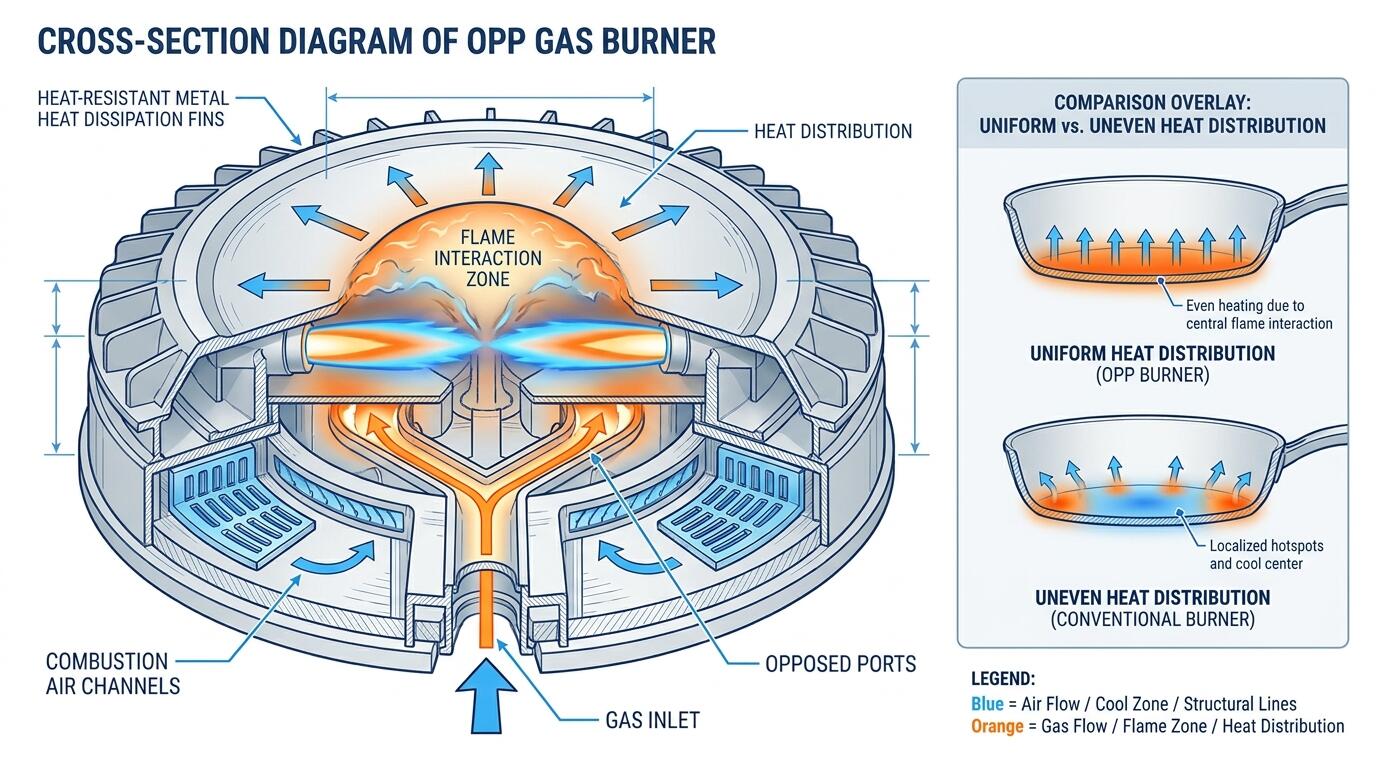
ALT: Cross-section diagram of OPP burner technology showing opposed port flame pattern for uniform precision cooking performance in smart kitchen ranges
Frequently Asked Questions FAQ
Q1: How does OPP burner technology differ from a standard gas burner in terms of daily cooking performance?
OPP (Optimal Precision Performance) burner technology is designed to support precision cooking performance. Its actual performance depends on the specific burner design, heat distribution, flame stability, and minimum stable heat output. Buyers should review manufacturer documentation and product-specific test results when evaluating its suitability for different cooking applications. Compared with conventional burner configurations, this design may affect flame distribution and low-heat operating characteristics.
For buyers evaluating daily cooking performance, the key factors include heat distribution across the cookware base, minimum stable heat output, and flame stability at different operating levels. Product-specific testing is recommended to determine how these characteristics translate into actual cooking results.
Q2: Are OPP burners compatible with all types of cookware commonly used in home kitchens?
OPP burner compatibility depends on the burner design, cooktop grate configuration, and cookware specifications. Common cookware materials such as stainless steel, cast iron, and carbon steel may be suitable when their dimensions, base shapes, and weight are compatible with the appliance.
Buyers should check the manufacturer's cookware compatibility guidance, including recommended pan diameter, base stability, and grate support requirements. Cookware with warped, highly curved, or otherwise unsuitable bases may not perform as intended.
Q3: What does integrating OPP burner technology into a private-label product typically involve from a sourcing timeline perspective?
Integrating OPP burner technology into an ODM or OEM product depends on the availability of an existing burner platform, the required customization scope, and the validation work needed for the target appliance.
For an existing platform, buyers should confirm which burner specifications, product configurations, and components have already been validated. Changes to burner geometry, gas input, ignition systems, or surrounding appliance structures may require additional engineering review and testing.
For a new design, the project may involve burner concept development, engineering drawings, prototype fabrication, sample evaluation, and product validation. Buyers should discuss these milestones with the manufacturer and establish a project-specific schedule based on the actual development and testing requirements rather than assuming a fixed time saving from using an existing platform.
Final Thoughts
OPP burner technology represents an alternative burner design approach for manufacturers exploring flame control and cooking precision. Its suitability for a specific appliance depends on the burner configuration, validated performance characteristics, manufacturing requirements, and applicable market regulations. For OEM/ODM buyers, these factors should be evaluated together when considering the technology for a new product line.
Key Takeaways:
- OPP (Optimal Precision Performance) burner technology is designed to support precision cooking. Its actual performance characteristics should be evaluated through manufacturer documentation, engineering specifications, and product-specific testing. Its performance should be evaluated against conventional burner designs through product-specific testing.
- The turndown ratio is an important burner performance metric. When evaluating OPP designs, buyers should compare the maximum rated heat input, minimum stable operating input, and flame stability across different gas flow conditions.
- Combustion characteristics and emissions performance should be assessed through product-specific testing. Buyers should verify CO and NOx results, where applicable, against the relevant regulatory requirements for their destination markets.
- OPP burner performance depends in part on manufacturing precision, including port geometry and burner cap dimensions. Buyers should review dimensional inspection criteria, sample validation results, and production quality records to assess manufacturing consistency across batches.
- For private-label brands and OEM/ODM buyers, evaluating burner architecture during the initial design stage helps align product requirements with the cooktop structure, ignition system, and manufacturing process. The actual performance and cost implications should be assessed based on the proposed design, tooling scope, and production volume.
The clearest next step for procurement teams and product development managers is to include burner architecture as a primary specification criterion in supplier qualification, request engineering samples for simmer stability testing, and engage manufacturing partners who can demonstrate OPP burner experience across validated product platforms.
Planning to develop a gas cooking appliance with OPP burner technology? Visit Hyxion's official website to explore its kitchen appliance manufacturing capabilities and discuss your product specifications, burner design requirements, and customization needs with the team. You can request relevant technical documentation and product information to evaluate the suitability of a potential OEM/ODM partnership. Visit Hyxion's official website to explore product lines, request a custom quote, or connect with the team to start your next sourcing partnership.
References & Further Reading
- American National Standards Institute (ANSI). "Standards for Gas Appliances and Combustion Performance".
https://www.ansi.org/ - CSA Group. "Certification Standards for Gas-Fired Cooking Appliances".
https://www.csagroup.org/ - U.S. Environmental Protection Agency (EPA). "Indoor Air Quality and Combustion Appliance Emissions Guidance".
https://www.epa.gov/
Note: Standards may be updated; please check the latest official documents or consult professional advisors.