How Customized-to-Drawing Manufacturing Works for Private-Label Ranges and Ovens

ALT: Private-label range and oven customized-to-drawing OEM/ODM manufacturing process at a smart kitchen factory
What Is Customized-to-Drawing Manufacturing — and Why Does It Matter for Private-Label Ranges and Ovens?
Customized-to-drawing manufacturing is a production approach in which a buyer supplies detailed engineering drawings, design specifications, or concept files, and the OEM/ODM factory builds the product exactly to those parameters rather than from a pre-existing template. For private-label brands entering the kitchen appliance market, this model is the clearest path from a unique product idea to a finished, shelf-ready range or oven that carries your brand identity rather than a generic manufacturer's design.
The question we hear most often from procurement managers and sourcing specialists is straightforward: "If I have a design in mind — or even just a rough concept — how does the factory actually turn that into a real product?" This article answers that question end-to-end. Each section below covers one stage of the customized-to-drawing journey, explaining what happens, why it matters, and what buyers should watch for. The stages were selected based on the consistent patterns we observe working with global importers, distributors, and private-label brands that are either launching their first custom product line or scaling an existing one.
A word on terminology before we begin: "OEM" (Original Equipment Manufacturer) means the factory builds to your specification and you apply your brand. "ODM" (Original Design Manufacturer) means the factory has a base design that you can modify. Customized-to-drawing sits at the OEM end of the spectrum and can be blended with ODM where a buyer starts from a factory platform and significantly modifies it.
The Seven Stages of Customized-to-Drawing Manufacturing for Ranges and Ovens
Technical Drawing Submission and Design Intent Alignment
The process begins the moment a buyer submits engineering drawings, CAD files, or detailed specification sheets to the manufacturing partner. These documents are the legal and technical contract between buyer and factory — they define dimensions, material grades, surface finishes, control system requirements, and any brand-specific visual elements. At Hyxion, our engineering team reviews submitted drawings for manufacturability within a short review window after submission, with the exact timeframe depending on drawing completeness and current engineering queue, checking that tolerances, material selections, and functional requirements can be achieved on current production lines.
Design intent alignment is a critical sub-step that many first-time buyers underestimate. Even a well-prepared drawing can contain ambiguities — a finish described as "brushed stainless" without a surface roughness rating, or a burner layout that conflicts with gas valve placement. We flag these gaps early in a formal design review meeting so they are resolved before any tooling cost is committed.
Best for: Buyers who already have a defined product concept, existing product data sheets from a previous supplier, or a design team that has prepared CAD files ready for manufacturing review.
Watch out: Submitting incomplete or inconsistent drawings accelerates into the next stage without proper review can cause costly tooling revisions later. Invest in complete, toleranced drawings before submission.
Material and Component Specification Confirmation
Once drawings are approved, the factory locks in the bill of materials (BOM) — a comprehensive list of every material, sub-component, and purchased part that will go into the product. For ranges and ovens, this includes the grade of stainless steel for the cavity and exterior panels, the type of glass for oven doors, the burner casting specification, control board architecture, and sealing materials for energy efficiency. (Specific material grades and components available depend on Hyxion's current product platforms and should be confirmed with the technical team.)
A pattern we consistently see is buyers focusing heavily on visible aesthetics while underspecifying hidden structural components. The internal cavity liner, insulation type, and wiring harness specification matter enormously for safety certification compliance and long-term product reliability. At this stage, we present buyers with material options alongside their relevant certification implications — for example, whether a specific insulation material is compatible with UL or CE testing requirements. Understanding how certifications intersect with material choices early is essential; resources like our guide on CSA and UL certification and in-house testing lab efficiency can help buyers prepare for this conversation before the BOM review meeting.
Important: Material substitutions or design modifications should be reviewed before implementation to determine whether they affect existing certifications. Depending on the nature and scope of the changes, the certification body may require additional documentation, component testing, partial retesting, or full product retesting. Always consult the relevant certification body before implementing changes that could affect product compliance.
Best for: Buyers sourcing materials and components for products intended for the Australian market, where material specifications must align with applicable Australian and New Zealand standards and regulatory requirements. Depending on the product category and EESS risk classification, compliance may involve product testing, certification, Responsible Supplier registration, equipment registration, and applicable RCM marking requirements. Buyers should verify the specific requirements for their product with the relevant certification body and Australian regulatory authorities rather than rely on a general SAA compliance claim. (Note: Specific standards apply depending on product model, configuration, and target market. Buyers should verify the exact certifications required for their intended product with the manufacturer and relevant certification bodies.)
Watch out: Substituting a specified material with a "similar" alternative to reduce cost can invalidate pre-approved certification test reports. No material substitution should be assumed to retain certification. Whether full or partial re-testing is needed depends on the change scope (e.g., insulation, wiring, structural load paths) and the certifier’s rules. A formal change-impact review is required before production.
Tooling Design and Prototype Mold Production
For products with custom-shaped panels, control bezels, door handles, or decorative trim, new tooling — typically metal stamping dies or injection molds — must be designed and fabricated. Tooling is the physical infrastructure that makes mass production possible, and it represents a one-time investment that amortizes over the production run.
The tooling design stage converts the buyer's drawings into manufacturing-ready tool designs. Our tooling engineers review part geometry for draft angles, wall thickness uniformity, and parting line placement, then produce tooling drawings for buyer approval before cutting the first mold. Lead times for tooling vary based on complexity; simple stamped sheet-metal panels are faster than multi-cavity plastic injection molds for control panels with integrated LED displays.
Buyers should understand that tooling ownership is not automatic upon payment alone. The buyer typically acquires defined tooling assets after full payment only where the tooling agreement expressly covers: which physical tools and fixtures are transferred, whether editable CAD/tool drawings are included, permitted use, storage, maintenance, modification rights, and end-of-program return. Until those terms are signed, the factory may retain possession and certain residual rights
Best for: Brands developing a visually distinctive product line where off-the-shelf panel shapes or handle profiles would undermine brand differentiation.
Watch out: Rushing tooling approval to meet a launch deadline without thorough dimensional verification of first-article parts is one of the most common causes of expensive retooling. Approve first articles carefully.
Engineering Sample Production (First Article Inspection)
An engineering sample — sometimes called a first article — is the first physical unit built using production-intent tooling and specified materials. It is not a hand-built mockup; it is a production prototype that validates whether the manufacturing process can consistently produce the product to drawing. First article inspection (FAI) is the systematic process of measuring and testing every critical dimension and functional characteristic against the approved drawing.
At Hyxion, FAI reports document dimensional checks, fit and function tests, electrical safety checks, and cosmetic inspection against agreed acceptance criteria. We share the full FAI report with the buyer before approving production. If deviations from drawing are found — a panel gap that exceeds tolerance, a door hinge that requires more insertion force than specified — we correct the tooling or process before proceeding.
For buyers unfamiliar with the process, the rapid sample production workflow provides a practical overview of how sample timelines are structured and what to expect at each checkpoint.
Best for: All custom programs, without exception. First article inspection is non-negotiable for private-label products that will carry your brand name in the market.
Watch out: Approving an engineering sample based on photos alone is insufficient. Whenever feasible, arrange for physical sample delivery or on-site inspection at the factory before sign-off.
Pre-Production and Process Validation
Pre-production is a short production run — typically a few dozen units — that validates the full manufacturing process under real production conditions. It differs from first article production in scale and purpose: where FAI checks the product, pre-production validates the process. Can the line produce consistent output at speed? Are yield rates acceptable? Are assembly sequences efficient and repeatable?
During pre-production runs at Hyxion, process engineers monitor critical control points — weld quality on cavity seams, adhesive cure times, circuit board solder joint quality, and final assembly torque values on critical fasteners. Any process instability identified at this stage is corrected before full production is released. Buyers are welcome to send a third-party quality inspector or visit the factory during pre-production runs; we actively encourage it because on-site verification builds the kind of trust that underpins a long-term supply relationship.
Best for: Buyers placing their first order with a new manufacturing partner, or introducing a significantly redesigned product where process risks are higher than in a mature product line.
Watch out: Skipping pre-production to save time and cost on small initial orders is a risk that frequently materializes as quality inconsistencies in the first full production batch. The cost of a pre-production run is small relative to the cost of a field quality issue.
Certification Testing and Market Compliance
Customized-to-drawing products built to a buyer's specification must pass the safety and regulatory certifications required in their target markets before they can be sold. For kitchen ranges and ovens, this typically means electrical safety standards (UL 858 for household electric ranges in the United States, EN 60335 series for Europe), gas appliance standards (ANSI Z21.1 for the US, EN 30 series for Europe), and energy efficiency standards where applicable. (Note: Specific standards apply depending on product model, configuration, and target market. Buyers should verify the exact certifications required for their intended product with the manufacturer and relevant certification bodies.)
Certification testing is conducted either by the manufacturer's in-house test laboratory (where accredited) or by an independent third-party test laboratory such as UL, CSA Group, TÜV Rheinland, or SGS. At Hyxion, our in-house testing capability allows us to conduct pre-compliance screening before formal third-party submission, which significantly reduces the risk of test failures and shortens the overall certification timeline. The critical point for private-label buyers is that certification is obtained in the product's configuration as built — if you change a component after certification, the certificate may no longer apply.
Best for: Any buyer selling into regulated markets, which in practice means any buyer selling ranges or ovens in North America, Europe, Australia, or other markets with established appliance safety regulations.
Watch out: Certification timelines are often longer than buyers anticipate, particularly for products entering the US market simultaneously through multiple certification schemes. Build certification lead time into your product launch schedule from the outset.
Mass Production, Quality Control, and Shipment
Mass production is the stage at which the validated product is manufactured at full volume. Effective quality control during mass production relies on the inspection plans, process control parameters, and acceptance criteria established in the earlier stages — it is not an independent activity but the culmination of everything that preceded it.
At Hyxion, in-line quality checks occur at multiple stations throughout the production process rather than only at final inspection. This approach catches defects early, when correction is least costly. Pre-shipment inspection — typically conducted on a statistical sampling basis using internationally recognized acceptance quality level (AQL) standards — provides buyers with documented evidence of product conformance before containers are loaded. For importers sourcing smart kitchen appliances at scale, understanding how to structure a sourcing relationship before this stage is covered in depth in our OEM/ODM kitchen appliance manufacturer selection guide, which walks through the full supplier evaluation framework.
Best for: All production orders. The rigor applied to mass production quality control should be proportional to the volume, market value, and regulatory risk of the product.
Watch out: Assuming that approved samples guarantee consistent mass production quality without ongoing monitoring is a common and costly misconception. Sampling inspection and periodic process audits are essential throughout a production program.
Quick Comparison at a Glance
| Stage | Best For | Key Strength | Limitation |
|---|---|---|---|
| Technical Drawing Submission | Buyers with defined product designs | Establishes unambiguous product specification | Requires complete, toleranced drawings to be effective |
| Material & Component Specification | Buyers targeting regulated markets | Aligns material selection with certification strategy | Material substitutions require certification review and may require additional testing, depending on their impact on product compliance. |
| Tooling Design & Mold Production | Brands needing visual differentiation | Enables unique, brand-specific product geometry | One-time tooling investment; revisions add cost and time |
| Engineering Sample / FAI | All custom programs | Validates product against drawing before mass production | Photo-only sample approval is insufficient |
| Pre-Production Validation | First-time buyers or redesigned products | Validates process consistency before full volume | Skipping it risks quality inconsistencies in first batch |
| Certification Testing | Any regulated market | Formal proof of safety and compliance | Timeline longer than many buyers anticipate |
| Mass Production & QC | All production orders | Converts validated design into consistent, shippable product | Requires ongoing monitoring; approved samples don't guarantee batch consistency |
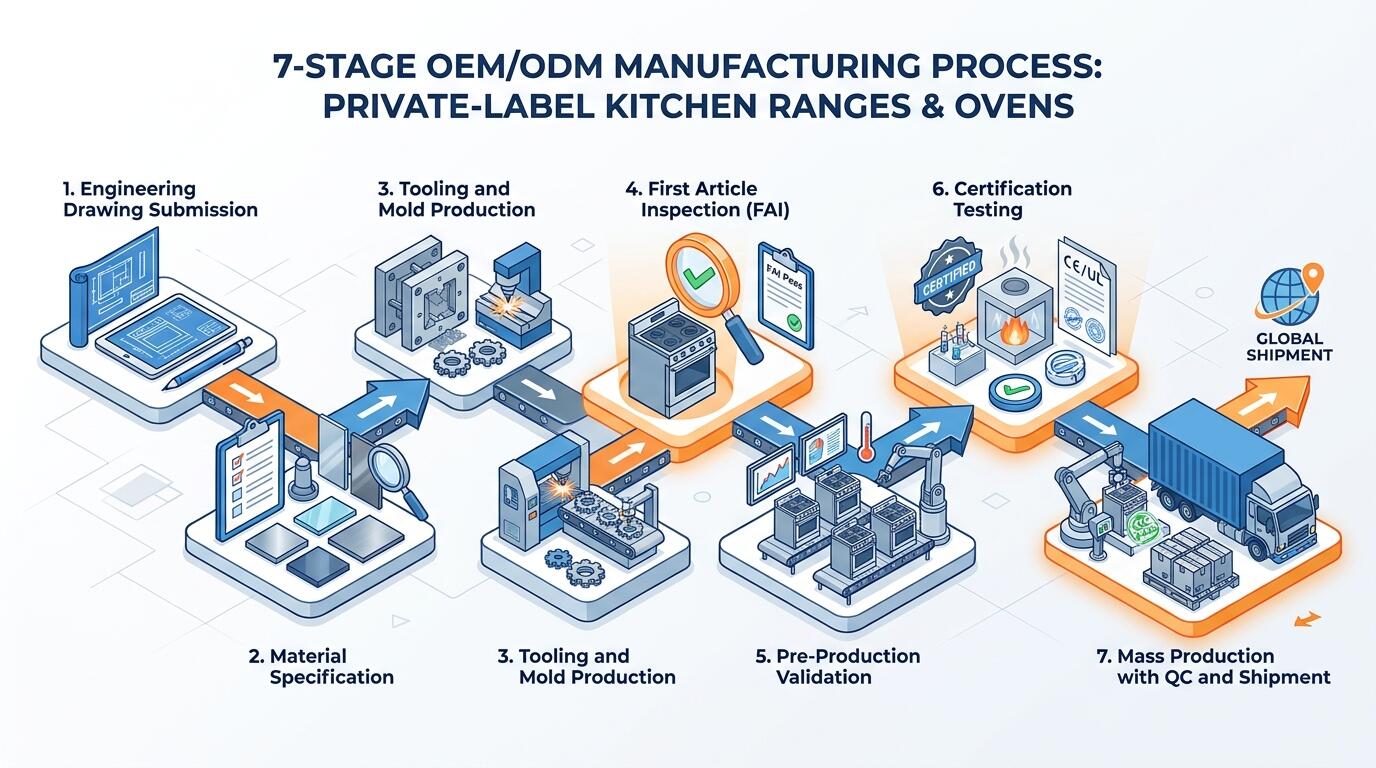
ALT: Step-by-step diagram of private-label OEM oven and range manufacturing from engineering drawing submission through certification testing to mass production shipment and quality control
How to Choose the Right Starting Point for Your Custom Range or Oven Program
The right entry point into the customized-to-drawing process depends on where your product concept currently stands. Buyers in different situations face different challenges, and the following guidance maps common buyer scenarios to the most appropriate approach.
If you have fully developed engineering drawings and a clear certification target market, you are ready to enter at Stage 1 — technical drawing submission — and can expect the fastest path to production because the key decisions have already been made. Engage the factory's engineering team early to conduct a manufacturability review before committing to tooling.
If you have a strong design concept but no engineering drawings, the most efficient approach is to work with the factory's ODM team to identify a base platform closest to your vision, then apply drawing-level customization to the panels, controls, and brand elements. This hybrid approach reduces tooling scope and development cost while still producing a genuinely differentiated product.
If you are sourcing a custom product for the first time and are uncertain about certification requirements in your target market, prioritize selecting a manufacturing partner with demonstrated in-house testing capability and experience with your target market's regulatory bodies. Attempting to manage certification independently for a first custom program significantly increases both timeline and risk.
A common misconception worth addressing directly: many buyers assume that "customized to drawing" means the factory will accept any drawing and produce it exactly as submitted, without any engineering input. In practice, the most successful custom programs are collaborative — the buyer provides design intent and market requirements, and the factory contributes manufacturing expertise, material knowledge, and certification experience. Treating the factory as a pure execution vendor rather than a development partner consistently produces worse outcomes than a genuinely collaborative engagement.
People Also Ask
Q1: How long does the customized-to-drawing process typically take for a private-label range or oven?
The timeline from drawing submission to first production shipment depends on product complexity, tooling scope, certification requirements, and order volume. Buyers should consider these factors when planning product launches and coordinating procurement schedules.
Timelines are estimated from the date of project kick-off, defined as receipt of complete engineering drawings and a signed agreement. All timelines are indicative only. Actual lead times depend on product specifications, tooling requirements, certification pathways, order volume, and both parties’ response speed. Final delivery schedules should be reviewed and confirmed at project kick-off rather than treated as fixed commitments.
Q2: Are tooling costs included in the unit price for custom private-label ranges and ovens?
Tooling costs are generally treated as a separate, one-time investment rather than being embedded in the per-unit price, because tooling represents a fixed cost that amortizes over the production run volume. The buyer typically pays tooling costs upfront or on a milestone basis during the development phase. Tooling is usually a separate one-time investment. Ownership and access rights transfer to the buyer only under the conditions written in the tooling contract—payment is a trigger, not the whole rule. Per-unit pricing is then quoted based on material, labor, and overhead costs at the agreed production volume. Blending tooling costs into unit price is sometimes offered for high-volume programs, but buyers should clarify this structure explicitly with their manufacturing partner at the outset.
Q3: What documentation should a buyer prepare before approaching an OEM factory for custom range manufacturing?
The most effective starting package includes: a set of engineering drawings or detailed product specification sheets with critical dimensions and tolerances identified; a list of target markets and the safety certifications required in each; a target retail price point or cost ceiling, which helps the factory recommend appropriate material grades; a desired annual production volume, which affects tooling investment recommendations; and any existing samples, reference products, or photography that communicates the intended design aesthetic. Buyers who arrive with this package in hand consistently move through the development review phase faster and with fewer revision cycles than those who begin with only a verbal description.
Wrapping Up
Customized-to-drawing manufacturing is the most direct path for private-label brands and importers who want a range or oven that is genuinely theirs — not a rebranded catalog product. The process is structured, predictable, and manageable when buyers understand what happens at each stage and what they need to contribute.
Key Takeaways:
- Complete, toleranced engineering drawings are the foundation of a successful custom program — invest in them before engaging the factory.
- Material and component selection decisions made at BOM confirmation stage directly determine certification eligibility; treat these as strategic, not tactical, choices.
- Tooling ownership is not automatic upon payment alone. The buyer typically acquires defined tooling assets after full payment only where the tooling agreement expressly covers: which physical tools and fixtures are transferred, whether editable CAD/tool drawings are included, permitted use, storage, maintenance, modification rights, and end-of-program return. Until those terms are signed, the factory may retain possession and certain residual rights.
- Engineering sample inspection and pre-production validation are non-negotiable checkpoints, not optional cost-saving targets.
- Certification timelines are routinely underestimated; build them into your launch schedule from day one.
- The most successful custom programs treat the manufacturing partner as a development collaborator, not a pure execution vendor.
- Note: The scope of services provided by Hyxion in an OEM/ODM project—including engineering support, tooling, testing, packaging, and logistics—varies by project and should be clearly defined in the manufacturing agreement. This article outlines typical stages but does not imply a full turnkey service in every case.
The natural next step is to open a technical discussion with a manufacturing partner who has demonstrated experience across all seven stages described here — from drawing review through certified mass production. Bring your drawings, your target markets, and your volume expectations, and ask specifically how the factory handles first article inspection, pre-production validation, and in-house pre-compliance testing.
Ready to bring your private-label range or oven design to life? Hyxion's smart kitchen manufacturing team partners with global B2B buyers to deliver fully customized OEM/ODM kitchen appliances — from initial drawing review through certified mass production — backed by in-house testing capability and factory-direct pricing from Dongguan. Visit the Hyxion website to explore product catalogues, request engineering samples, or open a conversation about a tailored manufacturing partnership built around your brand's specifications.
Sources & Further Reading
Note: Standards may be updated; please check the latest official documents or consult professional advisors.
- UL Solutions. "UL Official Website".
https://www.ul.com/ - OSHA. "NRTL Program – List of Standards".
https://www.osha.gov/nationally-recognized-testing-laboratory-program/list-standards - CSA Group. "CSA Group Official Website".
https://www.csagroup.org/ - ANSI. "ANSI Webstore – Standards Catalog".
https://webstore.ansi.org/