
Why Dual Factories in China and Thailand Strengthen Supply Chain Resilience This Year
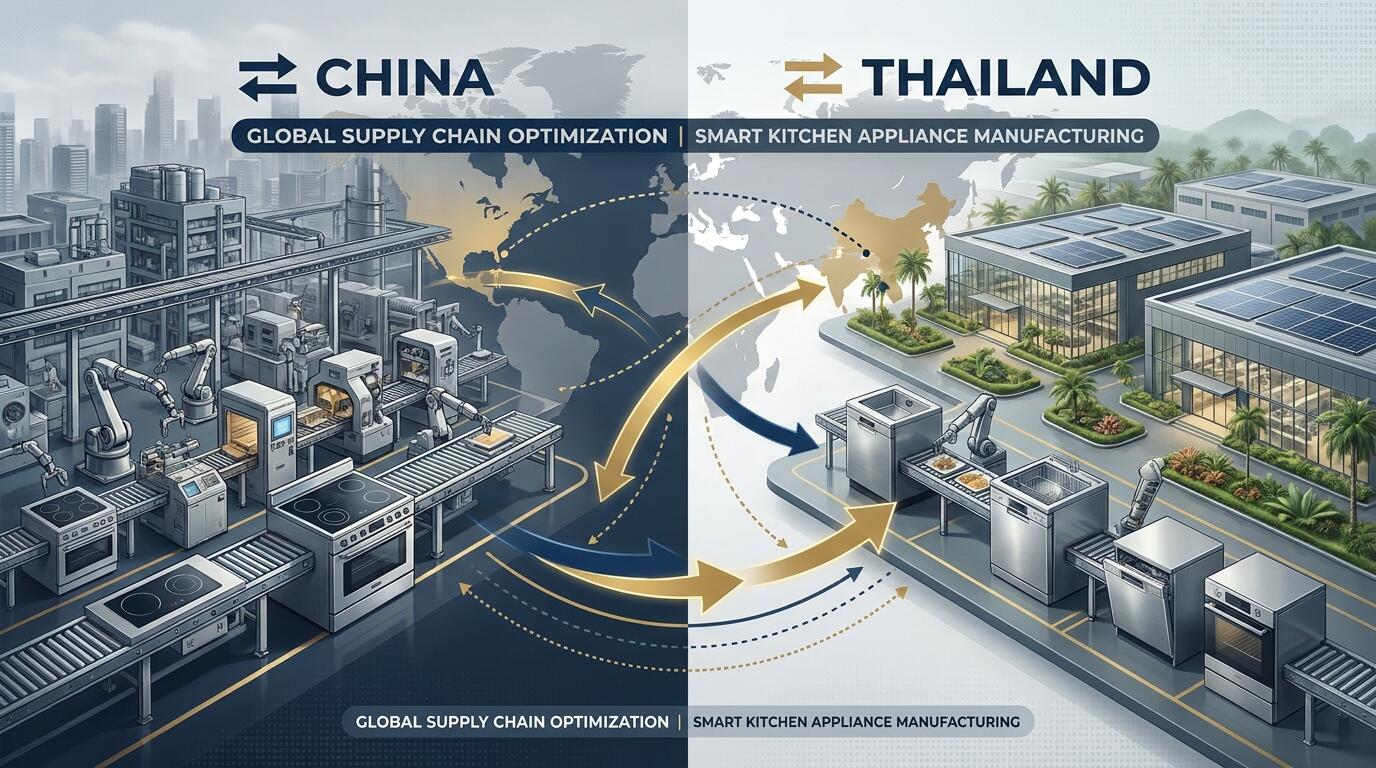
ALT: Dual factory strategy in China and Thailand strengthening supply chain resilience for smart kitchen appliances
Why Manufacturing Diversification Across Two Countries Is Reshaping Sourcing Strategy
Imagine you are a procurement manager for a mid-sized kitchen appliance brand in North America. You have built a reliable supply chain over several years — single-source, single-country, optimized for cost. Then a sudden policy shift introduces new tariff schedules, and overnight your landed cost calculation needs to be rebuilt from scratch. This scenario is not hypothetical; it is a pattern we consistently see among buyers who come to us looking for a more durable sourcing structure.
The core thesis here is straightforward: maintaining production capability in both China and Thailand — a dual-factory approach — is one of the most effective structural defenses a global kitchen appliance buyer can build into their supply chain today. This article breaks down why that is true, what the underlying mechanics look like in practice, and what pitfalls to avoid when making the transition.
The State of Global Kitchen Appliance Sourcing and How It Got Here
Global supply chain resilience has become a strategic boardroom priority, not simply a logistics consideration. The kitchen appliance manufacturing sector — which encompasses everything from smart ranges and cooktops to dishwashers and outdoor kitchen cabinets — has been among the most exposed categories to tariff volatility, logistics disruption, and demand-side uncertainty over the past several years.
For decades, China held a near-unassailable position as the world's dominant manufacturing hub for consumer and commercial kitchen equipment. The combination of deep component ecosystems, skilled labor, infrastructure scale, and competitive factory pricing made single-sourcing from China the default strategy for most importers and distributors worldwide. Regions like Dongguan in Guangdong Province became internationally recognized centers of manufacturing excellence, particularly for electronics-integrated and smart appliance production.
The disruptions that emerged from global trade tensions, pandemic-era logistics bottlenecks, and shifting geopolitical alignments fundamentally changed the risk calculus for procurement teams. As noted by GTR Review, the pandemic served as a stark warning to global buyers about the risks of over-concentration in any single manufacturing geography. Those warnings have since translated into concrete sourcing policy changes at importers and retail chains across North America, Europe, and Australia.
Thailand has emerged as one of the most credible alternative manufacturing destinations in Southeast Asia. The country benefits from established industrial infrastructure, a skilled manufacturing workforce, favorable trade agreement frameworks — including ASEAN-related preferential access — and a government policy environment that actively encourages foreign manufacturing investment. Research from the Economic Research Institute for ASEAN and East Asia (ERIA) has documented how supply chain survey data across the region reflects growing corporate interest in building Southeast Asian production capacity as a complement to, rather than a replacement for, Chinese manufacturing.
The critical insight that experienced buyers have arrived at is that the choice is not China versus Thailand. It is China and Thailand — a dual-factory model that captures the strengths of each geography while structurally reducing dependence on either.
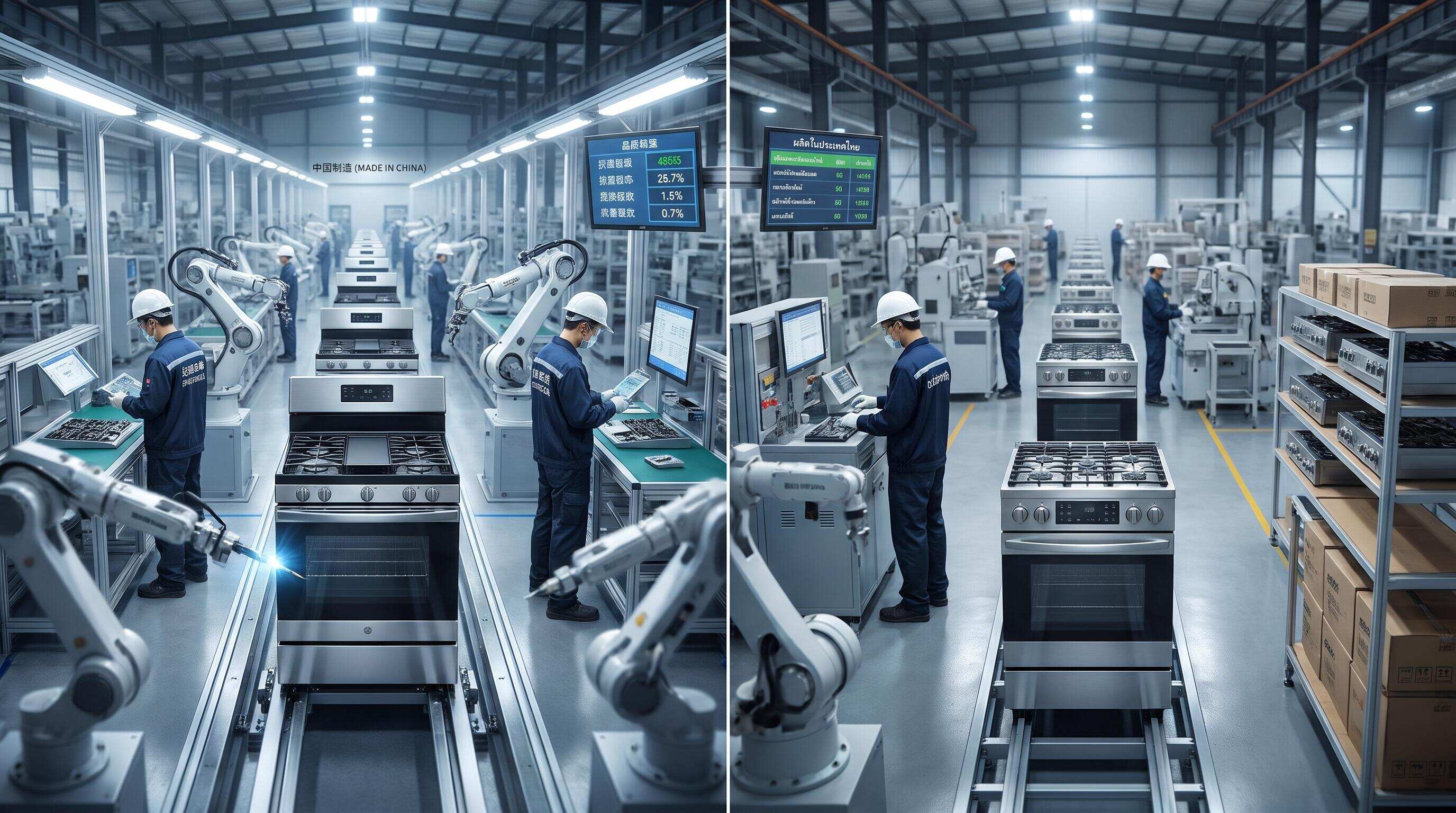
ALT: Side-by-side view of smart kitchen appliance manufacturing lines in China and Thailand representing dual factory supply chain resilience strategy for OEM ODM buyers
The Underlying Mechanics of Dual-Factory Supply Chain Resilience
A dual-factory supply chain strategy is an operational model in which a manufacturer maintains active production facilities in two distinct geographic locations, enabling flexible allocation of orders between sites based on trade conditions, demand volume, and logistics requirements. Understanding why this model delivers genuine resilience — rather than simply adding cost and complexity — requires examining several distinct mechanisms.
Supply Chain Integration and Production Flexibility
Supply chain integration and production flexibility are key considerations when evaluating a single-source manufacturing strategy. When a buyer's entire production volume is concentrated in one country, production capacity, component sourcing, and delivery schedules all depend heavily on the capabilities and operating conditions of a single manufacturing base. A dual-factory model across China and Thailand provides greater flexibility by leveraging the complementary strengths of both locations. For example, buyers can coordinate technically complex, component-intensive production through established manufacturing facilities in Dongguan, while utilizing Thailand's manufacturing base to support regional supply chain integration, production allocation, and delivery responsiveness. China-Thailand production coordination helps align component supply, production capacity, and scheduling. This approach allows manufacturers and buyers to better align production resources with changing order volumes, product requirements, and target-market demand. Rather than relying solely on unit-cost comparisons, buyers can evaluate the combined benefits of production coordination, sourcing efficiency, operational flexibility, and overall cost optimization. In our work with clients, effective coordination between manufacturing locations can provide meaningful advantages in managing changing production requirements and improving supply chain efficiency.
Component Ecosystem Depth vs. Market Access Balance
Component ecosystem depth refers to the density and variety of specialized suppliers, sub-component manufacturers, and technical service providers available within a given manufacturing region. China — and Dongguan specifically — offers an extraordinarily deep component ecosystem for smart kitchen appliances, encompassing precision metal fabrication, electronics integration, control systems, and specialized surface finishing. Thailand's manufacturing base, while growing, does not yet replicate this depth across all categories. A well-structured dual-factory strategy accounts for this asymmetry by using Chinese facilities for technically complex, component-intensive production — such as smart ranges with integrated control systems — while leveraging Thailand's manufacturing base to support global supply chain integration, improve production responsiveness, and optimize overall costs.
Logistics and Lead-Time Diversification
Lead-time diversification is a supply chain benefit that becomes critical during port congestion events, logistics capacity crunches, or regional disruptions that affect shipping routes. A single-source supply chain has a single failure point: if the origin port is congested, if a regional labor action disrupts freight movement, or if logistics capacity in a particular trade lane tightens, the entire supply pipeline is affected. A dual-factory model distributes this risk. Shipments from Thailand may access different port infrastructure, different shipping alliances, and in some cases different seasonal logistics dynamics than shipments from Chinese facilities. For buyers managing seasonal demand peaks — which are especially pronounced in the kitchen appliance category — this logistical diversification can be the difference between arriving in time for a retail season and missing it entirely.
Regulatory Certification and Market Qualification
Regulatory certification requirements vary by destination market, and origin country can affect the complexity and speed of compliance. For buyers supplying North American markets, certifications such as UL and CSA are non-negotiable requirements. For European markets, CE marking and applicable safety directives apply. A manufacturer operating across two facilities needs to maintain certification alignment across both sites — which is a genuine operational discipline challenge. Buyers evaluating a dual-factory partner should verify that the manufacturer's quality management systems, testing protocols, and certification documentation are consistent across both facilities, not just at the primary site. Understanding how in-house testing labs accelerate market entry is directly relevant here, because manufacturers who maintain in-house testing capability can verify compliance continuity as production shifts between sites.
Operational Continuity Under Disruption
Operational continuity — the ability to maintain production output even when one facility is affected by disruption — is the most fundamental resilience benefit of a dual-factory model. Regional natural disasters, public health events, energy supply constraints, or facility-level operational issues are all events that can interrupt a single factory's output. When a manufacturer maintains two geographically separated facilities with independent utility connections, labor pools, and logistics access points, the probability that both facilities are simultaneously disrupted approaches very low levels. For buyers whose brands depend on consistent product availability — particularly those managing shelf-space commitments with major retailers — this continuity guarantee is commercially significant.
Evaluating the Dual-Factory Model: Evidence and Competing Perspectives
The dual-factory model is not without its critics, and a balanced procurement analysis should engage honestly with the trade-offs. Research published by the ERIA on supply chain resilience patterns in ASEAN countries confirms that multi-location manufacturing strategies consistently score higher on resilience metrics — but also introduce complexity costs and coordination overhead that single-source arrangements do not carry. LinkedIn industry analysis tracking manufacturing diversification trends highlights that Thailand's rising prominence in the China-plus-one strategy reflects both its infrastructure readiness and its strategic geographic position within ASEAN trade networks.
The question for buyers is not whether dual-factory models are resilient in theory, but whether a specific manufacturing partner can execute the model in practice.
| Perspective / Approach | Strengths | Trade-offs | Best Fit |
|---|---|---|---|
| Single-source China | Established supplier ecosystem, integrated component sourcing, mature manufacturing capabilities, competitive production costs, and faster product development. | Greater dependence on one manufacturing base, concentrated supply chain exposure, and potential capacity constraints during demand fluctuations. | Buyers prioritizing integrated manufacturing resources, consistent product quality, efficient production coordination, and competitive total cost. |
| Single-source Thailand | Growing manufacturing capabilities, access to developing supplier networks, flexible production coordination, and opportunities for long-term supplier integration. | Less-developed component ecosystem, potential supplier qualification requirements, and longer initial production ramp-up. | Buyers seeking to establish a diversified manufacturing relationship, develop regional production capacity, and build long-term supply chain partnerships. |
| Dual-factory China + Thailand | Integrated production resources across two locations, flexible capacity allocation, improved supply continuity, production scheduling flexibility, and diversified manufacturing capabilities. | Higher coordination requirements, additional quality management processes, and greater operational complexity across facilities. | Buyers managing multi-market distribution, fluctuating order volumes, seasonal demand, or long-term supply chain resilience. |
| Near-shoring (alternative) | Shorter delivery distances, faster production replenishment, reduced transit time, and improved responsiveness to local market demand. | Higher overall manufacturing costs, potentially limited component sourcing options, and reduced economies of scale. | Buyers prioritizing rapid replenishment, shorter delivery cycles, localized production responsiveness, and specialized product requirements. |
Another risk worth naming: buyers who attempt to implement a dual-factory strategy by working with two entirely separate, unrelated manufacturers often encounter the opposite of resilience — they introduce quality inconsistency, divided accountability, and coordination complexity that can be more damaging than the single-source risk they were trying to mitigate. The more robust solution is a single manufacturing partner with genuine dual-factory capability, where quality systems, component specifications, and production standards are unified across both sites.
Where This Is Heading and What It Means for Procurement Strategy
The structural forces driving adoption of dual-factory sourcing models are not short-term phenomena. Trade policy complexity, geopolitical uncertainty, and sustainability-driven regulatory requirements in key destination markets are all trending toward greater, not lesser, supply chain scrutiny. The pattern we consistently observe in our work with global buyers is that the transition from reactive single-source procurement to proactive multi-geography strategy is becoming a baseline expectation among serious importers, not a premium practice reserved for large enterprises.
For kitchen appliance buyers specifically, several near-term implications stand out. First, the product categories most exposed to tariff risk — including smart ranges, cooktops, and outdoor kitchen cabinets — are precisely the categories. Second, as sustainability reporting requirements in Europe and North America increasingly demand supply chain transparency and geographic disclosure, buyers with diversified sourcing structures are better positioned to meet those reporting standards. Third, the smart appliance category — which requires tighter integration between hardware, software, and control systems — places particular demands on manufacturer technical capability across both facilities, making the selection of a genuinely capable dual-factory OEM/ODM partner a more consequential decision than in commodity product categories.
Practical takeaways for procurement teams engaging with this topic now:
- Audit your current supply chain for single-geography concentration risk before tariff changes force a reactive response.
- When evaluating manufacturing partners, verify dual-factory capability with physical facility audits, not documentation alone.
- Global supply chain integration, production responsiveness, and overall cost optimization.
- Build transition timelines that account for certification alignment across both facilities, particularly for markets with stringent safety standards.
- Treat the dual-factory model as a permanent strategic structure, not a temporary workaround, to capture its full resilience value.
Common Questions
Q1: How do manufacturers ensure consistent product quality across China and Thailand facilities?
Consistent quality across dual factory locations depends on unified quality management systems applied identically at both sites. This includes standardized component specifications, identical production process documentation, shared testing protocols, and — where possible — in-house testing capability at each facility. Buyers should require quality audit reports for both facilities independently and confirm that the manufacturer's certification documentation covers production from each site, not just the primary factory.
Q2: Is the Thailand factory option genuinely cost-competitive compared to Chinese manufacturing?
Thailand's manufacturing base can complement China's production capabilities by supporting global supply chain integration, improving production responsiveness, and optimizing overall costs. Rather than focusing solely on factory-gate pricing, buyers should evaluate the broader operational benefits of a dual-factory strategy, including production flexibility, supply chain coordination, component sourcing, and delivery efficiency. The overall cost-effectiveness of this approach depends on the specific product category, component complexity, destination market, and manufacturing capabilities of each facility.
Q3: How long does it typically take to transition production volume to a secondary facility?
The timeline for transitioning meaningful production volume to a secondary facility depends on product complexity, certification requirements, and the manufacturing partner's existing capacity at that facility. For smart kitchen appliances — which involve integrated control systems and must meet destination-market safety certification requirements — the transition timeline should be evaluated based on the specific product, required validation and testing procedures, certification status, and the secondary facility's production readiness. Buyers planning a dual-factory shift should build realistic transition timelines and avoid assuming that a secondary facility can absorb full volume immediately without quality or lead-time risk.
Final Thoughts
A dual-factory manufacturing strategy across China and Thailand offers three key advantages: stronger global supply chain integration, improved production responsiveness, and greater flexibility in managing overall costs. By leveraging the respective manufacturing capabilities and supply chain resources of both locations, buyers can coordinate production more effectively, respond to changing order requirements, and optimize sourcing and operational efficiency. Together, these capabilities make the dual-factory model a practical approach for global kitchen appliance buyers seeking a more flexible and coordinated manufacturing structure.
For procurement teams, the key step is to move from evaluating the concept to verifying the manufacturing capabilities behind it. Buyers should confirm that a potential manufacturing partner has established facilities in both locations, clearly defined production responsibilities, and the technical resources needed to coordinate manufacturing across sites. The assessment should be facility-specific and cover production capacity, equipment, workforce, quality management, and the ability to support the intended product requirements.
For buyers in the smart kitchen appliance category, selecting an OEM/ODM partner with complementary technical and manufacturing capabilities across China and Thailand is particularly important. The partner should be able to coordinate product development, component sourcing, production processes, quality control, and applicable certification requirements across both facilities, while maintaining consistent product standards. This level of coordination helps improve production responsiveness, support customization requirements, and optimize overall manufacturing and supply chain costs.
Ready to build a more resilient sourcing structure for your kitchen appliance lineup? Explore Hyxion's dual-factory OEM/ODM capabilities — spanning smart ranges, ovens, cooktops, rangetops, dishwashers, and outdoor kitchen cabinets — backed by factory-direct pricing and rigorous quality standards across both production sites. Visit the Hyxion smart kitchen appliance platform to request product catalogues, initiate sample development, or discuss a tailored manufacturing partnership built for the demands of today's global sourcing environment.
Sources & Citations
- Getting supply chain resilience right in S-E Asia. "Getting Supply Chain Resilience Right in S-E Asia".
https://www.google.com/goto?url=CAESnQEBxCJF18P39aGENzrC3MCcaBohxWPE730o7iQZ1oF5wE_M2_J9hafsTDCa_Zdw2SH1uYfVd7Ayx4m2DSZSTUDr_oPhpu45cV1fKbn4DbEL6If7EbFGzMlGEUj5YCYu1U0q9-UfNC0fRcoYbbmxFSsUxJYbdLcBAHHq127U6o0-uw0HtRJArnrReg_EMgDitVNDIr6P9odbVCA5uOIN - Pandemic a warning to diversify supply chains outside of China. "Pandemic a Warning to Diversify Supply Chains Outside of China".
https://www.gtreview.com/news/asia/pandemic-a-warning-to-diversify-supply-chains-outside-of-china/ - Chapter 6: ERIA Survey of Supply Chain Resiliency. "ERIA Survey of Supply Chain Resiliency in ASEAN".
https://www.eria.org/uploads/media/Research-Project-Report/2021-11-UK-ASEAN-Trade-Strengthening-Supply-Chain/10_Chapter-6-ERIA-Survey.pdf - Thailand Gains Attention in Manufacturing Diversification. "Thailand Gains Attention in Manufacturing Diversification".
https://www.linkedin.com/posts/east-west-associates_manufacturing-chinaplusone-thailand-activity-7519385368333529090-Zj7Y
Note: Standards and trade policies may be updated; please check the latest official documents or consult professional advisors.