Trends Shaping Smart Range Manufacturing for the Upcoming Year

ALT: Smart range manufacturing trends shaping the future of intelligent kitchen appliance production globally
Why Smart Range Manufacturing Is at an Inflection Point
The global kitchen appliance industry is undergoing a fundamental shift — one that is quietly reshaping how ranges are designed, produced, and brought to market. Procurement managers who sourced ranges the same way five years ago are finding that their familiar playbook no longer guarantees the margins, compliance approvals, or differentiation that retail and commercial buyers now demand. The central finding of this article is straightforward: the forces converging on smart range manufacturing right now are not cyclical; they are structural, and understanding them is the first step toward building a sourcing strategy that remains competitive over the coming year and beyond.
This topic deserves a deeper analysis precisely because "smart range" is no longer a premium niche. It has become the baseline expectation for a growing share of end consumers in North America, Europe, and Australia — which means the OEM and ODM manufacturers who supply distributors and private-label brands must themselves be smarter, faster, and more flexible than at any previous point in the category's history.
The Current Landscape of Smart Range Manufacturing
Smart range manufacturing today sits at the intersection of two powerful forces: accelerating consumer demand for connected kitchen appliances and the rapid maturation of the manufacturing technologies needed to build them at scale. A smart range, at its core, is a cooking appliance — gas, electric, or induction — that integrates digital controls, connectivity protocols, and sensor-driven automation to give users precise, often remotely managed, control over the cooking process.
The global smart manufacturing market has expanded significantly over the past several years, driven by the adoption of Industrial Internet of Things (IIoT) technologies, artificial intelligence, and advanced robotics across virtually every product category — kitchen appliances included. According to market research tracked by IMARC Group, the smart manufacturing sector is on a sustained long-term growth trajectory through the 2030s, underpinned by ongoing digitization of both factory floors and finished products.
Within the kitchen appliance segment, ranges and cooktops have historically been slower to digitize than, say, refrigerators or dishwashers. That is changing rapidly. Consumers now expect their ranges to connect to home automation ecosystems, respond to voice commands, and provide real-time feedback on cooking temperatures and energy usage. Retailers and distributors who import ranges in volume are receiving that signal loudly from their retail partners and end-user communities.
From our direct experience working with global importers and private-label brands, a pattern we consistently see is that buyers who approached smart ranges as a "premium tier add-on" two or three product cycles ago are now scrambling to make connected features standard across their core SKUs. The question is no longer whether to source smart ranges; it is how to source them reliably, at the right cost structure, and with the flexibility to differentiate through customization.
The manufacturing geography matters too. Dongguan and the broader Pearl River Delta region of China remain the global epicenter of kitchen appliance production, offering a concentration of component suppliers, tooling capabilities, and manufacturing expertise that is difficult to replicate elsewhere. For OEM and ODM buyers, this means that factory-direct sourcing from this region continues to represent a structurally advantaged cost and capability position — provided they choose manufacturing partners who have genuinely invested in smart manufacturing infrastructure.
The Root Causes Driving Smart Range Manufacturing Evolution
Understanding why smart range manufacturing is changing so rapidly requires looking at the underlying drivers, not just the surface trends. Several distinct mechanisms are at work simultaneously.
The Convergence of Consumer Technology and Appliance Design
Connectivity standards — the communication protocols that allow appliances to interact with smartphones, voice assistants, and home automation hubs — have matured to the point where integrating them into a range is a solved engineering problem rather than a frontier challenge. Wi-Fi, Zigbee, and Matter-compatible modules are now commodity components, available from a dense supplier ecosystem in Dongguan and Shenzhen. This has dramatically lowered the cost of building connected features into a range, which in turn has lowered the price point at which importers can offer those features to their retail customers.
The practical consequence for OEM/ODM buyers is significant: a range that would have required a premium product tier to absorb the cost of connectivity hardware several years ago can now be offered at mid-market price points, opening up a much larger addressable market.
The Maturation of AI-Assisted Manufacturing Processes
Artificial intelligence in manufacturing — the application of machine learning algorithms to quality control, process optimization, and predictive maintenance on the production line — is no longer theoretical. Leading smart kitchen appliance manufacturers have deployed AI-driven vision systems for defect detection, AI-assisted assembly verification, and predictive maintenance scheduling on CNC and stamping equipment. The practical outcome is higher first-pass yield rates, lower rework costs, and greater consistency in finished product quality.
For importers and distributors, this manufacturing-side AI adoption translates into more reliable quality outcomes and tighter batch-to-batch consistency — which matters enormously when sourcing at volume for retail environments where product returns carry significant downstream cost.
Sustainability and Energy Efficiency as Regulatory and Market Drivers
Energy efficiency regulations are tightening in every major import market. The European Union's Ecodesign Regulation, North American energy standards administered by the U.S. Department of Energy, and equivalent frameworks in Australia are progressively raising the minimum performance thresholds that imported appliances must meet. Smart ranges are well-positioned to meet these standards because their sensor and control systems enable genuinely more efficient cooking — not just efficiency claims, but measurable reductions in gas consumption or electrical draw.
Manufacturers who have invested in R&D around induction cooktop integration, precise burner modulation, and intelligent pre-heat algorithms are ahead of the compliance curve. For OEM buyers, partnering with a manufacturer who has already solved for the next tier of efficiency standards — rather than scrambling to retrofit — is a material risk-reduction advantage.
Flexible Customization as a Competitive Differentiator
In our work with private-label brands and regional distributors, one of the most consistent requests we receive is for meaningful product differentiation — features, finishes, control interfaces, or connectivity integrations that allow a buyer's branded range to stand out on a retail floor or in a digital catalogue. OEM/ODM customization capability — the ability to modify a base platform to accommodate different burner configurations, control panel designs, colorways, and software integrations — is now a primary selection criterion when buyers evaluate manufacturing partners.
The manufacturers who can accommodate custom requirements without requiring impractical minimum order quantities or extended lead times are capturing a disproportionate share of new private-label program business. This is not a marginal advantage; in a category where product differentiation at retail is increasingly difficult to achieve through pricing alone, customization capability is a genuine competitive moat.
Supply Chain Resilience and Nearshoring Considerations
The post-pandemic period exposed structural fragility in single-source, long-lead-time supply chains. Many importers responded by diversifying their supplier base or seeking manufacturers who could offer shorter lead times and more flexible production scheduling. The pattern we consistently see today is that buyers are asking harder questions about production capacity, raw material sourcing independence, and the ability to accelerate or decelerate orders in response to market conditions.
Manufacturers with vertically integrated component sourcing — controlling their supply of sheet metal, electronic modules, and burner components — are demonstrably better positioned to deliver on lead-time commitments than those dependent on a fragmented external supply chain.
Evidence and Multi-Angle Comparison: Approaches to Smart Range Sourcing
The decision of how to approach smart range procurement is not uniform across buyer types. Importers, distributors, and private-label brands each bring different priorities, and the right sourcing approach differs accordingly. The comparison below synthesizes the trade-offs as we observe them across buyer profiles.
| Perspective / Approach | Strengths | Trade-offs | Best Fit |
|---|---|---|---|
| Standard catalogue OEM sourcing | Faster onboarding, lower minimum order quantities, predictable specifications | Limited differentiation; shared product platforms across multiple buyers | Smaller distributors testing the smart range category for the first time |
| Full ODM custom development | Maximum brand differentiation; unique features and design language | Longer development timelines; higher upfront tooling investment | Established private-label brands with clear product roadmaps |
| Hybrid platform customization | Differentiates at the control, finish, and software layer without tooling a new chassis | Moderate development timeline; some platform-level constraints | Mid-sized importers seeking differentiation at manageable cost |
| Multi-factory diversified sourcing | Reduces single-source risk; competitive pricing leverage | Higher coordination overhead; inconsistent quality management | Large-volume importers with internal QC infrastructure |
The evidence from manufacturing trends research supports the view that hybrid approaches — combining a proven base platform with meaningful customization at the interface and software layer — are gaining traction precisely because they balance speed-to-market with differentiation. When evaluating potential manufacturing partners, understanding their OEM/ODM selection criteria and factory capabilities systematically is worth the upfront due diligence investment.
A further dimension worth examining is certification readiness. Smart ranges entering North American markets require UL or CSA certification; European markets require CE marking; Australian markets require RCM. Manufacturers who maintain in-house testing laboratories can compress the time between final prototype and market-ready product meaningfully. For buyers managing seasonal or promotional product launches, that time compression is not an operational convenience — it is a competitive advantage with direct revenue implications.
The manufacturing trends literature, including analysis from LinkedIn's industry pulse on key trends shaping 2026 manufacturing, consistently highlights that companies integrating AI-driven quality management and digital twin simulation into their production processes are achieving measurably better first-pass certification outcomes — fewer redesign cycles, faster regulatory clearance.
Outlook: Where Smart Range Manufacturing Is Heading and What It Means for Buyers
Smart range manufacturing is moving decisively toward greater intelligence at both the product level and the production level, and this dual evolution will define the competitive landscape over the coming year. At the product level, ranges will increasingly offer adaptive cooking intelligence — sensor arrays that adjust heat in real time based on detected pan temperature, cooking content, and user behavior patterns — rather than simply offering connectivity as a passive feature. At the production level, manufacturers who have deployed AI-assisted quality systems and flexible automated assembly lines will be able to bring new SKUs to market faster while maintaining the consistency that large-volume buyers require.
For procurement managers and product sourcing specialists, the actionable implication is clear: the selection criteria for smart range manufacturing partners need to evolve beyond unit price and basic specification sheets. The questions that determine a partnership's long-term value include: Does this manufacturer have genuine R&D investment in smart cooking technology? Can they support firmware updates and software customization as part of an OEM program? Do they hold the certifications required for my target markets, and can they demonstrate how they achieve and maintain them?
Sustainability is not going away as a purchasing consideration. Buyers sourcing for European retail partners in particular are under growing pressure to document the energy performance and environmental compliance of their products. Smart range features — precision burner control, intelligent standby management, real-time energy monitoring — are increasingly becoming the mechanism through which those compliance requirements are met, not just marketing claims.
Finally, the trend toward faster sampling and shorter development cycles is structural. The expectation in the market, based on patterns we consistently observe with global buyers, is that a credible manufacturing partner can move from a brief to a physical sample in a compressed timeframe. For buyers evaluating manufacturers, understanding how rapid sample production works in practice is an important step in qualifying a partner's true development capability.
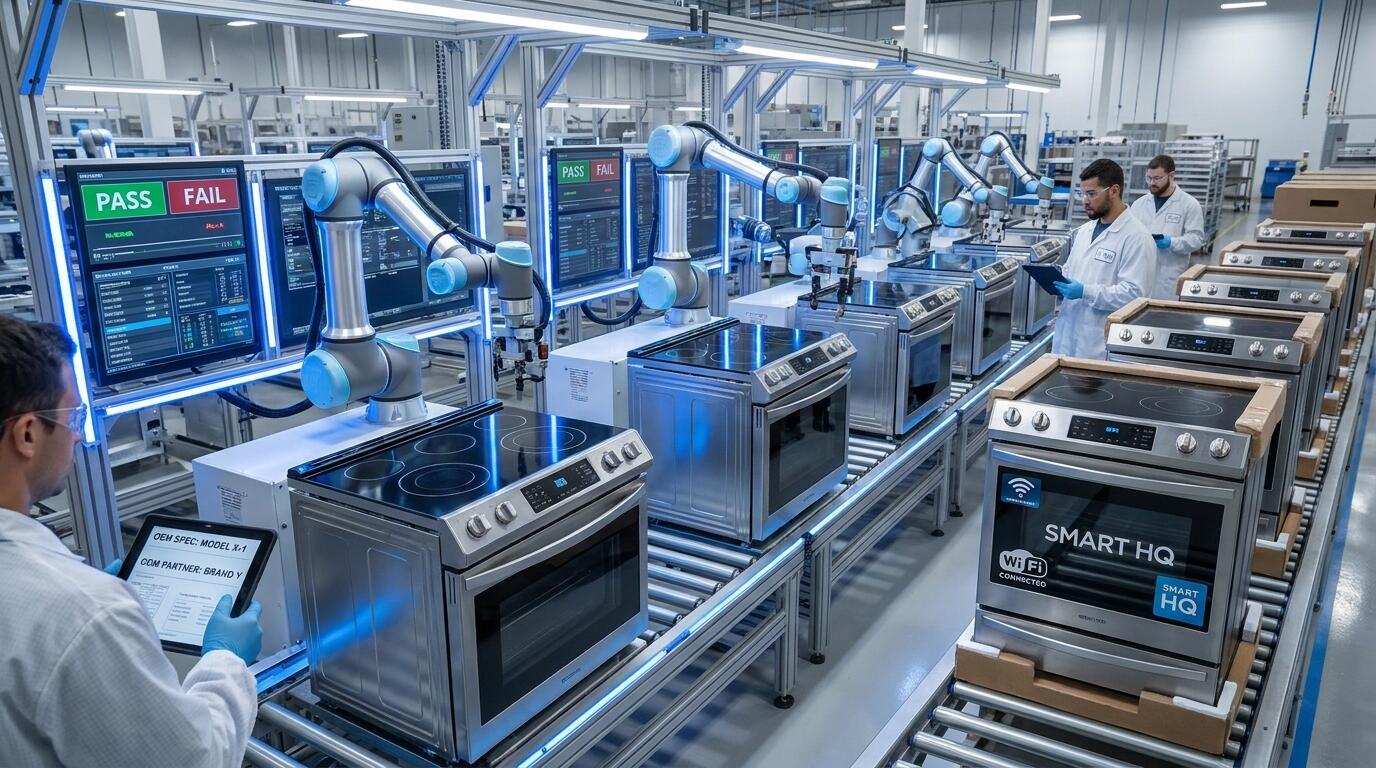
ALT: Advanced smart range production line demonstrating OEM ODM manufacturing capabilities for global kitchen appliance importers and distributors
Frequently Asked Questions FAQ
Q1: How do smart range manufacturers integrate connectivity features into their OEM products?
Smart range manufacturers integrate connectivity by embedding certified wireless communication modules — typically Wi-Fi or Matter-compatible chips — into the range's main control board during the assembly process. OEM partners can specify the target home automation ecosystems (such as Amazon Alexa or Google Home) they need the product to support, and the manufacturer customizes the firmware accordingly. The critical qualification question for buyers is whether the manufacturer controls firmware development in-house or relies on a third-party software vendor, as in-house control significantly affects the speed and flexibility of customization.
Q2: Are smart range certifications transferable between markets if I source from a Dongguan manufacturer?
Certifications are market-specific and generally not directly transferable. For a UL-certified range, buyers should verify the certification coverage of each specific model separately for the U.S. and Canadian markets. Products intended for the European Union must meet applicable CE marking requirements, while products intended for Australia must comply with applicable RCM requirements. The most efficient scenario for buyers targeting multiple markets is to partner with a manufacturer whose in-house testing laboratory can run certification processes for multiple standards concurrently or sequentially, as described in resources covering CSA and UL certification processes and how in-house labs accelerate market entry. This consolidates your certification management with a single partner rather than coordinating across multiple testing facilities.
Q3: How long does a typical OEM smart range development cycle take from brief to production-ready product?
The timeline depends heavily on the degree of customization required and the manufacturer's development infrastructure. A range built on an existing certified platform with customization at the control panel, finish, and software layer can move from initial brief to production-ready sample considerably faster than a fully ground-up design. Manufacturers with established rapid prototyping and sampling workflows can deliver initial samples for buyer review in compressed timeframes. Full production tooling, compliance testing, and ramp-up add additional time, so buyers should factor the full development timeline into their sourcing calendar when planning product launches.
Key Takeaways
- Smart range manufacturing is shifting from connectivity as a premium feature to connectivity as a standard expectation, driven by consumer demand and falling component costs.
- AI-assisted production systems — covering quality inspection, process optimization, and predictive maintenance — are elevating the consistency and reliability of finished ranges sourced from leading OEM/ODM manufacturers.
- Energy efficiency regulations in North America, Europe, and Australia are tightening, and smart range features are increasingly the mechanism through which compliance is achieved, not just a marketing differentiator.
- Customization capability — the ability to differentiate at the control, software, and finish layer without requiring full ground-up tooling — is now a primary criterion separating strong OEM/ODM partners from commodity producers.
- Certification readiness and in-house testing laboratory capability directly affect speed-to-market and should be evaluated as rigorously as unit pricing during supplier qualification.
For procurement teams ready to move from analysis to action, the next step is to engage directly with a smart kitchen appliance manufacturer whose capabilities match the trends outlined here — one that combines genuine R&D depth, flexible OEM/ODM infrastructure, and established multi-market certification pathways.
Ready to align your sourcing strategy with the manufacturing trends shaping the smart range category? Visit Hyxion's official website today to explore product catalogues, request samples, or discuss a fully tailored OEM/ODM manufacturing partnership — from smart ranges and cooktops to outdoor kitchen cabinets — backed by factory-direct pricing and rigorous quality standards.
References & Further Reading
- Cflow Apps. "The Top 12 Manufacturing Trends for 2026".
https://www.cflowapps.com/manufacturing-industry-trends/ - LinkedIn / Devox Software. "The Future of Manufacturing: Key Trends 2026".
https://www.linkedin.com/pulse/future-manufacturing-key-trends-2026-devox-software-esmte - IMARC Group. "Smart Manufacturing Market Size, Growth & Forecast 2034".
https://www.imarcgroup.com/smart-manufacturing-market
Note: Standards and regulatory requirements may be updated; please check the latest official documents or consult professional advisors for current compliance requirements in your target markets.