
Key Features Checklist for Specifying Commercial-Grade Gas Ranges
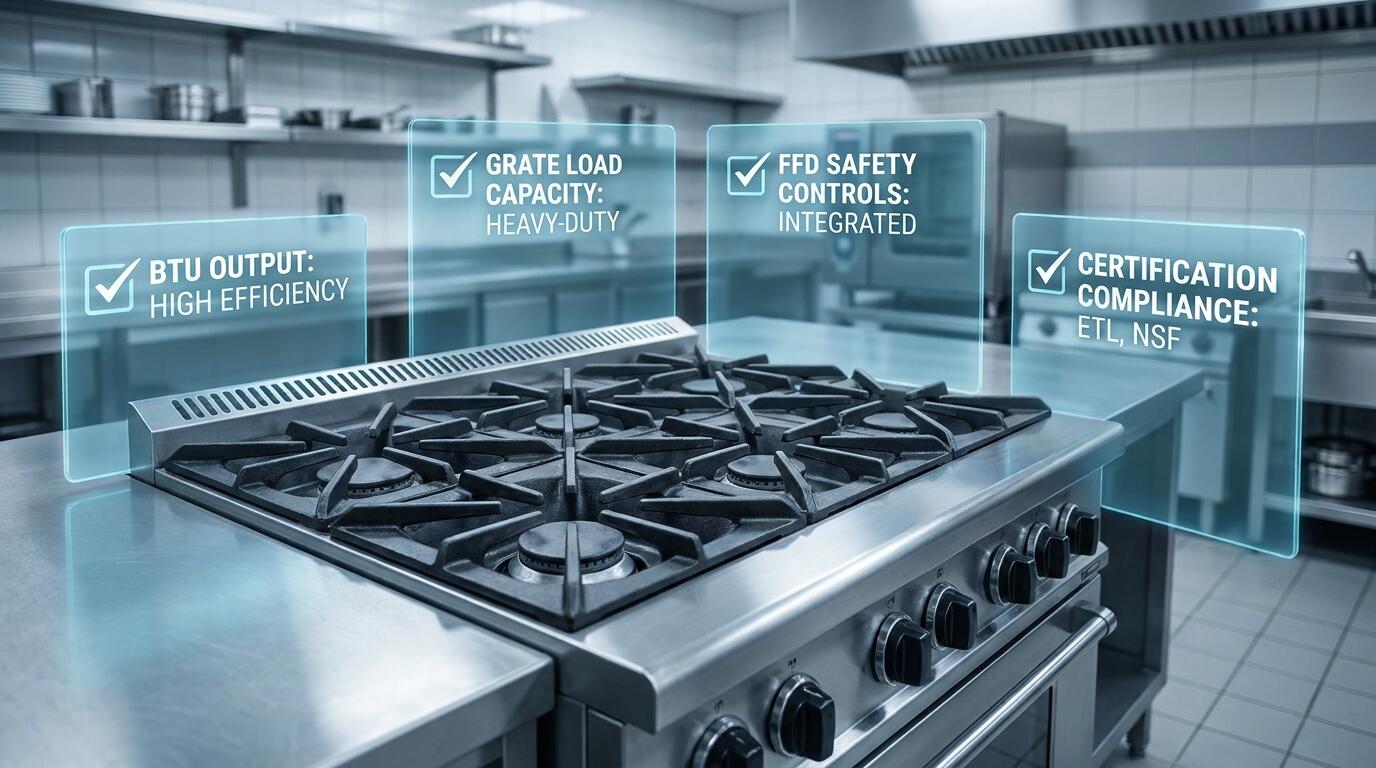
ALT: Commercial-grade gas range specification checklist for B2B kitchen appliance buyers and procurement managers
What Every Buyer Must Verify Before Specifying a Commercial-Grade Gas Range
Key Conclusion: Specifying a commercial-grade gas range without a structured checklist is one of the most common and costly mistakes in commercial kitchen procurement. This guide walks procurement managers, importers, and private-label brands through the essential features — from burner output and construction materials to safety controls — that determine whether a gas range will perform reliably at scale, comply with international market standards, and hold up to the demands of professional kitchen environments.
Selecting a commercial-grade gas range is a decision that reverberates through years of kitchen operations, service contracts, and end-customer satisfaction. In our work with global buyers and distributors, a pattern we consistently see is that specification errors typically stem not from ignorance of the product category, but from using an incomplete evaluation framework — one that prioritizes price or aesthetics while glossing over the mechanical and regulatory details that actually govern performance.
The features in this checklist were selected based on what most frequently differentiates long-term operational success from premature equipment failure or costly compliance issues. Use this list sequentially during your RFQ process, supplier audits, and final procurement sign-off. Each item is applicable whether you are sourcing a single SKU for a private label launch or specifying units across a multi-location rollout.
The Commercial Gas Range Specification Checklist
Burner Configuration and BTU Output Range
Burner output — measured in British Thermal Units (BTUs) per hour — is the single most decisive factor in determining whether a commercial gas range can meet the heat demands of a professional kitchen. Commercial-grade burners typically operate at substantially higher outputs than residential equivalents, and the specific configuration (number of burners, layout, and individual output levels) must match the cooking volume and technique requirements of the target use case.
A heavy-duty restaurant range needs burners capable of rapid temperature recovery after cold product is loaded onto the grate. Ranges used for simmer-intensive applications such as sauce production require precision at the low end of the output spectrum as well. Procurement managers should request the full BTU range per burner — both maximum and minimum — not just the peak figure.
- Best for: High-throughput commercial kitchens, catering operations, and restaurant brands sourcing equipment for intensive daily cooking schedules.
- Watch out: A high peak BTU figure means little if the burner cannot maintain a stable, controllable simmer. Always evaluate the full output range, not just the top number.
Grate Material and Load Capacity
The grates on a commercial gas range are the primary contact surface between cookware and heat, and their structural integrity directly affects both safety and durability. Cast iron grates are widely used in commercial settings because they retain heat efficiently and distribute it evenly across the cooking surface. Heavier-gauge cast iron or enameled cast iron variants offer additional durability in high-use environments.
Load capacity is a specification that is frequently overlooked during procurement. In commercial kitchens, large stockpots, cast iron skillets, and heavy pans are standard. Grates that cannot support significant weight will warp, crack, or shift — creating safety hazards and increasing replacement costs. Always request the rated load capacity per grate section, not just per unit.
- Best for: Operations using heavy cookware, large batch cooking, or any environment where multiple large-format pots and pans are in simultaneous use.
- Watch out: Grate coating quality varies significantly. Porcelain-enameled finishes can chip under impact or extreme thermal cycling; raw cast iron requires seasoning and careful moisture management to prevent rust.
Construction Material and Gauge Specification
A commercial-grade gas range that is genuinely built for professional environments is constructed from heavy-gauge stainless steel — typically the body, side panels, and oven interior. Stainless steel grade (commonly 430 or 304 series) affects corrosion resistance, cleanability, and longevity, particularly in high-humidity or high-grease environments.
In our experience evaluating units from manufacturers across the supply chain, the gauge of the steel is often where cost-cutting occurs without immediately visible consequences. Thinner steel panels flex, dent more easily, and are more susceptible to heat warping over time. Specifying minimum gauge requirements for the range body, oven cavity walls, and bottom pan in your RFQ protects the long-term durability of the product.
- Best for: Buyers specifying ranges for commercial food service environments where daily cleaning, thermal stress, and physical impact are routine.
- Watch out: Manufacturers may use a premium steel grade for visible exterior panels while reducing gauge on internal structures. Request a full material specification sheet, not just surface-level material claims.
Ignition System Type and Reliability
Commercial gas ranges use one of two primary ignition systems: standing pilot ignition, which maintains a continuous small flame, or electronic spark ignition, which generates a spark on demand. Each has distinct operational implications for commercial buyers.
Standing pilot systems are mechanically simpler and continue to function in environments where power interruptions occur. Electronic ignition systems eliminate the continuous gas consumption of a standing pilot, which can represent meaningful energy savings over time, and are increasingly preferred in energy-conscious procurement programs. For smart kitchen appliances with integrated controls, electronic ignition also enables better compatibility with digital monitoring systems.
- Best for: Electronic ignition suits energy-efficiency programs and smart kitchen integration; standing pilot suits environments with unreliable power supply or where mechanical simplicity is prioritized.
- Watch out: Electronic ignition modules in commercial environments are exposed to grease, heat, and moisture. Ensure the ignition system carries a commercial-duty rating and that spare parts are readily available through the manufacturer or distributor network.
Safety Controls and Flame Failure Devices
A flame failure device (FFD) — is a critical safety component that automatically cuts off gas supply if a burner flame is extinguished. This feature is a regulatory requirement in many markets verify based on the sales region and specific equipment configuration.
Beyond FFDs, commercial gas ranges used in professional environments benefit from additional safety features including overheat protection, spillage-resistant burner designs, and in smart-enabled models, remote shutoff capability. Procurement managers sourcing for markets in North America, Europe, and Australia should cross-reference flame failure device requirements with local standards bodies, as specific performance thresholds vary by region.
- Best for: Any commercial kitchen procurement — FFDs are a universal safety requirement, not an optional upgrade.
- Watch out: Some ranges in lower price tiers omit FFDs entirely. Verify the specific flame failure device response time specification against the requirements of your target market's regulatory authority.
Oven Cavity Size, Heat Distribution, and Venting
For commercial ranges that include an integrated oven section, the oven cavity dimensions, heat distribution uniformity, and venting design are specification points that have direct operational consequences. An undersized cavity limits batch capacity; uneven heat distribution creates inconsistent results at scale; and poor venting can cause heat buildup that affects both performance and equipment longevity.
Convection fans, if present, should be evaluated for their airflow pattern and whether they can be disabled for applications that require still-air cooking. The oven door seal quality and insulation thickness directly affect temperature consistency and energy efficiency — both factors that matter to operators running ovens for extended periods during service.
- Best for: Procurement for full-service restaurants, bakeries, catering companies, and any operation where oven cooking is a primary production method rather than a secondary function.
- Watch out: Manufacturers sometimes overstate oven cavity dimensions by measuring exterior rather than usable interior dimensions. Request verified internal dimensions and confirm shelf rack compatibility with your anticipated cookware sizes.
Certification and Compliance Readiness
Compliance with applicable technical standards and product certification requirements is a critical step in accessing regulated markets for commercial gas ranges. In North America, commercial gas cooking appliances are generally evaluated against ANSI Z83.11 / CSA 1.8, with product testing and certification conducted by an appropriately recognized certification body, such as CSA Group or UL Solutions. In the European Union, gas appliances fall under Regulation (EU) 2016/426 (Gas Appliances Regulation, GAR). Relevant harmonised EN standards provide technical specifications for demonstrating conformity, while the required conformity assessment must be completed before the manufacturer affixes the CE marking. In Australia, commercial catering gas equipment is assessed against applicable Australian Standards, including AS 4563, with product certification issued by an accepted Conformity Assessment Body (CAB), such as the Australian Gas Association (AGA).
As detailed in our guide on CSA and UL certification and in-house testing lab advantages, manufacturers with integrated testing facilities can dramatically shorten the certification timeline compared to those relying entirely on third-party labs. For buyers managing compressed launch schedules, this capability difference between manufacturers is a critical sourcing variable — not just a background technical detail.
- Best for: Any buyer sourcing for regulated markets — which, in practice, includes nearly every professional commercial kitchen market globally.
- Watch out: Certifications can be outdated, geographically scoped, or narrowly applicable. Always verify that the certification on file covers the specific model variant, gas type (natural gas versus LPG), and destination market jurisdiction you are sourcing for.
Cleaning Accessibility and Maintenance Design
A commercial gas range that is difficult to clean will not be properly maintained in a high-volume kitchen environment — and inadequate maintenance accelerates wear, creates food safety risks, and shortens equipment lifespan. The design features that determine cleaning accessibility include removable burner caps and grates, sealed top surfaces that prevent grease infiltration into internal components, drip tray design and accessibility, and the ability to disassemble burner components without tools.
In our work with buyers specifying equipment for restaurant chains and hospitality groups, cleaning accessibility consistently ranks as a higher priority in repeat procurement decisions than it does in first-time purchases. Operators learn quickly that a range that takes significantly longer to clean per service generates real labor cost implications at scale.
- Best for: Any high-volume commercial kitchen operation where daily deep cleaning is required by health code or operational standards.
- Watch out: Marketing descriptions often use terms like "easy clean" without specifying the design features that enable it. Request cleaning procedure documentation from the manufacturer and evaluate it against your kitchen team's actual workflow.
Smart Controls and Integration Capability
Smart kitchen technology in commercial gas ranges encompasses a range from basic digital temperature displays to fully integrated control systems capable of preset program storage, remote monitoring, and connectivity with broader kitchen management platforms. For buyers sourcing smart kitchen appliances, the integration capability of the range's control system is an increasingly important specification dimension.
At the OEM/ODM level, smart control customization allows brands to differentiate their product lineup with proprietary interfaces, branded digital displays, or connectivity features tailored to specific market segments. This is particularly relevant for private-label brands and distributors building a distinctive product portfolio. When evaluating smart control features, assess both the current feature set and the manufacturer's capability to implement custom firmware or interface modifications at scale.
- Best for: Private-label brands, technology-forward distributors, and buyers targeting premium commercial kitchen segments where connected appliance features are a sales differentiator.
- Watch out: Smart features add complexity to both production and after-sales support. Verify that the manufacturer can provide ongoing firmware support and that the connectivity protocols used (Wi-Fi, Bluetooth, Zigbee, etc.) are compatible with your target market's standard infrastructure.
Quick Comparison at a Glance
| Feature | Best For | Key Strength | Limitation |
|---|---|---|---|
| Burner Configuration & BTU Range | High-throughput restaurants and catering | Directly determines cooking performance capacity | High BTU alone does not guarantee simmer control |
| Grate Material & Load Capacity | Heavy cookware and large batch cooking | Structural safety and heat retention | Coatings can degrade under extreme thermal cycling |
| Construction Material & Gauge | Corrosive or high-use kitchen environments | Longevity and resistance to physical wear | Lower-gauge internal components may be hidden by premium exterior finish |
| Ignition System Type | Energy-conscious or smart-integrated kitchens | Electronic systems reduce gas waste; standing pilots are power-independent | Electronic modules require commercial-duty rating and parts availability |
| Safety Controls & FFDs | All commercial gas range procurement | Regulatory compliance and operational safety | Quality and response time vary; always verify specifications |
| Oven Cavity & Heat Distribution | Full-service restaurants and bakeries | Batch capacity and cooking consistency | Cavity dimensions may be overstated; always verify internal usable space |
| Certification & Compliance | Any regulated destination market | Market entry and legal operation | Certifications may be model-specific or jurisdiction-limited |
| Cleaning Accessibility | High-volume operations with daily deep cleaning | Labor cost reduction and food safety compliance | Design claims require documentation — verify with actual cleaning procedures |
| Smart Controls & Integration | Premium product lines and private-label brands | Product differentiation and operational data capabilities | Firmware support and connectivity compatibility require long-term manufacturer commitment |
How to Choose the Right Specifications for Your Sourcing Situation
Mapping the right specification priorities to your specific procurement context is what separates a successful sourcing engagement from one that generates rework and cost overruns. Here is a practical framework based on the most common buyer profiles we work with.
If you are a restaurant chain or food service operator sourcing ranges for multiple locations, burner output, grate durability, and cleaning accessibility should be your top three priorities. Equipment that underperforms or is difficult to maintain will compound in cost and operational disruption across every location. Certification compliance for your operating jurisdiction is non-negotiable — and should be confirmed before design finalization, not after.
If you are a private-label brand or importer building a differentiated product lineup, construction quality, smart control capability, and OEM customization flexibility become central. The value of sourcing from a manufacturer with genuine OEM/ODM capability — including custom branding, firmware customization, and design modification support — is that your product can carry a distinctive identity rather than being a commodity repackage. Reviewing a thorough OEM/ODM manufacturer selection checklist before engaging suppliers is an effective way to structure this evaluation.
If you are a wholesale distributor serving the hospitality and commercial kitchen segment, your priority is likely a balanced specification that covers durability, compliance, and after-sales serviceability — with the ability to offer a range of SKUs at different price points without compromising on the safety fundamentals.
A common misconception in commercial gas range procurement is that certification compliance and feature richness are inherently in tension — that meeting regulatory requirements forces a compromise on advanced features. In practice, manufacturers with mature product development and testing infrastructure can deliver both. The key is selecting a manufacturing partner whose certification capability is current and whose engineering team can implement smart features within the bounds of certified configurations.

ALT: Procurement manager reviewing commercial-grade gas range specifications checklist with B2B supplier technical documentation for OEM sourcing
Common Questions
Q1: How do I verify that a manufacturer's certification claims are valid for my specific destination market?
Certification documents should include the certifying body's name, the specific model number covered, the gas type(s) tested, and an expiration or review date. Contact the certifying body directly — such as CSA Group for North American certifications or the relevant national authority for European CE marking — to confirm the certificate is current and covers the exact variant you are procuring. Never accept a certificate that has been modified or that covers a different model designation than the one in your purchase order.
Q2: Are commercial-grade gas ranges with smart controls more difficult to certify for international markets?
Smart controls add a layer of complexity to the certification process, primarily because connected devices may need to meet both cooking equipment standards and electromagnetic compatibility (EMC) requirements depending on the destination market. However, manufacturers with in-house testing labs and established relationships with certification bodies can manage this process efficiently. The key is to raise the smart feature specification and target market list early in the product development phase rather than attempting to retrofit certification after production tooling is finalized.
Q3: How long does the OEM/ODM customization and certification process typically take for a commercial gas range?
Timelines vary based on the degree of customization required and the certification pathway for the target market. Standard OEM customization — such as branding, colorway, or control panel modifications — is typically faster than engineering changes that affect the burner system, gas valve, or safety components, as the latter may require re-testing.
Final Thoughts
Specifying a commercial-grade gas range is a layered procurement decision — one where surface-level evaluation leads to the kind of costly surprises that experienced buyers learn to avoid only after encountering them firsthand. The checklist in this guide consolidates the specification dimensions that most reliably determine whether a range will perform, comply, and endure in professional kitchen environments.
Three core points are worth carrying forward from this guide. First, certification compliance is a gate, not a checkbox — it must be verified at the model level, gas type level, and jurisdiction level before procurement proceeds. Second, the construction quality indicators that determine long-term durability (steel gauge, grate load capacity, burner component design) are often obscured by marketing language; request full technical specifications and push for documentation. Third, smart control capability and OEM customization flexibility are increasingly competitive differentiators for brands and importers — and these capabilities are most effectively leveraged when the manufacturing partner has integrated testing and engineering depth.
The practical next step is to use this checklist during your next supplier qualification or RFQ process, mapping each item against the technical documentation your prospective manufacturer provides. Gaps in that documentation are as informative as the content itself.
Ready to work with a manufacturing partner whose engineering capability, certification infrastructure, and OEM customization depth can support your commercial gas range specification requirements? Explore Hyxion's smart kitchen appliance manufacturing capabilities and request product catalogues or samples directly through the Hyxion website.
Sources & Further Reading
Note: regulatory requirements may be updated; please check the latest official documents or consult professional advisors.
- KaTom Restaurant Supply. "Comparing Options to Get the Right Cooking Equipment".
https://www.katom.com/learning-center/comparing-commercial-range-options-to-get-the-right-cooking-equipment.html?srsltid=AYCX9vKAJ-ZzQDPtb6mDl6CxLoR9PqXvr_wWx9WjFtx33G-3aexho_Ph - Google Search Feature. "What Are Some Features of Commercial Gas Cooktops".
https://www.google.com/goto?url=CAES6wEBxCJF1y_4AlRiBZqtmWjPH3SI37-GEpo1KXhUEunkx4aOObPQy_j5SixL9DJyQrTY3iSGpv7wucvpRz5-kTSFZN0QT7bNWBYzev_z75f8U7xwjFtx33G-3aexho_Ph - Caterkwik. "Commercial Oven Checklist".
https://www.caterkwik.co.uk/shop/downloads/G58_COOKERCHECKLISTREV10.pdf - Simco Group. "A Comprehensive Guide to Commercial Gas Cooking Equipment".
https://simcogroup.com.au/blog/post/a-comprehensive-guide-to-commercial-gas-cooking-equipment/?srsltid=AYCX9vJZidROAAKy_MEGurmVTEeSk8xcij9cjyNtUYlDuFZLiLl0qnfr