
Cooktop vs. Rangetop: Understanding the Difference for Product Line Planning
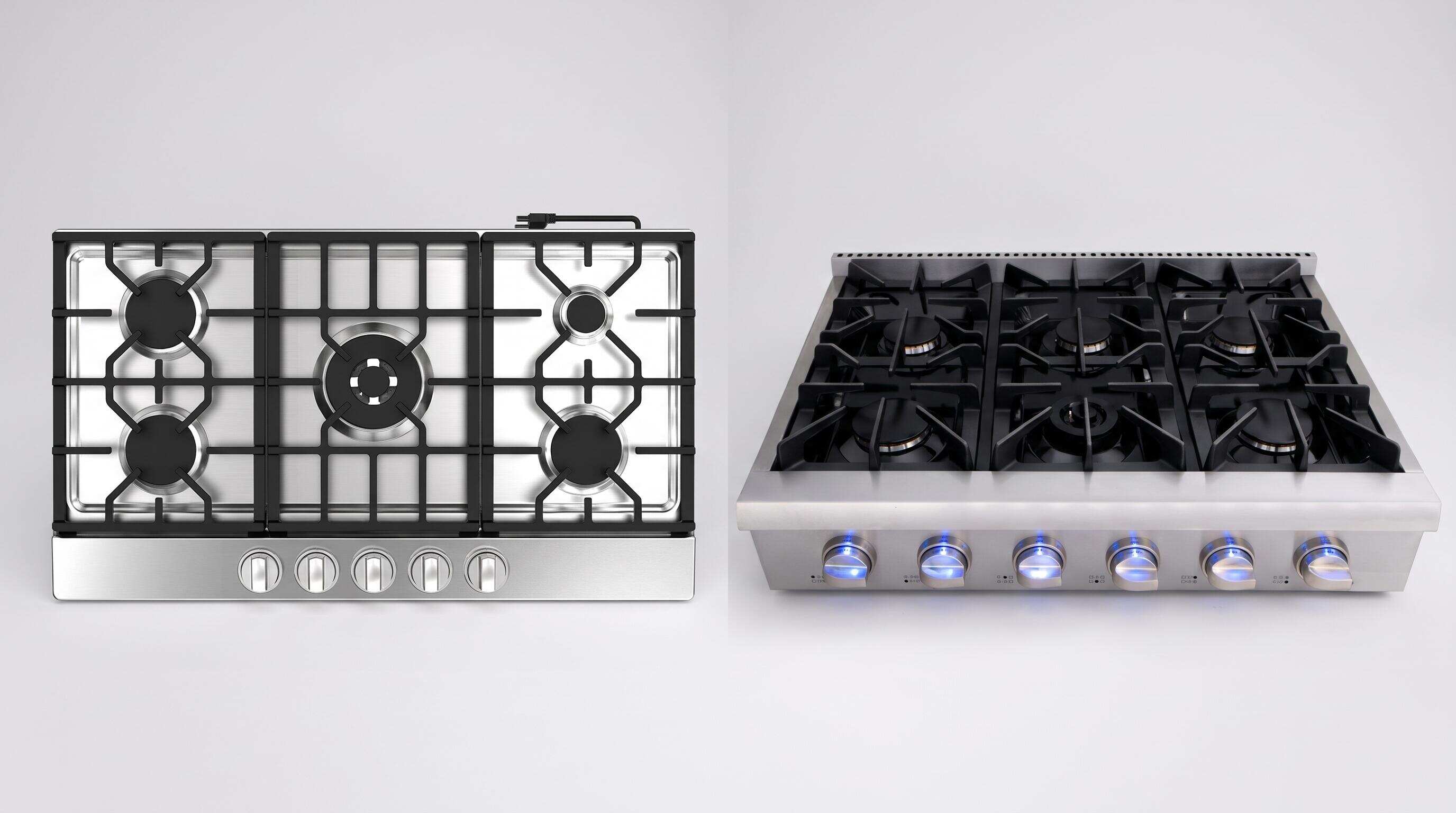
ALT: Cooktop vs rangetop comparison guide for B2B kitchen appliance product line planning
Cooktop vs. Rangetop: What's the Real Difference and Why It Matters for Product Line Planning
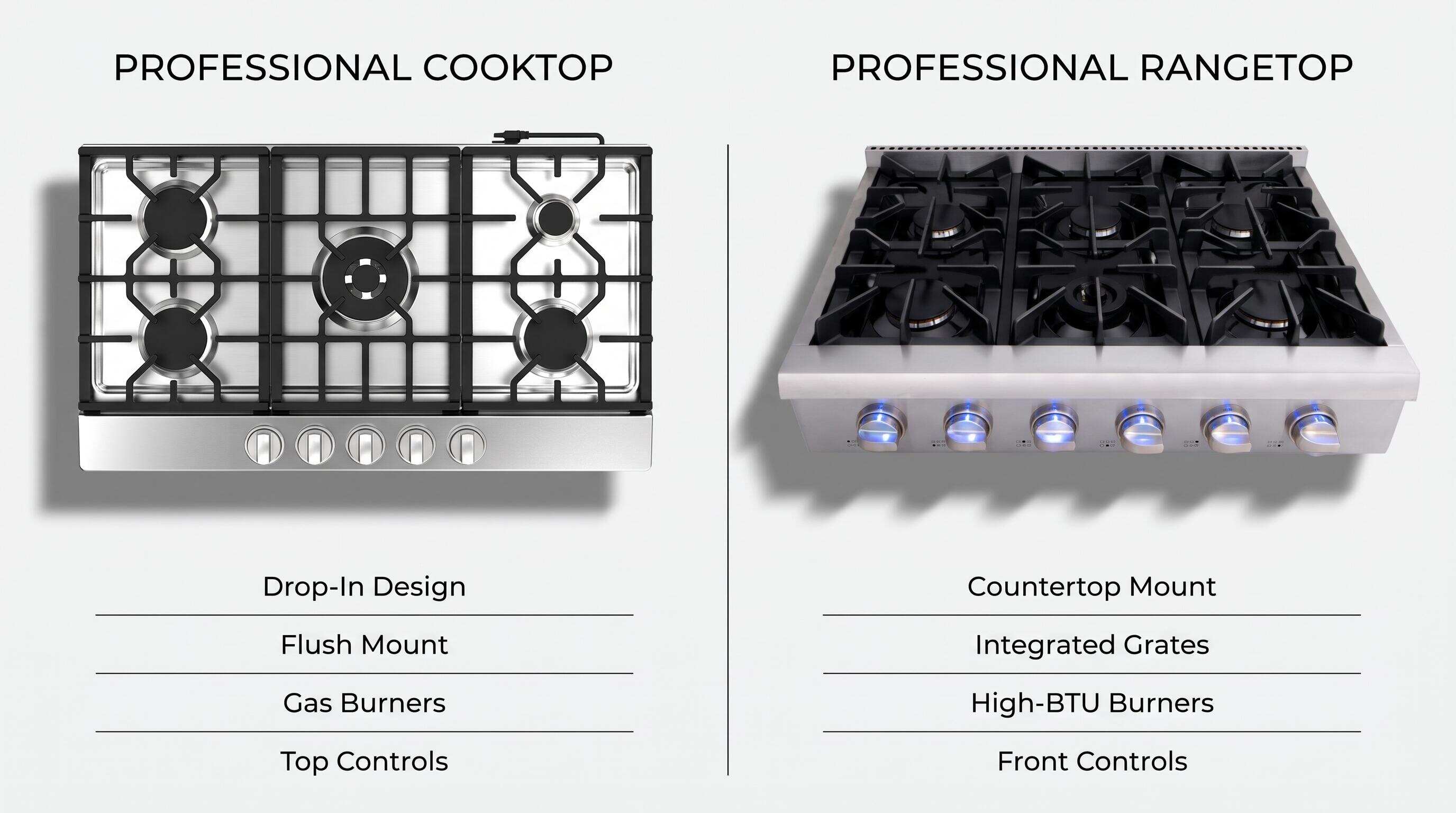
Key Conclusion: A cooktop is a built-in cooking surface designed to be installed directly into a countertop, drawing power from a home's gas or electrical supply without an integrated oven below. A rangetop is typically a built-in cooking appliance designed for installation into a kitchen countertop and cabinet structure, featuring front-mounted control panels, continuous cast-iron grates, and high-output burners for demanding cooking applications. Installation requires appropriate cabinet openings, adequate structural support, and sufficient clearance around the appliance. For B2B buyers planning a product line, the choice between cooktops and rangetops affects target customer segments, installation requirements, price positioning, and OEM/ODM complexity. Specific front-control panel configurations, cabinet cutout dimensions, and support requirements vary by model and should be verified against the corresponding manufacturer's installation drawings.
When global kitchen appliance importers, distributors, and private-label brands approach us at Hyxion with a request to develop a cooking surface line, the first question we always ask is: are you targeting the built-in residential market, or the premium semi-professional segment? The answer almost always comes down to the cooktop versus rangetop distinction — two categories that look superficially similar but diverge sharply in engineering specifications, end-user expectations, margin structures, and certification pathways. This article provides a detailed, practitioner-level comparison to help procurement decision-makers choose the right product category for their lineup.
Evaluation Criteria: How to Compare Cooktops and Rangetops for Sourcing Decisions
Choosing between cooktops and rangetops for your product portfolio requires examining six dimensions that directly affect sourcing complexity, end-market fit, and commercial viability.
Installation format and kitchen compatibility is the most immediate differentiator. Cooktops integrate seamlessly into standard kitchen cabinetry and countertop cutouts, making them broadly compatible with residential renovation projects. Rangetops require a dedicated cabinet base or a custom surround, which affects how installers, kitchen designers, and end consumers interact with the product.
Cooking performance and BTU output reflects the core value proposition of each product type. Cooktops serve everyday cooking needs with moderate heat output across gas, electric, and induction variants. Rangetops are engineered for sustained high-heat cooking, typically featuring professional-grade burners capable of delivering significantly more thermal intensity — a defining quality for culinary enthusiasts and prosumer buyers.
Certification and compliance requirements vary considerably between the two categories. Because rangetops often borrow design elements from commercial kitchen equipment, they may face additional scrutiny under residential appliance standards in markets like North America and Europe. Understanding which standards apply — such as those governed by ANSI or CSA — is essential before committing to tooling investment.
OEM/ODM customization scope determines how much flexibility your manufacturing partner can offer. Cooktops tend to have more standardized form factors, making them easier to private-label or customize within a constrained development timeline. Rangetops involve more complex structural components and higher-precision manufacturing tolerances, which requires a factory with demonstrated experience in professional-grade cooking equipment.
Price positioning and margin structure are closely tied to category positioning. Rangetops command a premium price point and are sold into a narrower, more discerning market, while cooktops occupy a broader, more competitive middle market with higher volume potential but tighter margins.
Retail and channel fit rounds out the evaluation. Cooktops move through general appliance retailers, kitchen showrooms, and e-commerce channels. Rangetops are more naturally positioned through specialty kitchen dealers, luxury home builders, and high-end renovation channels — which affects your distribution strategy and packaging requirements.
The Contenders: Cooktops and Rangetops Defined
Cooktops: The Built-In Residential Workhorse
A cooktop is a self-contained cooking surface unit installed directly into a countertop cutout, with no integrated oven cavity below. Cooktops are available in gas, electric radiant, and induction formats, each with distinct heat delivery mechanisms and installation requirements. Gas cooktops use open burners fed by natural gas or propane. Electric cooktops use radiant heating elements beneath a smooth glass-ceramic surface. Induction cooktops use electromagnetic fields to heat ferromagnetic cookware directly, offering precise temperature control and fast response times.
In our work with clients sourcing residential kitchen appliance lines, cooktops consistently represent the highest-volume category. Their appeal lies in design flexibility, with a range of configuration options available to meet different homeowner and designer preferences. Side-by-side or stacked installation requires verification of model compatibility, ventilation clearances, and manufacturer-approved installation requirements. Standard widths commonly include 30 to 36 inches, although actual dimensions and countertop cutout requirements vary by model and should be confirmed against the manufacturer's specifications.
From a manufacturing standpoint, cooktops are highly amenable to OEM/ODM customization. Burner count, surface material, control type (knob versus touch panel), ignition system, and connectivity features (such as smart home integration) can all be adjusted to meet brand-specific requirements. At Hyxion, we've seen strong demand from North American and European distributors for induction cooktops with app-enabled controls — a configuration that sits squarely within our smart kitchen manufacturing capabilities.
Rangetops: The Prosumer Performance Category
A rangetop is a heavy-duty cooking surface that occupies the top portion of what would otherwise be a full freestanding range, but without the oven section below. Common residential rangetops are designed for built-in countertop and cabinet installation, typically featuring front-mounted control panels for convenient operation. Installation requires a properly sized cabinet opening, adequate clearance for the front control panel, and sufficient structural support from the countertop and cabinet structure. They are primarily gas-powered, although fuel configurations may vary by model. Specific cabinet cutout dimensions, control panel clearances, and support requirements must be verified against the installation drawings and instructions for each specific model.
The defining characteristics of a rangetop are its performance credentials: continuous cast-iron grates that run across the full cooktop surface, restaurant-grade knobs, high-output burners, and often a built-in griddle, wok burner, or grill section. These features serve the prosumer buyer — someone who cooks seriously at home, values culinary capability, and is willing to invest in equipment that reflects professional kitchen standards.
A pattern we consistently see is that importers entering the rangetop category for the first time underestimate the structural and thermal engineering complexity involved. The grate systems, drip pans, and burner caps on a rangetop are precision components, and the assembly process requires tighter quality control than a standard residential cooktop. At Hyxion, our manufacturing process for rangetop-class products involves dedicated assembly lines with stricter inspection protocols to ensure consistent performance across production batches.
Rangetops also differ from cooktops in their spatial demands. They are wider on average, often spanning 30 to 48 inches or more, and their substantial weight and depth require purpose-built cabinetry. This has implications for how you communicate product requirements to your distribution and installation partners — something a good OEM/ODM manufacturer will help you document clearly.
Head-to-Head Comparison: Cooktops vs. Rangetops Across Key Criteria
| Criterion | Cooktop | Rangetop |
|---|---|---|
| Installation format | Built-in countertop drop-in | Built-in countertop installation, typically with front-mounted controls |
| Primary fuel types | Gas, electric, induction | Primarily gas; some dual-fuel |
| Target end user | Broad residential market | Prosumer, culinary enthusiast, luxury residential |
| Burner/cooking performance | Moderate to high (residential standard) | High to very high, depending on model and burner configuration |
| Continuous grates | Typically sectional, varies by model | Commonly features continuous cast-iron grates |
| Smart/connected features | Widely available, especially induction | Less common; availability depends on model |
| OEM/ODM customization ease | High — standardized form factors | Moderate — greater variation in control-panel and installation configurations |
| Certification pathway | Standard residential appliance certifications | Applicable residential appliance standards and certifications; requirements depend on model, fuel type, output, and target market |
| Average retail price positioning | Mid-market | Premium to luxury |
| Channel fit | General appliance retail, e-commerce | Specialty dealers, luxury home builders |
| Installation complexity | Low to moderate | Moderate; requires coordination of front-control panel placement, cabinet openings, clearances, and structural support |
| Cabinetry compatibility | Standard countertop cutout | Requires a compatible cabinet opening and adequate support; front-control panel clearance and installation dimensions vary by model |
The table above highlights that cooktops and rangetops are not simply different sizes of the same product — they serve fundamentally different market segments and require different go-to-market strategies.
The most commercially significant difference for B2B buyers is the channel and customer segment divergence. A cooktop line can be distributed broadly through general appliance retailers and large e-commerce platforms, reaching a wide consumer base. A rangetop line, by contrast, requires a more curated distribution approach — specialty kitchen showrooms, luxury builder programs, and high-end retail environments where knowledgeable staff can communicate the product's value proposition effectively.
From a manufacturing complexity standpoint, the gap between these two categories is real but manageable when you work with the right OEM/ODM partner. Cooktops offer more standardization and faster tooling cycles, which is advantageous if you need to bring a new private-label line to market quickly. Rangetops require more engineering investment upfront — particularly around burner assembly, grate systems, and thermal management — but they also carry significantly higher margins and face less price-based competition at retail. For distributors building a differentiated premium line, that trade-off is often worth it. If you're evaluating manufacturing partners for either category, the checklist for selecting an OEM/ODM kitchen appliance manufacturer offers a structured framework for assessing factory capability, certification support, and customization depth.
Certification is another area where the two categories diverge in practical terms. Cooktops — particularly gas models — are well-understood by certification bodies in North America (CSA, UL) and Europe (CE), and the documentation pathways are established. Rangetops, especially those with high-output burners, may require additional testing and documentation to demonstrate compliance with residential appliance standards. Working with a manufacturer that has in-house testing capabilities can significantly reduce the time and cost of this process.
Which Should You Choose? Scenario Recommendations for B2B Product Line Planning
If you are building a broadly distributed residential appliance line aimed at renovation-focused homeowners across North America or Europe, a cooktop-led strategy is the right starting point. Cooktops offer the widest addressable market, the most flexible design customization options, and the lowest barriers to channel entry. Within this category, induction cooktops with smart connectivity features represent the fastest-growing segment — a configuration that also aligns with energy efficiency regulations becoming more prominent in key markets.
If you are targeting luxury home builders, kitchen designers, or high-end appliance dealers, a rangetop offering is a compelling differentiator. The prosumer cooking category continues to attract strong consumer interest, and importers who establish a credible rangetop line early tend to build durable relationships with specialty dealers who value exclusivity. The higher average selling price also supports better margin structures for both the importer and the retailer.
If your brand currently offers freestanding ranges and you want to expand upmarket, adding a rangetop is the natural next step. It signals a commitment to serious cooking performance and allows you to serve kitchen renovation projects where the customer wants to separate their cooking surface from their oven — often to install a steam oven, speed oven, or wine cooler in a dedicated column beneath the countertop.
If you are entering the market for the first time with limited tooling budget and need to establish volume quickly, start with a cooktop line and use it to build relationships with distributors and retail buyers. Once your brand has market presence and cash flow, expanding into rangetops becomes a natural second phase that leverages the trust you've already built.
Pros and cons summary:
Cooktops offer broad market access, flexible installation, wide channel compatibility, and strong OEM/ODM customization potential, but face more competitive pricing pressure and lower average selling prices compared to premium cooking surfaces.
Rangetops offer premium positioning, high margins, strong brand differentiation, and loyal specialty channel relationships, but require higher upfront engineering investment, more complex installation, and a more targeted distribution approach.
ALT: Side-by-side view of a built-in induction cooktop and a professional rangetop illustrating product line planning differences for B2B kitchen appliance buyers and OEM distributors
Questions & Answers
Q1: How does the choice between a cooktop and a rangetop affect OEM/ODM tooling costs and lead times?
Cooktops generally have shorter tooling cycles and lower tooling investment because their form factors are more standardized across the industry. Rangetops involve more complex structural components — particularly grate systems, high-output burner assemblies, and heavier enclosures — which can extend tooling timelines and require a higher initial engineering investment. Buyers who prioritize speed-to-market may find cooktops more accessible as an entry point, while those building a premium line should budget more time for rangetop development. Working with a manufacturer experienced in rapid prototyping can help close this gap considerably.
Q2: Are rangetops subject to different certification requirements than cooktops in North American markets?
Both product types must comply with applicable residential appliance standards in North American markets, with certification typically provided by bodies such as CSA or UL. However, rangetops with very high BTU output burners may face additional scrutiny during testing because their heat output approaches thresholds more commonly associated with commercial cooking equipment. It is important to clarify with your manufacturer which certification pathway applies to your specific product configuration before finalizing specifications. Manufacturers with in-house testing laboratories, like Hyxion, can help identify and resolve compliance issues early in the development process — reducing costly delays. The CSA and UL certification explained guide provides further detail on how in-house labs accelerate market entry.
Q3: How long does it typically take to bring a custom cooktop or rangetop to market through an OEM/ODM manufacturer?
Development timelines vary depending on product configuration, tooling availability, material sourcing, testing and certification requirements, and production capacity. For cooktops and rangetops, the overall project schedule should be determined by evaluating these factors at each stage of development. Custom branding and control panel modifications may involve different requirements from structural changes to burner and grate systems. Working with a manufacturer that has established tooling infrastructure, reliable material supply chains, and testing capabilities can help streamline the development process while maintaining product quality and compliance.
Summary
Three points frame the core takeaway for procurement decision-makers evaluating this category.
First, the cooktop and rangetop categories serve fundamentally different market segments, and the product line decision should be driven by channel strategy, not just product specification. Cooktops serve the broad residential renovation market; rangetops serve the premium prosumer and luxury residential segment. Getting this alignment right before committing to tooling investment is essential.
Second, both categories present viable OEM/ODM opportunities, but they require different manufacturing capabilities and development approaches. Cooktops favor speed, standardization, and volume. Rangetops reward engineering depth, precision manufacturing, and a willingness to invest in category credibility. A capable OEM/ODM partner can support both paths, but it is worth verifying their experience with the specific category you are targeting.
Third, smart kitchen technology is increasingly relevant across both categories — particularly for induction cooktops — and represents a meaningful differentiator for brands entering competitive distribution channels. Connectivity, app integration, and energy management features are moving from premium to expected in many markets, making it strategically important to partner with a manufacturer who understands both the hardware and the software dimensions of intelligent kitchen appliances.
The next step for most buyers is to validate their product concept with a manufacturer who can offer category-specific guidance, rapid prototyping, and end-to-end compliance support.
Ready to build a cooktop or rangetop line that stands out in your target market? Explore Hyxion's full range of smart kitchen manufacturing capabilities — from flexible OEM/ODM design to factory-direct pricing — by visiting the Hyxion smart kitchen appliances website, where you can browse product catalogues, request samples, or open a conversation about a custom manufacturing partnership tailored to your brand's specifications.
Sources & Further Reading
Note: Standards may be updated; please check the latest official documents or consult professional advisors.
- National House Search. "Cooktop vs Range: The Canter Kitchen Explained".
https://nationalhousesearch.com/post/cooktop-vs-range-canter-kitchens - The True House. "Range vs. Cooktop vs. Range Top".
https://www.thetruehouse.com/post/range-vs-cooktop-vs-range-top - Google. "Cooktop or Range: Which is Right for You? [Bonus: Wall Oven Options]".
https://www.google.com/goto?url=CAES0AEBxCJF19T7qMuzXaWIeCrZ9jo0QD1ut20m5csY6bslGKVtT8QMRNKSt1eJ-a4uhxWIybLwrYzsJC7_hRCHKXAHRvFRAbX7AM-FdbGgL_5Mk4SOjYmqKCPHzQof2QNlZoDOZlfy4OdB7JyA-ocaCT4wBlmop2eqJBGS0wi_KHo4aq82od0NK1bFbl_Wyqg6krDpEJ6Gho98zVC_T1f7Dn4QAbjY5pFdDjwAOoTIaC-q6vjAI2yP-Db69JsGaMdOputyEyTC-VcxawrZ0flD0jpz