
5 Mistakes Distributors Make When Becoming an Oven and Range Reseller

ALT: Distributor reviewing oven and range reseller mistakes with smart kitchen appliances on warehouse shelves
Critical Errors That Derail New Oven and Range Resellers — And How to Avoid Them
What separates a profitable oven and range distribution business from one that stalls out in its first year? The answer, in most cases, is not market demand — it is a handful of avoidable operational and strategic missteps that trip up even experienced distributors entering the kitchen appliance category for the first time.
Becoming a kitchen appliance reseller, specifically one focused on ranges and ovens, is a genuinely attractive opportunity. Global demand for high-performance cooking appliances is strong across residential, commercial, and outdoor kitchen segments. But the category carries complexity that many distributors underestimate: regulatory certification requirements vary by destination market, product specifications must be matched carefully to local infrastructure and consumer expectations, and the manufacturing partnership you choose will shape your competitive position for years to come.
The Five Mistakes New Oven and Range Resellers Consistently Make
Underestimating Certification and Compliance Requirements by Market
In North America, gas ranges and electric ovens must typically comply with standards administered by bodies such as UL (Underwriters Laboratories) or CSA Group. European markets require CE marking and adherence to relevant directives covering electrical safety and electromagnetic compatibility. Australia and New Zealand enforce their own regulatory framework under the Australian/New Zealand standards system. These requirements are not interchangeable — a certification valid in one market rarely satisfies the authorities of another.
A pattern we consistently see is distributors assuming that a product certified for one English-speaking market automatically qualifies for another. This assumption is incorrect. For a detailed breakdown of how in-house testing capabilities at the manufacturing stage accelerate market entry, the guide on CSA and UL certification and why in-house testing labs speed up market entry provides a practical framework worth reviewing before committing to a supplier.
Best for: Distributors planning multi-market entry who need to map certification requirements before finalizing product specifications with their manufacturer.
Watch out: Certification timelines can be lengthy. Factoring them into your product launch schedule — rather than treating them as an afterthought — is essential to avoid delays.
Choosing a Manufacturer Solely on Unit Price
Price is a legitimate evaluation criterion, but it should never be the dominant one when selecting an OEM/ODM manufacturer for ovens and ranges. In our work with global importers, a pattern we see repeatedly is that the distributor who selects the lowest-quoted manufacturer ends up absorbing hidden costs — in the form of quality escapes, rework, failed certifications, or delayed shipments — that far exceed the initial savings.
A competitive unit price from a kitchen appliance manufacturer is meaningful only when it is accompanied by demonstrated quality controls, documented production processes, and transparent communication. Manufacturers without in-house quality assurance infrastructure frequently pass testing and inspection costs back to the buyer, often at inconvenient stages of the production cycle. Distributors entering the oven and range category for the first time are particularly vulnerable to this dynamic because they lack the category-specific benchmarks needed to identify an unsustainably low quote.
The evaluation framework should extend beyond per-unit cost to include tooling fees, minimum order quantities, sample lead times, modification flexibility, and post-shipment support. A manufacturer operating with genuine OEM/ODM expertise — the ability to build a product from a buyer's design brief or to adapt an existing platform to meet private-label specifications — provides a fundamentally different value proposition from a simple trading company reselling stock items. For buyers at the early stages of this evaluation, the buyer's checklist for choosing an OEM/ODM kitchen appliance manufacturer offers a structured approach to assessing suppliers across the factors that matter most.
Best for: Distributors building a private-label brand or seeking long-term manufacturing partnerships where consistent quality directly protects brand equity.
Watch out: The cheapest quote at the RFQ stage frequently reflects missing costs — in testing, compliance preparation, or quality management — that will surface later in the supply chain.
Misreading Market Demand and Stocking the Wrong Product Mix
New oven and range resellers frequently enter the category with a product mix shaped by what was easiest to source rather than what their target market actually demands. This is a structural mistake: inventory tied up in poorly matched products creates cash flow pressure and forces discounting that erodes margins and damages brand positioning.
The oven and range category is more segmented than many distributors initially appreciate. Consumer and commercial buyers have meaningfully different requirements. Within the residential segment alone, preferences for fuel type (gas, electric, induction, dual-fuel), form factor (freestanding, slide-in, built-in), cooking surface configuration, and smart connectivity features vary significantly by region and by end-customer demographic. A product mix optimized for the North American freestanding gas range market will not translate directly to European built-in induction demand, or to the growing outdoor kitchen segment where weather-resistant cabinetry and robust construction are primary decision criteria.
The practical remedy is to invest in market research before committing to initial production volumes — and to partner with a manufacturer who can offer genuine customization flexibility rather than forcing your product mix into a fixed catalogue. Distributors who skip this step typically discover the mismatch only after their first container arrives at the warehouse.
Best for: Distributors entering the oven and range category from adjacent product lines who have not yet built category-specific demand intelligence.
Watch out: Demand patterns in kitchen appliances can shift with consumer trends in home renovation, smart home adoption, and outdoor living. Building review cycles into your buying calendar helps catch these shifts before they affect inventory health.
Neglecting After-Sales Support Infrastructure
The oven and range category is not a transactional product category. Ranges and ovens are high-involvement purchases — both for residential buyers and for commercial operators — and the after-sales experience has a direct, measurable effect on repeat purchase rates, warranty claim costs, and retailer confidence in stocking your line.
A mistake we consistently see among new resellers is treating after-sales support as a cost center to be minimized rather than as a competitive asset. Distributors who cannot offer responsive spare parts availability, clear warranty terms, and accessible technical support damage their relationships with retail partners and end customers alike. In the B2B channel, a single poorly managed warranty claim handled in front of a retail buyer can undermine months of relationship-building.
The foundation of effective after-sales support is established at the manufacturing stage. Work with your OEM/ODM manufacturer to ensure that spare parts are available, that service documentation is complete and accessible, and that your team is trained to handle the product category's specific failure modes. Manufacturers with genuine product development depth — rather than those assembling third-party components without process ownership — are significantly better positioned to support this requirement.
Best for: Distributors supplying retail chains or commercial operators where after-sales performance directly influences reorder decisions.
Watch out: Warranty claim rates and spare parts lead times are worth asking about explicitly during supplier qualification. A manufacturer unwilling to provide this information at the evaluation stage is signaling a gap in their service infrastructure.
Failing to Differentiate From Established Brands
New oven and range resellers frequently attempt to compete head-to-head with established brands on the same product attributes — price, basic features, and aesthetic finish — without developing a clear differentiation strategy. This approach typically produces unsatisfying results: the new entrant is perceived as a generic alternative, margin pressure from incumbent brands is intense, and there is no compelling reason for buyers to switch.
Differentiation in the kitchen appliance category is achievable, but it requires deliberate choices at the product specification stage. Smart kitchen technology — integrated connectivity, app-based control, voice assistant compatibility, and intelligent cooking programs — represents a genuine differentiator that is increasingly accessible through capable OEM/ODM manufacturers. Outdoor kitchen solutions, including weather-resistant ranges and coordinated cabinet systems, address a segment that established residential appliance brands have been slower to serve. Custom branding, including private-label programs with tailored color options, control interfaces, and packaging, allows distributors to build brand equity rather than simply reselling a commodity.
The distributors who succeed in the oven and range category over time are those who leverage their manufacturing relationship to build a product that reflects a specific market insight — a gap in feature availability, an underserved price-performance tier, or a category adjacency that their channel relationships position them to address. This requires a manufacturer partner who treats OEM/ODM as a genuine capability rather than a marketing description.
Best for: Distributors with an existing channel or customer relationship that can be leveraged to introduce a differentiated product — private-label brands, regional distributors with retail exclusivity, or importers targeting a specific end-use segment.
Watch out: Differentiation through smart features requires that your manufacturer can deliver on those features reliably at production scale. Request working samples and conduct thorough functional testing before committing to a product specification.
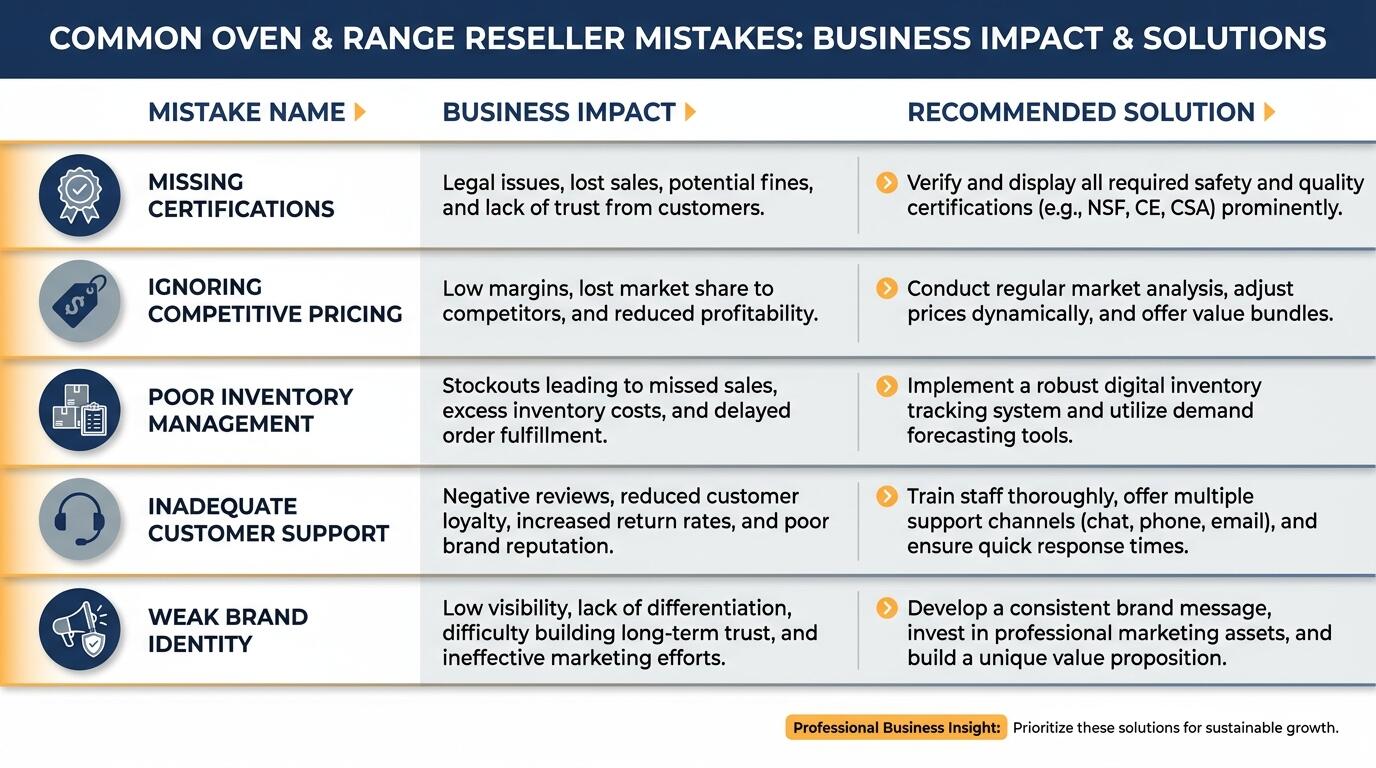
ALT: Summary table comparing five oven and range reseller mistakes, their business impact, and recommended solutions for kitchen appliance distributors
At a Glance: The Five Mistakes and What They Cost You
| Mistake | Best Addressed By | Key Risk | Practical Remedy |
|---|---|---|---|
| Underestimating certification requirements | Multi-market distributors and importers | Shipment holds, product recalls, channel bans | Map certifications by destination market before finalizing specs; partner with a manufacturer offering in-house testing |
| Choosing a manufacturer on unit price alone | All new resellers building a private-label line | Hidden costs in quality, compliance, and rework | Evaluate manufacturers on quality controls, OEM/ODM depth, and total landed cost |
| Stocking the wrong product mix | Distributors entering from adjacent categories | Inventory write-downs, margin erosion, cash flow pressure | Conduct market research before production commitments; prioritize a flexible manufacturing partner |
| Neglecting after-sales infrastructure | Distributors supplying retail chains or commercial operators | Warranty claim costs, damaged retailer relationships | Establish spare parts availability and service documentation at the sourcing stage |
| Failing to differentiate from incumbents | Private-label brands and regional distributors | Commodity positioning, unsustainable margin pressure | Use smart features, outdoor kitchen options, or custom branding to build a distinct product identity |
How to Choose the Right Starting Point
The right entry strategy for your oven and range distribution business depends on your existing channel relationships, your target geography, and the degree of product control you want to maintain.
If you are an established distributor entering the kitchen appliance category for the first time, the most urgent priority is certification compliance. Regulatory missteps in this category are expensive and disruptive, and they tend to surface at the worst possible moment — when a container is sitting at port and your retail partner is waiting on stock. Address this before you finalize any product specifications.
If you are a private-label brand or an importer with a specific market insight, differentiation strategy should drive your manufacturer selection. The ability to customize products — not just apply a logo, but genuinely configure features, materials, and smart capabilities — separates manufacturers with real OEM/ODM expertise from those offering superficial customization. Ask specific questions about configuration flexibility, minimum order quantities for custom runs, and the development timeline from brief to production sample.
A common misconception in this category is that smart kitchen features are only relevant to premium, high-price-point products. In practice, smart connectivity and intelligent cooking programs are increasingly accessible at mid-market price points, and they represent one of the clearest opportunities for a new reseller to offer something that established, slower-moving brands are still catching up to. The smart kitchen segment rewards distributors who move with the market rather than waiting for the market to settle.
If after-sales support infrastructure is your current gap, start by reviewing your manufacturer's service documentation and spare parts supply chain. The investment required to establish this capability is modest compared to the cost of a high-volume warranty claim event that damages a key retail relationship.
Questions & Answers
Q1: How do I determine which certifications my oven and range products need before importing?
Certification requirements for ovens and ranges are determined by the destination market, the product's fuel type, and its intended use. In North America, standards bodies such as UL and CSA Group administer the most relevant approvals. European markets require CE marking. Australian markets enforce their own national standards. The most reliable approach is to identify your target markets first, then work directly with your OEM/ODM manufacturer and a qualified third-party testing laboratory to map the specific certifications required before finalizing product specifications and production schedules.
Q2: Is it realistic for a new oven and range reseller to compete with established brands on a limited budget?
Yes — but only with a clear differentiation strategy. Competing on price alone against established brands is rarely viable for a new entrant. The more realistic path is to identify a specific segment, feature set, or geographic market that incumbent brands are underserving — smart cooking technology, outdoor kitchen applications, or a specific price-performance tier — and build a product tailored to that opportunity through a capable OEM/ODM manufacturing partner. Channel relationships, responsive after-sales support, and private-label branding can compound this advantage over time.
Q3: How long does it typically take to bring a custom oven or range product from initial brief to market?
The timeline from product brief to market-ready inventory depends on the complexity of the customization, the certification requirements of your destination market, and your manufacturer's development process. Generally, a new product involving significant feature customization will require a longer development and testing cycle than a private-label adaptation of an existing platform. Certification testing adds additional time on top of development. Working with a manufacturer who maintains in-house testing capabilities and an experienced OEM/ODM development team materially reduces total lead time compared to routing these activities through external parties.
The Bottom Line
The oven and range reseller category offers genuine commercial opportunity for distributors willing to approach it with preparation and strategic clarity. The five mistakes outlined in this article — underestimating certification complexity, selecting manufacturers on price alone, misjudging product mix, neglecting after-sales infrastructure, and failing to differentiate — share a common root: treating a complex, technically demanding product category as though it were a simple commodity resale business.
Three principles define the distributors who build durable businesses in this space. First, compliance is a foundation, not a checkbox — address it at the sourcing stage, not after the product is on the water. Second, the manufacturing relationship is a strategic asset — a partner with genuine OEM/ODM expertise gives you the ability to build a differentiated product, not just source a generic one. Third, after-sales performance is a competitive dimension — the distributors their retail partners rely on most are those who deliver consistently after the sale, not just at point of purchase.
The entry point for getting this right is the manufacturer you choose. Everything else — product specification, certification readiness, differentiation strategy, and after-sales support — flows from that relationship.
Ready to build a smarter oven and range product line with a manufacturing partner who can deliver on the full scope of that promise? Visit Hyxion's website to explore product catalogues across smart ranges, ovens, cooktops, and outdoor kitchen cabinets, request production samples, or discuss a fully customized OEM/ODM manufacturing partnership tailored to your brand's market goals.
References
- APDA — Appliance Parts Distributors Association. "Find a Parts Distributor".
https://www.apda.com - UASA — United Appliance Servicers Association. "Appliance Repair Servicers Member Directory".
https://www.unitedservicers.com/biz - NBS-US Blog. "Top 5 Mistakes Wholesale Distributors Make".
https://blog.nbs-us.com/top-5-mistakes-wholesale-distributors-make - Cin7. "7 Common Mistakes Wholesalers and Distributors Make".
https://www.cin7.com/blog/7-common-mistakes-wholesalers-and-distributors-make/
Note: Standards and regulatory requirements may be updated; please check the latest official documents or consult professional advisors.