
45-Day Bulk Delivery: What It Means for Your Kitchen Appliance Supply Chain

ALT: Smart kitchen appliance bulk delivery supply chain planning for B2B importers and OEM buyers
Why 45-Day Bulk Delivery Is a Game-Changer for Kitchen Appliance Supply Chains
Imagine you are a procurement manager for a mid-sized kitchen appliance distributor, preparing for a major seasonal push. You have confirmed purchase orders, retailer commitments, and a launch date locked in — but your factory lead time is unclear, your freight window keeps shifting, and your safety stock is thinning. This is not a hypothetical edge case. It is a pattern we consistently see across importers sourcing from overseas manufacturers, and it is exactly the kind of pressure that makes delivery timelines one of the most consequential variables in appliance procurement.
A 45-day bulk delivery commitment — defined here as a manufacturer's guarantee to produce, quality-inspect, and ship a full bulk order within a 45-calendar-day production-to-dispatch window — is a specific, measurable performance standard that transforms how global buyers plan inventory, manage cash flow, and satisfy downstream demand. This article breaks down what that commitment actually means in operational terms, what factors enable or undermine it, and how procurement teams can structure sourcing relationships to consistently hit their market windows.
The items in this list were selected based on the core supply chain stages that determine whether a 45-day bulk shipment succeeds or fails. Use this guide sequentially if you are onboarding a new OEM/ODM partner, or as a diagnostic checklist if an existing program is underperforming.
The Key Supply Chain Factors Behind a 45-Day Bulk Delivery
Pre-Order Technical Alignment
Pre-order technical alignment is the process of finalizing all product specifications, compliance documentation, and tooling requirements before a purchase order is placed — and it is the single biggest determinant of whether a 45-day clock can start on time.
In our work with clients, delayed technical sign-off is the most common reason a "confirmed" order quietly slides from a 45-day window to 70 or 90 days. When buyers submit incomplete BOM details, unresolved branding requirements, or pending certification queries after the order is placed, the factory cannot begin procurement of long-lead components, and the schedule compresses from the inside. For OEM/ODM kitchen appliance programs specifically — covering smart ranges, ovens, cooktops, and dishwashers — the complexity of embedded electronics and smart connectivity features means that pre-production sign-off is non-negotiable.
Best for: Importers launching new private-label SKUs or buyers introducing a new product category where customization depth is high.
Watch out: Assuming that a "close enough" specification can be refined during production. Any revision after material procurement begins resets part of the production timeline and erodes the delivery window.
Component Procurement and Supply Continuity
Component procurement is the stage at which a manufacturer sources all raw materials, sub-assemblies, and specialty components required to build the ordered product — and in a 45-day window, this stage must begin on or before day one of the production calendar.
Manufacturers with vertically integrated supply chains or long-standing supplier relationships in established manufacturing hubs have a structural advantage here. Dongguan-based production facilities, for example, benefit from dense networks of component suppliers for electronics, cabinetry hardware, and cooking technology — which significantly compresses the time between order confirmation and first-article production. For smart kitchen appliances with connected features, the availability of communication modules and embedded controllers within regional supply clusters is a material factor in hitting tight delivery commitments.
Best for: High-volume repeat buyers who have established a stable SKU portfolio, since known bill-of-materials means suppliers can maintain pre-positioned stock.
Watch out: Single-sourced specialty components — particularly imported chips or proprietary actuators — that may carry their own lead times and sit outside the manufacturer's direct control. Vetting a supplier's component sourcing depth is a step often skipped during factory audits but can be found in a comprehensive OEM/ODM buyer's checklist.
Parallel Production Scheduling
Parallel production scheduling means structuring the manufacturing process so that sub-assembly lines run simultaneously rather than sequentially — and for a 45-day delivery program to hold, this is not optional; it is an operational requirement.
A smart range or smart oven, for instance, comprises a cooking cavity assembly, an electronic control unit, a user-interface panel, and a finishing/cladding stage. If these are built in a strict serial sequence, the total production time expands substantially. Factories with dedicated production cells for each sub-assembly — and the planning infrastructure to synchronize them — can compress total build time without sacrificing quality. When evaluating a supplier's ability to deliver within 45 days, ask specifically about their production scheduling methodology, not just their headline capacity numbers.
Best for: Buyers placing orders for complex appliances with multiple integrated systems, such as smart cooktops with touch controls or outdoor kitchen cabinet systems requiring both structural fabrication and electronic integration.
Watch out: Suppliers who quote a 45-day lead time based on single-product runs but have not modeled the timeline for your specific SKU mix. Mixed-SKU orders require dedicated scheduling resources that not every manufacturer has in place.
In-Process Quality Control
In-process quality control (IPQC) is a system of inspections performed at defined stages during production — not only at final assembly — and it is the mechanism that prevents quality failures from compressing delivery timelines at the end of the cycle.
A pattern we consistently see is buyers who deprioritize IPQC discussions in favor of price negotiation, then face end-of-line rejections that hold shipments for rework. When quality control is embedded throughout the production process, defects are caught early, rework is localized, and the final inspection becomes a confirmation rather than a discovery exercise. For smart kitchen appliances destined for markets in North America or Europe, where certifications such as UL, CSA, or CE carry legal weight, a manufacturer's in-house testing capability is directly connected to delivery reliability — because products that cannot pass compliance testing before shipment are not products that can be delivered on time. The relationship between in-house testing labs and market-entry speed is explored in depth in this article on CSA and UL certification and in-house testing lab advantages.
Best for: Any buyer whose target market carries mandatory safety or performance certification requirements, particularly for appliances with electrical heating elements or gas-ignition systems.
Watch out: Factories that position third-party end-of-line inspection as equivalent to embedded IPQC. Third-party inspection is a valuable verification layer, but it cannot replace the time efficiency of catching defects during — not after — production.
Export Documentation and Customs Readiness
Export documentation and customs readiness encompasses the preparation of all shipping documentation, country-of-origin certification, compliance declarations, and customs classification codes required for international freight — and in a 45-day window, this work must begin during production, not after goods are packaged.
Delays at the documentation stage are frequently invisible to buyers until the moment freight is ready to load, at which point a missing certificate or misclassified HS code can hold a container at port for days. Manufacturers with dedicated export coordination teams — experienced in managing documentation for North American, European, and Australian market entry — treat documentation as a parallel workstream, not a final step. For OEM/ODM orders where private-label branding, country-of-origin labeling, and market-specific compliance marks must all appear on the finished product and packaging, this coordination complexity is substantial.
Best for: Buyers importing into markets with strict customs enforcement, particularly for appliances that fall under regulated product categories requiring pre-shipment certification.
Watch out: Assuming the manufacturer's export team is familiar with your destination market's specific requirements. Always confirm which markets a supplier has active export experience with, not just which certifications their products carry in general.
Freight Window Coordination and Booking Lead Time
Freight window coordination is the process of aligning production completion dates with vessel departure schedules — and because major shipping routes from China to North America, Europe, and Australia operate on fixed weekly or bi-weekly sailings, missing a vessel can add one to two weeks to an otherwise on-time production run.
In practice, effective 45-day delivery programs treat the freight booking as a fixed constraint that the production schedule works backward from, not a variable to be arranged after production completes. Ocean freight from major Chinese ports to US West Coast destinations, for example, carries a transit time that must be added on top of the 45-day production window — so when manufacturers quote a 45-day figure, buyers should clarify whether that timeline represents production-to-dispatch or production-to-destination. The distinction materially affects inventory planning and retailer commitment dates.
Best for: Buyers with fixed retailer floor-set dates or promotional launch windows, where missing a vessel is equivalent to missing the sales opportunity.
Watch out: Relying on spot-market freight bookings for time-sensitive bulk orders. Preferred-carrier relationships and advance booking capacity are features that distinguish high-performance manufacturing partners from transactional suppliers.
Packaging and Retail-Ready Presentation
Packaging in a 45-day bulk delivery context is not simply protective wrapping — it is a deliverable that must meet retailer cartonization requirements, pass drop-test standards, carry correct language-compliant labeling, and support efficient warehouse receiving and shelf replenishment.
For private-label kitchen appliance programs, packaging design and print production must be finalized well before production completes, since printed cartons and inner packaging are themselves manufactured components with their own lead times. Factories that treat packaging as an afterthought frequently discover, in the final week of a production run, that cartons are unavailable, sizing is inconsistent, or labeling is non-compliant — all of which delay dispatch. When evaluating a manufacturer's 45-day capability, ask specifically about their packaging procurement and print timelines relative to their stated production window.
Best for: Retail-channel buyers whose products go directly to store shelves or fulfillment centers, where retail-ready packaging is a contractual requirement, not a preference.
Watch out: OEM programs where the buyer provides the packaging design but underestimates the time required for print production and delivery to the manufacturing facility. Packaging artwork should be approved at the same time as product specifications — not at the end of the design cycle.
Post-Shipment Visibility and Delivery Tracking
Post-shipment visibility is a buyer's ability to track cargo in real time from factory dispatch through port loading, ocean transit, and domestic last-mile delivery — and it is the final element that determines whether a 45-day production commitment translates into a reliable supply chain outcome for the end customer.
Appliance logistics involve particular complexity at the last-mile stage. Large, heavy goods require specialized handling, appointment scheduling, and in some cases threshold or in-home delivery services. As documented by logistics providers with direct experience in appliance fulfillment, the last-mile stage for large appliances carries higher damage rates and customer dissatisfaction risk than standard parcel delivery — which means that production quality and delivery quality are both necessary, and neither is sufficient alone. Buyers should establish shipment tracking protocols with their manufacturing partners and their freight forwarders from the outset of any new program.
Best for: Importers who operate direct-to-consumer or omnichannel fulfillment models, where end-customer delivery experience is an extension of the product brand.
Watch out: Treating post-shipment as the freight forwarder's sole responsibility. Manufacturers who maintain active communication through final delivery — providing packing lists, container load plans, and proactive exception notifications — are operationally superior partners, and this capability should be part of supplier qualification.
Quick Comparison at a Glance
| Supply Chain Factor | Best For | Key Strength | Limitation |
|---|---|---|---|
| Pre-Order Technical Alignment | New SKU launches and high-customization OEM programs | Prevents timeline erosion before it starts | Requires buyer discipline and early spec commitment |
| Component Procurement and Supply Continuity | High-volume repeat programs with stable SKUs | Compresses production start time significantly | Specialty or imported components may carry independent lead times |
| Parallel Production Scheduling | Complex appliances with multiple integrated sub-systems | Reduces total build time without quality trade-offs | Requires scheduling infrastructure not all factories possess |
| In-Process Quality Control | Markets with mandatory safety certification requirements | Prevents end-of-line rework from compressing dispatch timelines | Does not replace third-party final inspection; both are needed |
| Export Documentation and Customs Readiness | Regulated destination markets (North America, EU, Australia) | Treats documentation as a parallel workstream, not a final step | Requires manufacturer experience with specific destination markets |
| Freight Window Coordination | Fixed retail floor-set or promotional launch dates | Embeds vessel scheduling as a production constraint | Spot-market freight bookings are higher risk for time-sensitive orders |
| Packaging and Retail-Ready Presentation | Retail-channel buyers with cartonization and labeling requirements | Ensures full delivery readiness, not just production readiness | Packaging artwork must be approved early — not at end of cycle |
| Post-Shipment Visibility and Delivery Tracking | Direct-to-consumer and omnichannel fulfillment models | Extends supply chain quality through final delivery | Requires coordination across manufacturer, forwarder, and logistics provider |
How to Choose the Right Focus Area for Your Program
Matching supply chain focus to your actual procurement situation is more valuable than applying every element equally. The right starting point depends on where your current program most frequently breaks down.
If your orders consistently ship late despite apparently confirmed timelines, the problem is almost always upstream — either in pre-order technical alignment or component procurement. A thorough pre-production checklist and early BOM review can resolve the majority of these delays without requiring any change to your manufacturing partner.
If your products ship on time but arrive with higher-than-acceptable defect rates or compliance failures, the gap is in in-process quality control and documentation readiness. This points to a need for deeper supplier quality system review — specifically, how defects are caught and resolved during production, not after.
If your production quality is strong but retailer relationships are strained due to unreliable delivery windows, the issue is typically in freight coordination and packaging readiness. These are operational disciplines that high-performing manufacturers embed into their production planning as standard practice.
A common misconception among buyers entering a 45-day bulk delivery program for the first time is that the manufacturer bears all responsibility for the timeline. In practice, every stage described in this article has a buyer-side input requirement — approved specifications, confirmed artwork, agreed packaging, and responsive communication. The 45-day window is a shared operational commitment, not a passive guarantee.
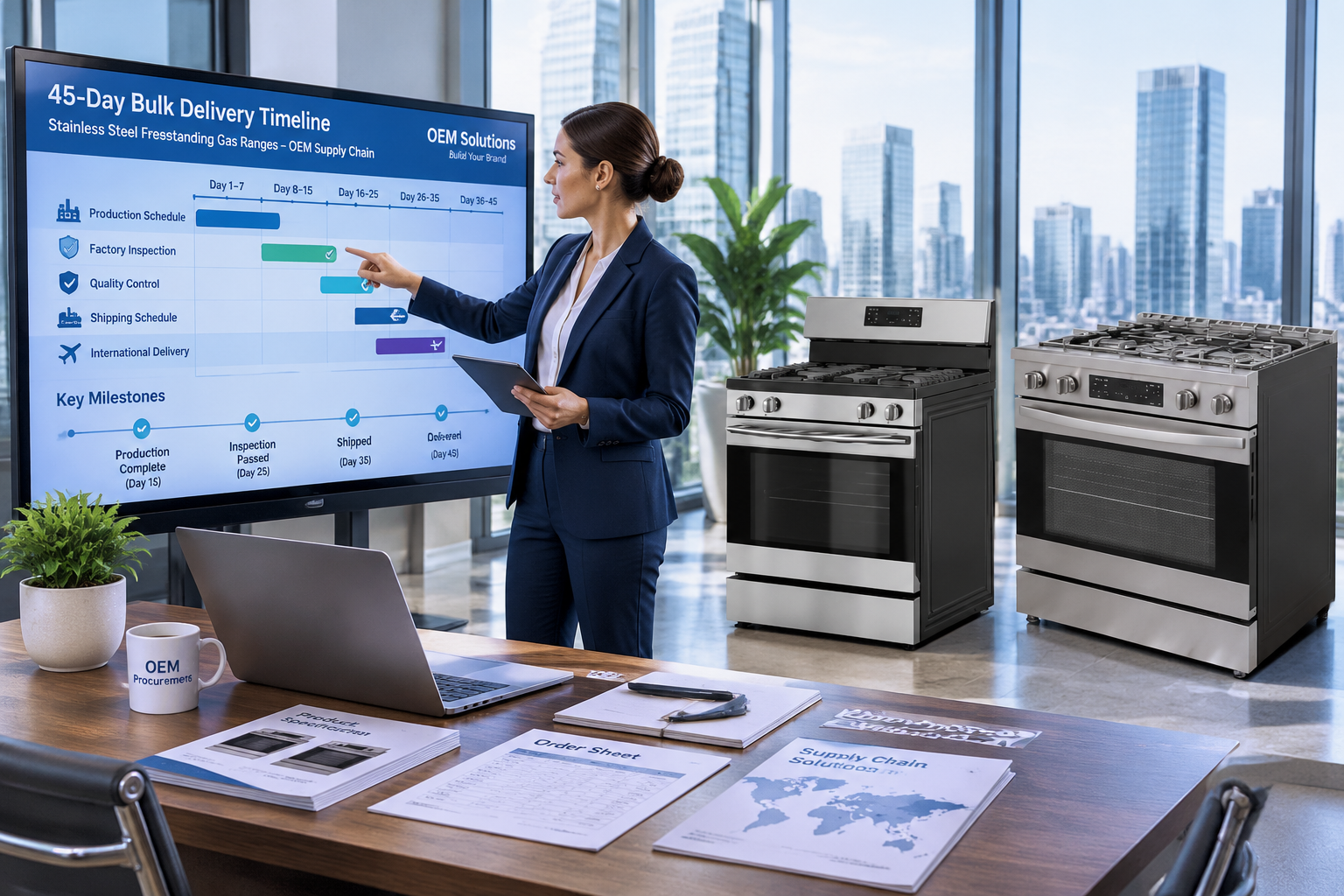
ALT: Procurement manager reviewing 45-day bulk delivery timeline for smart kitchen appliance OEM supply chain in a modern office setting
People Also Ask
Q1: How does a 45-day bulk delivery window affect kitchen appliance inventory planning?
A 45-day production-to-dispatch window allows procurement teams to plan inventory replenishment cycles with meaningful precision. When this window is reliable, buyers can align purchase orders with sell-through data, reduce safety stock requirements, and avoid both stockout and overstock scenarios. The key is distinguishing between the 45-day manufacturing window and total supply chain lead time — ocean freight transit adds to this figure and must be incorporated into any demand planning model.
Q2: Is a 45-day lead time realistic for customized OEM kitchen appliances?
A 45-day lead time is achievable for OEM kitchen appliances when pre-production technical sign-off, component procurement, and parallel production scheduling are all in place before the clock starts. Manufacturers with vertically integrated supply chains and established component supplier networks in regions like Dongguan are structurally better positioned to meet this standard than those relying on extended external supply chains. The more customization involved — particularly smart connectivity features or unique cladding materials — the more critical early-stage alignment becomes.
Q3: How long does the full delivery cycle take from factory dispatch to warehouse receipt in North America or Europe?
The full cycle from factory dispatch to warehouse receipt typically involves the 45-day production window plus ocean freight transit time, which varies by route and vessel schedule. Transit from major Chinese ports to US West Coast destinations is generally in the range of two to three weeks; to European ports, transit can range from three to five weeks depending on routing and port of entry. Buyers should work with their freight forwarders and manufacturing partners to map the total cycle accurately and build purchase order schedules around realistic end-to-end timelines rather than production lead time alone.
Summary
A 45-day bulk delivery commitment is a meaningful operational standard — not a marketing claim — when every stage of the supply chain performs as designed. The buyers who consistently achieve on-time, on-spec bulk delivery outcomes are those who treat the manufacturing timeline as a shared responsibility, invest in pre-production alignment, and select manufacturing partners with the scheduling infrastructure, quality systems, and export capabilities to sustain performance across programs.
Key Takeaways:
- Pre-order technical sign-off is the highest-leverage point in the 45-day window — delays here cascade through every subsequent stage.
- Component procurement depth and regional supply chain density are structural advantages that distinguish reliable bulk delivery partners from inconsistent ones.
- Parallel production scheduling, embedded IPQC, and export documentation readiness are operational capabilities, not standard features — they must be verified during supplier qualification.
- The 45-day window covers production to dispatch; total lead time includes ocean freight transit and must be incorporated into inventory and retailer commitment planning.
- Post-shipment visibility is the final link in a supply chain designed around reliable delivery — buyers should establish tracking and exception protocols from program launch.
The next step for procurement teams evaluating a new bulk delivery program is a structured supplier capability assessment — one that covers not only production capacity but scheduling methodology, component sourcing depth, quality systems, and export documentation experience.
Ready to partner with a manufacturer whose 45-day bulk delivery capability is built into the production process, not bolted on as a promise? Visit Hyxion's smart kitchen appliance manufacturing platform today to explore product catalogues, request samples, or discuss a fully customizable OEM/ODM program designed around your brand's supply chain requirements.
References & Further Reading
- DTS Direct. "Wholesale Kitchen Appliances: Sourcing + Service".
https://dts-direct.com/wholesale-kitchen-appliances/ - Ryder. "The Quest for Perfecting Last-Mile Appliance Delivery".
https://www.ryder.com/en-us/insights/blogs/last-mile/perfecting-last-mile-appliance-delivery - CDS Logistics. "Last Mile Delivery for Mattresses, Furniture & Appliances".
https://www.cdslogistics.net/last-mile-delivery-large-items-mattresses-furniture-appliances/ - International Organization for Standardization (ISO). Quality Management and Supply Chain Standards.
https://www.iso.org/
Note: Standards may be updated; please check the latest official documents or consult professional advisors.