
What's Included in a One-Stop OEM/ODM Service: From Design to Packaging
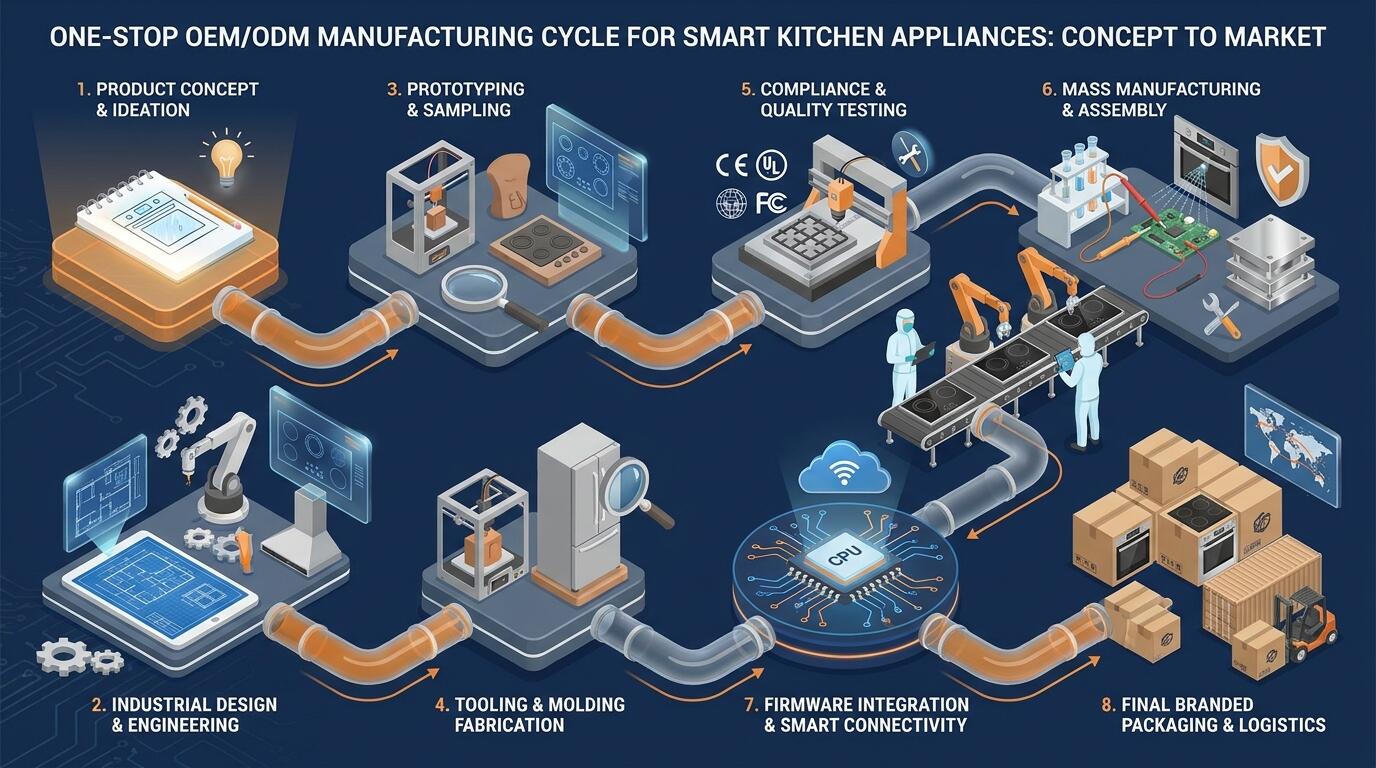
ALT: One-stop OEM ODM service stages from product design to final packaging for smart kitchen appliances
What a Complete OEM/ODM Service Actually Covers — From First Sketch to Finished Package
A one-stop OEM/ODM service is a full-cycle manufacturing partnership that takes a buyer's product concept — or an existing reference design — and delivers market-ready, branded goods without requiring the buyer to manage individual vendors for engineering, tooling, production, compliance, or logistics preparation. For global procurement teams sourcing smart kitchen appliances, understanding exactly what that scope includes is the difference between a smooth product launch and a costly, fragmented supply chain.
In our work with clients — kitchen appliance importers, private-label brands, and regional distributors across North America, Europe, and Australia — a pattern we consistently see is that buyers arrive at the first conversation with a clear outcome in mind (a finished product on their shelf) but an incomplete picture of the intermediate steps that connect a concept to that outcome. This article maps every major stage a credible one-stop service should contain, explains why each stage exists, flags where things can go wrong, and gives procurement decision-makers a framework for evaluating whether a potential manufacturing partner genuinely covers the full scope or is quietly leaving gaps that will fall on the buyer to fill.
Buyers can use these eight stages to confirm the scope of an OEM/ODM project and who is responsible for each deliverable, a Dongguan-based OEM/ODM manufacturer of smart kitchen appliances, and cross-referenced against documented industry practice. Each item is treated as a service component you should explicitly discuss and confirm with any factory partner before signing a purchase agreement.
The Eight Core Stages of a One-Stop OEM/ODM Service
Product Concept Development and Market Requirement Translation
Product concept development is the stage where a buyer's commercial intent — a target price point, a feature set, a competitive gap in a specific market — is translated into engineering language a factory can act on. Without this stage, what a buyer wants and what a factory produces can diverge from the very first specification document.
In practice, this means a one-stop partner should offer structured briefing sessions, formal product requirement documents (PRDs), and competitive benchmarking support. At Hyxion, this stage involves our engineering team sitting with the buyer's sourcing or product team to align on function priorities, regional regulatory constraints, and cost envelopes before a single line is drawn. The output is a written specification that all subsequent stages reference.
- Best for: Brands entering a new product category, importers who want to differentiate from generic catalog products, and procurement managers who lack in-house industrial design capacity.
- Watch out: Manufacturers that skip a formal PRD and move straight to sampling tend to generate revision cycles that inflate lead times and tooling costs significantly.
Industrial Design and Engineering Design (ID/ED)
Industrial design and engineering design together define what a product looks like and how it works at a component level. ID covers form factor, materials palette, color and finish specifications, and human-interface elements. ED covers mechanical engineering, electrical schematics, component selection, and thermal or airflow calculations — particularly relevant for smart ovens, cooktops, and rangetops where heat management is a safety-critical variable.
Early reviews between industrial designers and engineers can identify design issues before tooling begins and reduce the risk of rework.
- Best for: Buyers commissioning truly bespoke products — private-label brands wanting distinctive aesthetics, or distributors seeking a product that cannot be easily replicated by competitors.
- Watch out: Confirm that the factory owns its own design team rather than outsourcing to a third-party bureau; the latter adds cost, communication lag, and IP risk.
Prototyping and Sample Fabrication
Prototyping is the stage where the engineering design is physically realized, typically in sequential iterations — from rough functional models to appearance prototypes to production-equivalent pre-series units. Each iteration validates a different set of assumptions: fit and function first, then aesthetics and ergonomics, then manufacturing process stability.
For smart kitchen appliances specifically, prototyping must address both the hardware and the embedded software/connectivity layer. A smart range that connects to a home automation system, for example, requires firmware validation alongside the physical prototype. At Hyxion, For connected models, agree on the firmware tests required before prototype approval.
- Best for: Any buyer committing to custom tooling — the prototype stage is where errors are caught at model cost rather than at tooling or production cost.
- Watch out: Factories that offer only one or two prototype rounds before pushing to tooling approval are compressing a stage that frequently needs three or more iterations for complex appliances.
Tooling and Mold Manufacturing
Tooling and mold manufacturing is the capital-intensive stage where production-grade dies, injection molds, and stamping fixtures are fabricated to enable repeatable, high-volume production. The quality of tooling directly determines dimensional consistency, surface finish quality, and the longevity of the production run before tools need refurbishment.
A one-stop partner either owns its tooling workshop or has long-term, transparent arrangements with dedicated tooling suppliers — and critically, should be willing to register tooling ownership in the buyer's name or provide written assurances about tool custody and portability. In our experience, tooling ownership terms are frequently underspecified in early agreements and become a point of friction when buyers wish to transfer production or run additional quantities at a second facility.
- Best for: Buyers planning medium-to-high volume runs where per-unit amortization of tooling cost makes economic sense; custom configurations that cannot be approximated with off-the-shelf molds.
- Watch out: Always clarify in the contract who owns the molds and what the process is if you need to move production — vague language here is a significant commercial risk.
Regulatory Compliance Engineering and Certification Support
Regulatory compliance engineering is the process of designing and testing a product to meet the electrical safety, electromagnetic compatibility (EMC), energy efficiency, and product safety standards required by the target market. For kitchen appliances exported to North America, Europe, Australia, and similar regulated markets, compliance is not optional — and it must be engineered in, not bolted on after a product is designed.
Relevant standards bodies and regulatory frameworks include UL (Underwriters Laboratories) for North American electrical safety, the CE marking framework administered through EU directives for the European market, and the SAA/RCM scheme for Australia and New Zealand. A credible one-stop OEM/ODM partner coordinates pre-compliance testing during prototype stages, prepares technical files, and manages third-party certification lab relationships on the buyer's behalf. This keeps compliance timelines parallel with development rather than sequential — a practice that materially shortens time to market.
- Best for: Importers and brands that lack in-house regulatory affairs capacity, particularly those entering a new geographic market for the first time.
- Watch out: Factories that claim certification support but actually leave the buyer to manage lab submissions and documentation are offering a much narrower service than a genuine one-stop model.
Manufacturing and Quality Control
Manufacturing and quality control is the stage most buyers focus on, but its effectiveness depends entirely on what happened in the preceding design and prototyping stages. At Hyxion's Dongguan facility, production of smart kitchen appliances — smart ranges, ovens, cooktops, rangetops, dishwashers, and outdoor kitchen cabinets — is governed by structured process controls including incoming material inspection, ask which production checks apply to your model and what inspection records will be available.statistical process control (SPC), and finished-goods inspection protocols.
For smart appliances specifically, quality control extends beyond dimensional and cosmetic inspection to include functional testing of electronic controls, connectivity modules, and safety interlock systems. A one-stop service should define, in writing, the acceptable quality level (AQL) for each inspection stage, the sampling plan, and the disposition process for nonconforming units — before production begins, not after a shipment fails inspection at the destination port.
- Best for: All buyers — this stage is non-negotiable regardless of volume or product category.
- Watch out: Factories that conflate final inspection with comprehensive quality control are describing only the last gate in a process that should have multiple checkpoints throughout production.
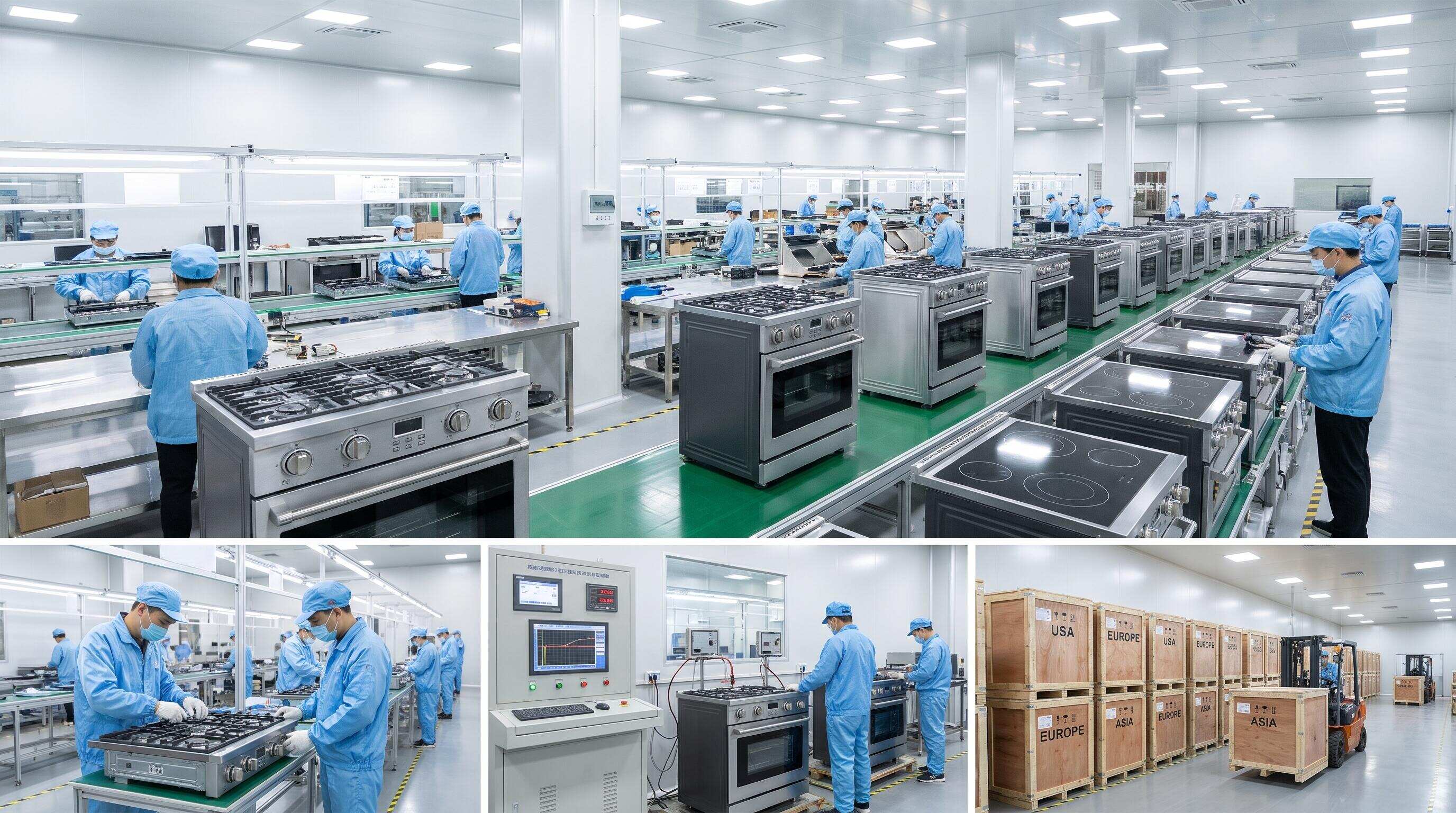
ALT: Smart kitchen appliance OEM ODM manufacturing line showing quality control, compliance testing, and assembly stages for global B2B export partners
Firmware, Software, and Smart Feature Integration
Firmware and software integration is a service component that separates generic appliance manufacturers from genuine smart appliance OEM/ODM partners. Smart kitchen appliances — connected ranges, app-controlled ovens, Wi-Fi-enabled cooktops — require embedded firmware, mobile application integration, and often cloud connectivity infrastructure that must be stable, updatable, and compliant with regional connectivity standards (such as Matter/Thread protocol compatibility increasingly expected in North American and European markets).
A one-stop service for smart kitchen appliances should include firmware development or customization, over-the-air (OTA) update capability planning, and UI/UX design for any associated control interfaces. In our work with international buyer clients, the software layer is frequently the stage where timeline risk is most underestimated — buyers who treat firmware as a commodity often discover late in the program that the connectivity feature set they specified is not achievable within the hardware architecture that was locked in tooling.
- Best for: Brands and importers positioning products in the connected home or smart kitchen segment, where differentiation increasingly comes from the software experience rather than hardware alone.
- Watch out: Confirm that firmware source code ownership, versioning, and OTA update responsibility are explicitly addressed in your manufacturing agreement — these terms are as commercially important as physical tooling ownership.
Private-Label Branding, Packaging Design, and Logistics Preparation
Private-label branding, packaging design, and logistics preparation is the final stage that converts a manufactured product into a market-ready unit bearing the buyer's brand identity. This includes application of the buyer's logo, colorway, and brand language across product surfaces, accompanying documentation, and all layers of packaging — primary (product box), secondary (master carton), and where relevant, tertiary (pallet configuration for retail or warehouse delivery).
A complete one-stop service does not stop at a finished unbranded product. It extends to preparing export documentation, applying destination-country barcodes and labeling (including FCC, CE, or energy-rating labels where mandated), and configuring carton dimensions and weights for the buyer's logistics provider. At Hyxion, packaging engineering is treated as a functional discipline — protecting the product through multimodal shipping while also delivering the unboxing experience a retail buyer expects — not simply as a cosmetic step.
- Best for: Private-label brands and retail chains that require shelf-ready presentation, importers supplying directly to major retail or e-commerce fulfillment centers with strict inbound packaging specifications.
- Watch out: Confirm that your partner's packaging service is calibrated to your specific retail or logistics channel requirements — packaging designed for pallet-in warehouse delivery differs significantly from packaging designed for individual e-commerce shipment.
Quick Comparison at a Glance
The table below summarizes all eight stages of a one-stop OEM/ODM service, their primary value, and the most common gap that emerges when a manufacturing partner's service is not genuinely end-to-end.
| Service Stage | Best For | Key Strength | Limitation to Verify |
|---|---|---|---|
| Concept Development and PRD | Brands new to a category; buyers without in-house product teams | Aligns commercial intent with engineering reality before investment | Skipped by factories that prefer to work from buyer-provided specs only |
| Industrial and Engineering Design | Custom products requiring distinctive aesthetics or complex function | Eliminates handoff errors between design and manufacturing | Outsourced design teams add IP risk and communication lag |
| Prototyping and Sample Fabrication | All custom programs before tooling commitment | Catches errors at model cost, not tooling or production cost | Compressed prototype rounds increase downstream revision risk |
| Tooling and Mold Manufacturing | Medium-to-high volume custom configurations | Enables repeatable, high-quality production at scale | Mold ownership terms must be explicitly contracted |
| Regulatory Compliance and Certification | Importers entering regulated markets (NA, EU, AU) | Keeps compliance parallel with development, shortens launch timeline | "Support" can mean anything from full management to pointing to a lab list |
| Manufacturing and Quality Control | All buyers at all volumes | Structured process controls ensure consistent finished goods | Multi-stage QC must be contracted, not assumed |
| Firmware, Software, and Smart Feature Integration | Connected appliance brands and importers | Delivers a differentiated, software-driven product experience | Software ownership, OTA responsibility must be explicitly agreed |
| Private-Label Branding, Packaging, and Logistics Prep | Retail chains, e-commerce brands, shelf-ready importers | Delivers a fully market-ready unit under the buyer's brand | Packaging must be calibrated to the specific retail or logistics channel |
How to Choose the Right OEM/ODM Partnership Scope
Selecting the right scope of OEM/ODM service depends primarily on three variables: how much of a finished product concept you bring to the table, what regulatory markets you are targeting, and whether your product requires smart or connected features.
Buyers who arrive with a finished industrial design and detailed engineering specifications may genuinely only need manufacturing, QC, certification, and packaging from a partner — this is a narrower OEM arrangement and is a legitimate starting point. Buyers who have a market opportunity and a rough brief but need a partner to develop the product from scratch benefit most from engaging the full eight-stage scope described above, which is the ODM model at its broadest.
A common misconception in this space is that ODM is only for buyers who have no design capacity at all, while OEM is for sophisticated brands with established product teams. In practice, the distinction is more nuanced. Many well-resourced brands use ODM engagements selectively — they may have strong marketing and ID capabilities but lack the electrical engineering depth to design a smart oven's thermal management and connectivity layer. A one-stop partner like Hyxion accommodates hybrid scopes, where the buyer leads certain stages and the manufacturer leads others, with clear handoff points documented at the outset.
The clearest signal that a potential partner's service is not genuinely one-stop is an inability to quote a fixed scope and timeline for stages beyond manufacturing. If a factory can tell you their production lead time precisely but cannot articulate how they manage compliance submissions or packaging engineering, those stages will become the buyer's problem — which contradicts the entire value proposition of a one-stop model.
Prioritize partners who present a stage-gated development plan with defined deliverables, decision points, and responsibility assignments at the first conversation. That level of process discipline is a reliable proxy for the operational maturity that sustains consistent product quality across markets.
Questions & Answers
Q1: How long does a full end-to-end OEM/ODM cycle typically take for a smart kitchen appliance?
The timeline for a complete one-stop OEM/ODM program — from concept brief to finished, packaged product — varies based on product complexity, the number of prototype iterations required, and the certification pathway for the target market. For smart kitchen appliances with connectivity features and multi-market compliance requirements, full-cycle programs are commonly measured in months rather than weeks. Engaging a partner who runs compliance testing in parallel with late-stage prototyping, rather than sequentially, is the most reliable way to compress the overall timeline.
Q2: Is intellectual property protection a realistic concern when working with a China-based OEM/ODM manufacturer?
IP protection is a genuine and manageable concern, not a reason to avoid China-based manufacturing. Before sharing drawings or specifications, have legal counsel review the confidentiality agreement, including its scope, governing law and dispute-resolution terms, and working with manufacturers who have established relationships with international buyer brands — a track record that creates reputational accountability. Vetting a partner's existing client base and contractual practices during supplier qualification is more protective than relying on any single legal instrument.
Q3: What does private-label packaging support actually cost relative to overall OEM/ODM program costs?
Packaging design and logistics preparation typically represent a relatively small proportion of total program cost, but the downstream cost of getting it wrong — rejected inbound shipments at retail warehouses, damaged goods from inadequate protective packaging, or non-compliant labeling triggering customs delays — can far exceed the incremental cost of doing it properly from the outset. Buyers should treat packaging engineering as a cost center with measurable ROI rather than a discretionary service, and confirm at the quoting stage exactly what the partner's packaging service includes.
Wrapping Up
A one-stop OEM/ODM service is only as valuable as its actual coverage — a partner that handles manufacturing but leaves compliance, firmware, and packaging to the buyer is not delivering a one-stop service, regardless of how it is marketed.
Key Takeaways:
- A genuine one-stop OEM/ODM scope spans eight stages, from concept development and industrial design through regulatory certification, smart feature integration, and market-ready packaging.
- Firmware and software integration is a distinct and often underestimated stage for smart kitchen appliances — treat it with the same contractual rigor as physical tooling.
- Tooling ownership, mold custody terms, and firmware source code rights are the three contractual elements most commonly left vague and most frequently responsible for commercial disputes.
- Running compliance testing in parallel with prototyping — rather than after design lock — is the single most effective tactic for shortening time to market in regulated export markets.
- Selecting a partner based on process discipline and stage-gate clarity, not simply on unit pricing, is the more reliable predictor of a successful multi-year supply relationship.
The next step for any procurement team evaluating smart kitchen appliance sourcing is to request a detailed stage-gate proposal from candidate manufacturers and compare not just what they claim to offer, but how specifically they can describe the deliverable, timeline, and responsibility assignment for every stage above.
Explore your next smart kitchen appliance OEM/ODM program with Hyxion — a factory-direct partner that Contact Hyxion to confirm which stages are included in your quotation, who will deliver them and which services are quoted separately. purpose-built for global B2B buyers.
References
- pritechcare.com. "OEM ODM Manufacturing Process: From Design to Mass Production."
https://www.pritechcare.com/blog/oem-odm-manufacturing-process-an-overview/ - Unifyr Atlas. "Original Design Manufacturer (ODM)."
https://www.unifyr.com/atlas/original-design-manufacturer - OEM Kiosks. "OEM/ODM: What Are the Differences of These Business Models?"
https://oemkiosks.com/blog/oemodm-differences-business-models/ - Brightpearl. "OEM vs ODM: A Clear Guide to Choosing the Right Model."
https://www.brightpearl.com/blog/oem-vs-odm-explained - Alibaba Seller. "OEM vs ODM Manufacturing: Complete Guide to Custom Manufacturing."
https://seller.alibaba.com/blogs/2026/southeast-asia/design-services/oem-vs-odm-manufacturing-guide-alibaba-b2b
Note: Standards and regulatory requirements may be updated; please check the latest official documents or consult professional advisors for current requirements in your target market.