
Wall Oven Buying Guide for Importers: Specifications That Matter This Quarter
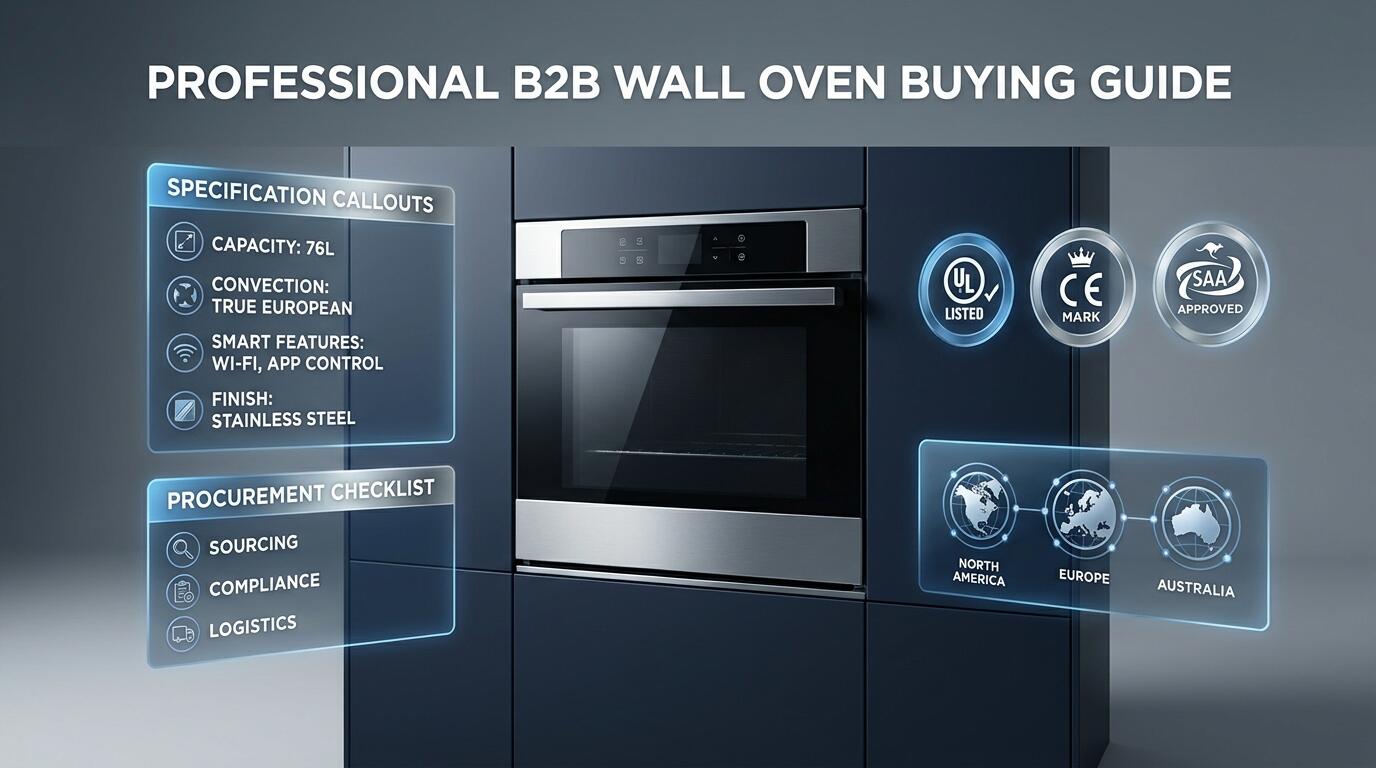
ALT: Wall oven buying guide for importers covering key specifications and OEM sourcing considerations
What This Wall Oven Buying Guide Delivers for Importers This Quarter
The single question most procurement managers face right now is this: which wall oven specifications actually determine whether a product will sell, comply, and scale — and which ones are just marketing noise? This guide answers that question directly. By the time you finish reading, you will have a structured framework for evaluating wall oven specifications against market compliance requirements, end-user expectations, and OEM manufacturing realities — so your next sourcing decision is grounded in criteria that protect margin and reduce risk.
This guide is written for kitchen appliance importers, wholesale distributors, private-label brands, and retail chains who are actively sourcing wall ovens this quarter and need a reliable, specification-led approach to supplier evaluation and product selection.
Before You Start: Prerequisites and Preparation for Smart Sourcing
Sourcing wall ovens at scale is not a task that rewards improvisation. In our work with global buyers across North America, Europe, and Australia, a pattern we consistently see is that procurement teams who arrive at supplier conversations without defined specification baselines end up accepting whatever the factory defaults offer — and those defaults rarely align with the destination market's regulatory environment or the brand's positioning requirements.
Before diving into specification evaluation, every importer needs a clear picture of four things: the target market's regulatory framework, the installation environment, the end-user segment, and the brand's differentiation strategy. Without these anchors, even a technically impressive wall oven specification sheet becomes difficult to evaluate meaningfully.
Wall oven sourcing timelines vary depending on customization depth, so approaching suppliers without prior knowledge of lead time realities and minimum order quantities will create scheduling risk. Qualitatively, deeper OEM customization — cavity coatings, control interface design, door hinge configurations — requires longer pre-production alignment than off-the-shelf units.
Checklist before starting:
- Confirm destination market certification requirements (UL/CSA for North America, CE/CB for Europe, SAA for Australia, and applicable equivalents for other regions)
- Document the installation cutout dimensions standard in your target market — wall oven cavity sizing conventions differ between regions and between single and double configurations
- Define your end-user segment: residential premium, mid-market residential, or light commercial — this determines the feature-set baseline
- Establish your private-label or OEM requirements: control panel branding, finish options, packaging, and documentation language
- Align internally on annual volume commitments, as these directly influence factory pricing tiers and customization flexibility
- Identify your quality inspection protocol — third-party pre-shipment inspection is strongly advisable for first-time factory relationships
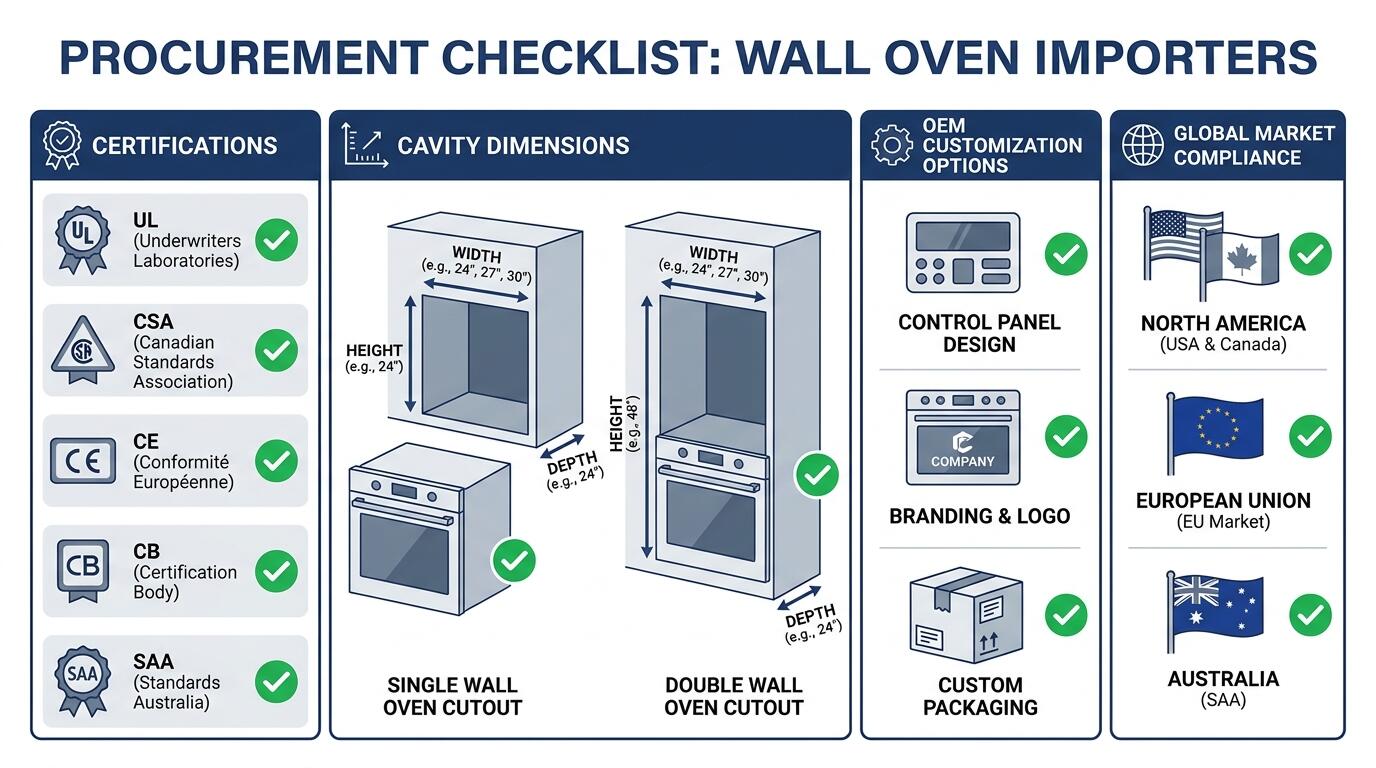
ALT: Importer procurement checklist for wall oven specifications including certifications, cavity dimensions, and OEM customization requirements for global market compliance
Step-by-Step: Evaluating Wall Oven Specifications That Matter This Quarter
Step 1: Anchor Your Evaluation to Destination Market Certifications First
Certifications are not optional add-ons — they are the non-negotiable gatekeepers of market entry. A wall oven that fails to carry the right certification for its destination market cannot legally be sold, regardless of how competitive its price point is. The first step in any specification evaluation is confirming that the supplier holds active, verifiable certifications for the markets you serve.
For North America, the standard certifications are UL (Underwriters Laboratories) and CSA (Canadian Standards Association). For the European Union, CE marking is mandatory, and the CB scheme (administered through the International Electrotechnical Commission's IECEE system) provides a recognized pathway for multi-market certification. For Australia and New Zealand, applicable certification, registration, and marking requirements must be verified separately for each product model and target market. SAA Approvals is a recognized certification body that may issue relevant product certificates, while the Regulatory Compliance Mark (RCM) is the applicable compliance mark for in-scope electrical equipment. The required certification and registration processes depend on the product classification and applicable local regulations. Many buyers overlook the fact that certifications must be held at the specific product model level — a factory's general certification does not automatically cover every variant it produces.
When evaluating suppliers, request certification documentation for the exact model configuration you intend to import. Confirm the certification body, the certificate number, and the expiry date. In our experience working with importers, overlooking certificate expiry is one of the most common and costly oversights in the sourcing process — particularly for buyers who rely on reorders of previously approved configurations without rechecking documentation.
Tip: Ask the supplier directly whether the certification covers your specific voltage and frequency configuration (Verify voltage, frequency, power rating, and circuit requirements against the nameplate and installation manual for each specific model) — these are distinct certification scopes, not interchangeable.
Step 2: Establish Cavity Capacity and Dimensional Compatibility
Wall oven cavity capacity — the usable interior volume expressed in cubic feet or liters — is the specification that most directly influences consumer purchase decisions and retailer category placement. It is also the specification that most frequently creates compatibility problems when importers fail to verify cutout dimensions against their market's standard cabinet configurations.
Cavity capacity conventions differ meaningfully between North American and European markets. North American buyers typically evaluate wall ovens in cubic feet, while European markets use liters. Critically, the cutout dimensions required for installation are not standardized globally — a unit designed for a standard North American cutout will not necessarily fit a European kitchen cabinet configuration, and vice versa. Importers targeting multiple regional markets often need to source distinct configurations rather than assuming a single SKU will travel.
When reviewing a supplier's specification sheet, map the external product dimensions and the required cutout dimensions against the standard cabinet configurations in your target market. For single wall ovens versus double wall ovens, this calculation changes substantially — double configurations stack vertically and require precise cutout height planning.
Tip: Request a physical or digital installation template from the supplier, and validate it against the cabinet dimension standards used by your target retail partners or installers before committing to a production run.
Step 3: Evaluate Heating Technology and Cooking Function Range
The heating technology embedded in a wall oven determines its performance positioning, energy consumption profile, and the market segments it can credibly address. Wall ovens today are commercially available in three primary heating configurations: conventional (top and bottom elements), convection (with an added fan to circulate heat), and multi-function platforms that combine conventional, convection, and additional modes such as steam injection, air fry, or pyrolytic self-cleaning.
Convection capability has moved from a premium differentiator to a baseline expectation in most developed markets. Buyers sourcing for the mid-market residential segment or above should treat convection as a minimum specification requirement. The differentiator now lies in the sophistication of the convection implementation — true European convection (a dedicated heating element surrounding the rear fan) distributes heat more evenly than simple fan-assisted convection and commands a stronger positioning argument in retail.
Smart wall ovens — units with integrated Wi-Fi or Bluetooth connectivity, app-based control, and voice assistant compatibility — represent the leading edge of the product category. As a manufacturer of smart kitchen appliances, we see consistent demand growth for connected wall ovens from importers targeting premium residential and design-led markets, where app integration and remote preheating have become meaningful purchase drivers.
Pyrolytic self-cleaning is another specification that commands a premium and significantly reduces buyer hesitation at retail. Confirm whether the supplier's pyrolytic function reaches the cavity temperatures required for effective cleaning, and whether the door glass and door seal are rated for repeated pyrolytic cycles without performance degradation.
Tip: Request a cooking function matrix from the supplier that maps each function to its heating element configuration — this reveals whether "multi-function" is genuine or simply a relabeling of a limited feature set.
Step 4: Scrutinize Energy Efficiency Ratings and Labeling Requirements
Energy efficiency ratings are increasingly a regulatory requirement rather than a marketing choice. In the European Union, the EU Energy Label applies to electric ovens, and products must be rated and labeled according to the current rating scale before they can be placed on the market. In Australia, the Energy Rating Label scheme administered by E3 (the Equipment Energy Efficiency program) applies to a range of appliances including ovens in some categories.
For importers, the practical implication is this: a wall oven that lacks a compliant energy label for its destination market is a legal liability, not a commercial opportunity. Confirm with your supplier whether the product has been tested and rated under the applicable regional energy efficiency framework, and request the supporting test reports.
Beyond regulatory compliance, energy efficiency ratings are a retail positioning tool. End consumers in North American, European, and Australian markets are increasingly sensitive to operating costs, and products with strong energy ratings convert at higher rates in both online and in-store retail environments.
Tip: Ask for the energy test report (not just the declared rating) so your quality team can verify the testing methodology and confirm it aligns with the destination market's standard — different markets use different test cycles and cavity load configurations.
Step 5: Assess Control Interface Design and Smart Integration Capabilities
The control interface is the primary touchpoint between the appliance and its user, and it is also the element of the product most directly associated with perceived quality and brand positioning. Wall oven control interfaces range from mechanical knobs and simple digital displays to full-color touchscreens with graphical interfaces, voice control integration, and cloud-based recipe ecosystems.
For importers building a private-label or branded product line, the control interface is also the most visible canvas for brand differentiation. OEM and ODM manufacturers can typically accommodate custom interface graphics, branded boot screens, language localization for menu text, and integration with specific smart home platforms — but these customizations require early engagement in the product development process, not a last-minute request before tooling is confirmed.
Smart integration specifications that matter this quarter include Wi-Fi protocol (2.4 GHz is the current consumer standard, with 5 GHz adoption growing), app platform compatibility (iOS and Android at minimum), and voice assistant compatibility (Amazon Alexa, Google Assistant). Importers targeting the North American premium market should confirm whether the product supports Matter — the cross-platform smart home interoperability standard — as this is becoming an expectation among tech-forward consumers and smart home ecosystem buyers.
Tip: Request a live demonstration of the connected features, not just a specification sheet entry. App responsiveness, firmware update delivery, and cloud server reliability are real differentiators that a spec sheet cannot communicate.
Step 6: Verify Build Quality Indicators and Material Specifications
Build quality in wall ovens is communicated through material choices that buyers can verify during factory visits or sample evaluation. The key material touch points are cavity liner material and coating, door glass construction, exterior finish options, and door hinge mechanism durability.
Cavity liners are most commonly constructed from cold-rolled steel with an enamel coating, though premium units use porcelain enamel or catalytic/pyrolytic-rated coatings. For pyrolytic models, the cavity coating must withstand repeated high-temperature cleaning cycles without crazing, discoloration, or adhesion failure — request test reports or cycle durability data from the supplier.
Door glass construction is a safety and durability indicator. Multi-layer door glass (typically three or four panes) provides better thermal insulation, keeps the outer glass surface safer to touch during operation, and reduces energy loss. Single-layer door glass is a cost-reduction signal that often reflects compromises elsewhere in the product.
Exterior finishes — stainless steel, black stainless, matte black, and custom RAL colors for OEM builds — need to be evaluated for fingerprint resistance and scratch resistance, as these are common consumer complaints in product reviews and a frequent driver of returns.
Tip: During sample evaluation, cycle the door open and closed repeatedly and assess the hinge resistance and closing feel — this qualitative test reveals hinge mechanism quality more reliably than any specification sheet entry.
Step 7: Confirm OEM/ODM Customization Scope and Production Flexibility
For importers building private-label brands or distributing under house brand positioning, the final and arguably most commercially important specification evaluation is not about the product itself — it is about the manufacturer's OEM and ODM capabilities. The question is not just what the factory makes, but how much of it they can change, how quickly, and at what volume threshold.
OEM customization typically covers branding elements: control panel graphics, nameplate, packaging design, and documentation language. ODM customization goes deeper, potentially encompassing heating element configuration, cavity dimensions, software interface design, and feature set selection. Confirm explicitly with your supplier which customization categories are available at your projected volume, and request examples of previous OEM builds to verify that the factory has genuine experience delivering branded products at market-ready quality.
Production flexibility — the ability to accommodate volume fluctuations, introduce mid-run engineering changes, or expedite specific SKUs — is a capability that separates strong manufacturing partners from transactional suppliers. In our experience, buyers who invest time in understanding a factory's production planning process before placing an order are significantly better positioned to manage the supply chain challenges that inevitably arise during scaling.
Tip: Ask the supplier for their standard lead time for an initial OEM production run versus a reorder — the gap between these two figures reveals a great deal about their tooling readiness and production scheduling discipline.
Common Mistakes and Troubleshooting
| Symptom | Likely Cause | How to Fix |
|---|---|---|
| Product rejected at customs or by retailer | Missing or expired destination market certification | Verify certificate validity and scope before confirming the production run; request updated documentation for every model variant |
| Installation cutout does not match cabinet dimensions | Specification sheet dimensions not validated against destination market standards | Obtain the full dimensional drawing including cutout requirements and cross-check with local cabinet standards before sample approval |
| Smart features fail to connect in destination market | Wi-Fi frequency band or app region lock incompatible | Confirm frequency band and app market availability for the destination country during the specification review stage |
| Control panel text in incorrect language | Localization not specified in the OEM brief | Include language localization as an explicit line item in the product specification document shared with the factory |
| Energy label non-compliant for EU or AU market | Energy testing not conducted under destination market test protocol | Request test reports citing the applicable regional standard; do not accept a rating without supporting test documentation |
| Cavity coating failure after limited use | Pyrolytic-rated coating not specified; standard enamel substituted | Specify cavity coating type explicitly in the product brief and request a material confirmation in writing from the supplier |
Pro Tips for Better Results
Treat sample evaluation as a stress test, not a showcase. Factories naturally present their best-configured samples. Run the oven through multiple cooking cycles, engage the self-clean function if applicable, and inspect the cavity, door seal, and hinge after the cycles are complete. The post-cycle condition of a sample tells you far more than its initial appearance.
Build specification documents that the factory cannot misinterpret. Vague specifications such as "good quality stainless steel" or "app compatible" are open to interpretation in ways that consistently disadvantage the buyer. Every specification that matters commercially should be expressed in a form that has a binary pass/fail outcome — either the door glass is three-layer or it is not; either the app supports iOS 16 and above or it does not.
Engage the factory's engineering team, not just the sales team. Sales teams are optimized to close orders; engineering teams are where the real specification conversation happens. If a supplier is reluctant to connect you with their engineering contacts during pre-order discussions, that reluctance is itself a signal about the depth of their OEM capability.
Plan for regulatory change. Energy efficiency standards and smart home connectivity requirements are both areas where regulations are actively evolving in major markets. Build a review checkpoint into your product development timeline so that specification decisions made during sourcing are re-validated against current regulatory requirements before production is confirmed.
Misconception to correct: Many importers assume that a product certified for one major market automatically meets the safety and performance requirements of other markets. This is not accurate. CE marking does not satisfy UL requirements; UL listing does not satisfy SAA requirements. Each destination market requires its own certification scope, and buyers who rely on a single-market certification for multi-market distribution create serious legal and commercial exposure.
Common Questions
Q1: How do I determine which wall oven specifications are most critical for the North American market?
For the North American market, the most critical specifications include UL and CSA certification (essential for many retail and commercial distribution channels), cavity capacity in cubic feet aligned with standard North American cutout dimensions, and convection capability as a baseline feature. For each specific model, verify the voltage, frequency, power rating, and circuit requirements against its nameplate and installation manual. Smart integration — particularly Wi-Fi connectivity and voice assistant compatibility — is increasingly important for premium SKUs. Confirm that the supplier holds valid UL and CSA certifications covering each specific model, rather than relying solely on company-level credentials.
Q2: Are OEM wall ovens from Chinese manufacturers compliant with international safety standards?
OEM wall ovens manufactured in China can and do achieve full compliance with international safety standards — the determining factor is whether the specific manufacturer holds the relevant certifications for the specific product configuration. China-based manufacturers that supply global markets routinely obtain UL, CE, CB, and SAA certifications through accredited international testing bodies. The critical buyer responsibility is to verify that the certification covers the exact model variant being sourced, including voltage, control configuration, and any OEM customization applied.
Q3: What is a realistic timeline for an OEM wall oven sourcing project, from specification to first shipment?
The timeline for a first-time OEM wall oven sourcing project varies depending on the depth of customization, but buyers should plan qualitatively for a multi-month process encompassing specification alignment, sample production, sample evaluation and revision, pre-production inspection, and sea freight. Deeper customizations — new tooling, custom software interfaces, or new cavity configurations — extend the timeline compared to branding-only OEM projects. Reorder timelines on established configurations are substantially shorter. Early engagement with the factory's engineering team compresses the front-end alignment phase significantly.
Final Thoughts
Wall oven sourcing decisions made this quarter will shape product line performance for the next several years. Three principles consistently separate importers who build durable, profitable product lines from those who cycle through supplier relationships managing quality problems and compliance gaps.
First, specifications are commercial commitments, not technical formalities. Every specification you define — or fail to define — has a downstream consequence in retail, compliance, and consumer satisfaction. The discipline of building precise, verifiable specification documents before engaging factories is the single highest-leverage investment a procurement team can make.
Second, certification is market access. No amount of competitive pricing compensates for a product that cannot legally enter its destination market. Treat certification verification as the first filter in supplier evaluation, not an afterthought.
Third, OEM partnerships are built on manufacturing transparency, not just product catalogues. The factories best positioned to support private-label growth are those that engage openly with engineering questions, provide documentation proactively, and demonstrate flexibility in production planning. These qualities are assessable in the sourcing process if you know what to look for.
The practical next step is to build your specification framework before your next supplier conversation — and to partner with a manufacturer whose OEM capabilities match the ambition of your brand's market positioning.
Explore smart wall oven configurations, request product samples, or start a customization conversation with Hyxion's OEM/ODM team — a trusted factory-direct partner for global kitchen appliance importers.
References
- Homewise Appliance. "Modernize Your Kitchen: The Best Wall Ovens of 2024".
https://www.homewiseappliance.com/blog/best-wall-ovens?srsltid=AYCX9vKFGyh-HSYZgeRy6fKb4jne6oL1Z1NRhjmUAmhCHS4vHHPET38c - YouTube. "Top 5 Best Wall Oven Reviews".
https://www.youtube.com/watch?v=H6eDS3IWbsc - Bray & Scarff. "Top 5 Most Popular Wall Ovens of 2023".
https://www.brayandscarff.com/blog/top-5-most-popular-wall-ovens-of-2023?srsltid=AYCX9vKaVrJaThbZXOKIp-d1U6G_DN8j4b3sakiXoOBg7w23-KAyw7rq - Grand View Research. "Wall Ovens Market Size, Share & Growth Report 2035".
https://www.google.com/goto?url=CAESzwEBxCJF1_4d6yzezEmxHymiVeO3kld90r1qGPAetMT13ykbz02Qc6rbqfNcwzWKadsVk3W0jTcp4kZ9yZJHDvDk0Ej0Mm4NKkO71_BmZAdmmSTGxFpC4TuktuF5EHkN8dochcLH6UXU_8_1J-olY8nQHHQBzBvmt0VUDEkrMI9nd9-wJh_SYFfTkSXJLi9YmHD8xjvgDMwE9ORNd3_Bs0FNPjqFLJvMssknuGzh2TTTAw1z2DEUYe-av9twQIGfz574HOWAjwncFRydOolGlR4
Note: Standards may be updated; please check the latest official documents or consult professional advisors.