
Steps to Launch a Private-Label Kitchen Appliance Line with an OEM Partner
Why Launching a Private-Label Kitchen Appliance Line Is More Achievable Than You Think
Imagine this: a regional home goods distributor has built a loyal customer base over a decade, but every product on its shelves carries someone else's brand. Leadership sees an opportunity — a growing demand for mid-range smart kitchen appliances — but the idea of building a factory feels impossible. What they actually need is not a factory. They need the right OEM partner and a clear process for launching their own private-label line.
Private-label kitchen appliance manufacturing is a business model in which a retailer, distributor, or brand owner commissions a third-party factory to produce goods that are sold under the buyer's own brand name. Private-label manufacturing is one option for importers, distributors, and regional brands looking to introduce products under their own brand names. Depending on the manufacturer's capabilities and the project agreement, OEM and ODM partnerships may cover selected activities such as product customization, engineering coordination, compliance documentation support, and packaging. Buyers should confirm which services are provided directly by the manufacturer and which require external partners or separate arrangements.
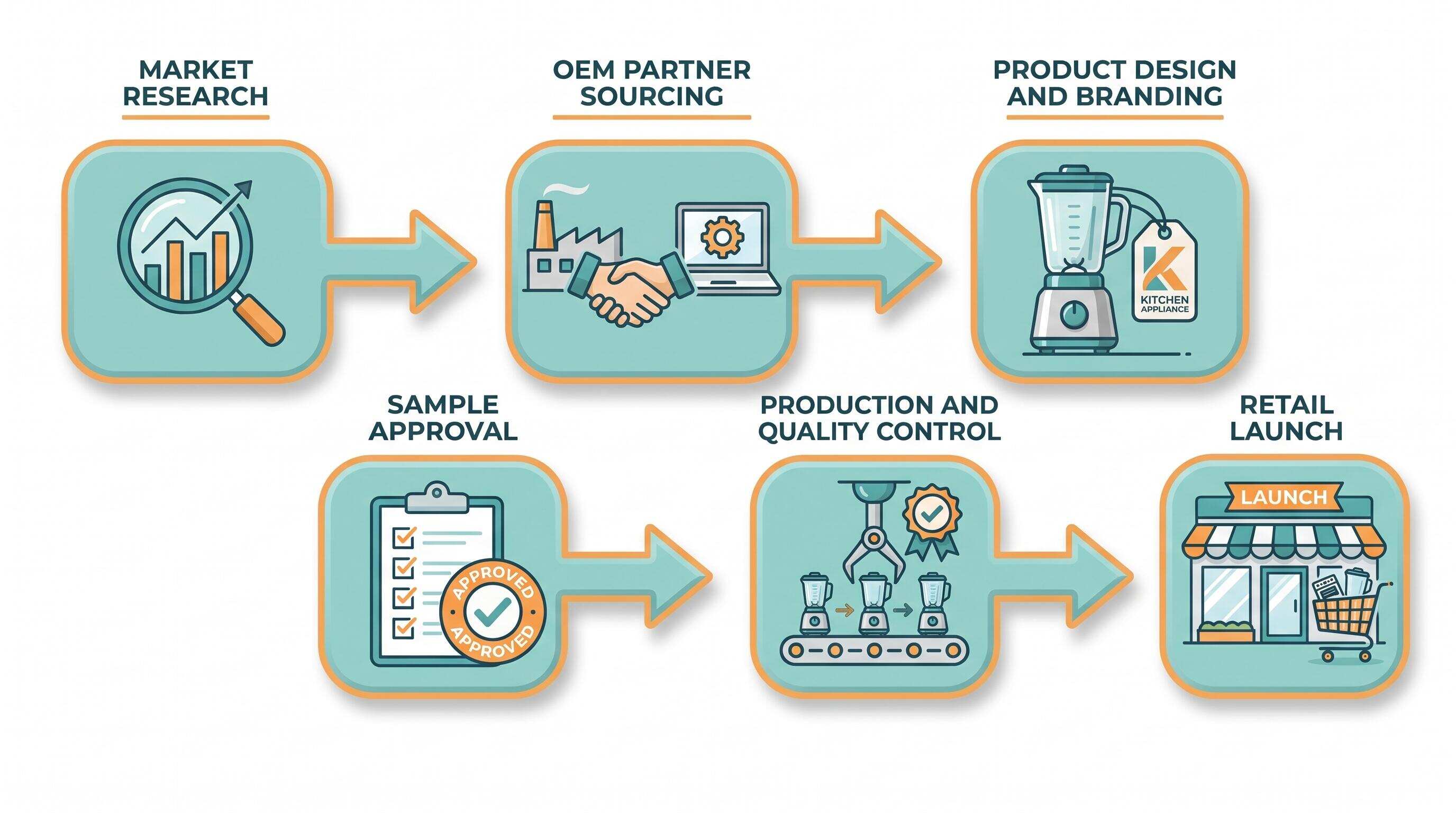
Launching a private-label kitchen appliance line typically involves several interconnected activities, including supplier evaluation, product specification development, compliance planning, sampling, and production coordination. The following steps provide buyers with a structured framework for organizing these activities and evaluating potential OEM partnerships. Whether you are a procurement manager evaluating this model for the first time or a sourcing specialist planning your next product category expansion, this list gives you a structured path to follow.
The Core Steps to Launch Your Own Private-Label Kitchen Appliance Line
Define Your Product Scope and Target Market Before You Approach Any Supplier
Defining the product scope and target market before contacting suppliers helps buyers communicate their requirements more clearly. Without a sufficiently detailed brief, differences in product specifications, customization expectations, and compliance requirements may lead to additional sample revisions or adjustments during project planning.
Your product scope should address the appliance category (ranges, cooktops, ovens, dishwashers, rangetops, or outdoor kitchen cabinets, for example), the intended end market (North America, Europe, Southeast Asia), the retail price tier your brand will occupy, and the core features your target customer expects. At this stage, competitive benchmarking is valuable: study three to five competitor SKUs in your target category and document what your private label must match or improve.
Best for: First-time private-label entrants and distributors expanding into a new product category who need to validate market demand before committing to tooling or MOQ commitments.
Watch out: Overly broad product briefs — "we want a smart oven" — give factories too much creative latitude and make it difficult to compare quotes meaningfully across multiple suppliers.
Research and Shortlist OEM/ODM Manufacturers with Demonstrated Category Expertise
Selecting the right OEM partner is the foundational decision that will shape every subsequent step — quality, lead time, compliance, and customization flexibility all flow from this choice. OEM (Original Equipment Manufacturing) partners produce goods to your specifications, while ODM (Original Design Manufacturing) partners offer existing product platforms that can be customized with your branding, colorways, and feature sets. Many manufacturers, particularly in China's kitchen appliance sector, offer both models.
When shortlisting manufacturers, evaluate their category depth. Manufacturers with experience in specific appliance categories may have established tooling resources, production knowledge, and component sourcing arrangements relevant to those products. Buyers should evaluate these capabilities through factory documentation, production records, product samples, and category-specific references rather than relying solely on a manufacturer's stated experience. A manufacturer's experience in the relevant appliance category can be an important factor when evaluating product development and sampling capabilities. Buyers should compare engineering resources, existing product platforms, sample requirements, and validation arrangements across suppliers to determine which partner is best suited to the project.
Evaluate manufacturers on: documented production certifications relevant to your target market, in-house design and engineering capability, stated MOQ flexibility, quality management systems, and experience exporting to your specific region. Request factory audit reports and, where possible, conduct a virtual or on-site facility visit before shortlisting.
Best for: Procurement managers sourcing from China for the first time, or buyers who have experienced quality or compliance failures with previous suppliers and need to rebuild confidence in their supply chain.
Watch out: A manufacturer's online presence and product photography are not reliable proxies for actual production capability. Always verify claims through direct documentation requests and reference checks with existing B2B clients.
Draft a Detailed Product Brief and Customization Requirements Document
A product brief is a written document that specifies every element of your private-label appliance that the OEM partner must deliver — it is the single source of truth that governs tooling, sampling, production, and quality inspection. Without a thorough brief, misunderstandings compound at every stage, and each correction costs time and money.
Your customization requirements document should cover: product dimensions and form factor preferences, intended fuel type or energy source, feature requirements (control panel type, smart connectivity if applicable, cooking modes), finish and material specifications, branding elements (logo placement, colorways, packaging design), regulatory certifications required for your target market, and labeling and language requirements. Where your brand has specific aesthetic standards — defined by a style guide, for example — share those assets directly with the factory's design team.
Buyers may supplement written specifications with reference samples or annotated product photographs to communicate visual and qualitative expectations. These materials can help clarify details such as finish, color, control layout, and assembly appearance, while measurable requirements should still be documented in the formal product brief.
Best for: Brands with an established visual identity or product portfolio that must be maintained consistently across a new appliance category, and buyers pursuing ODM-based customization of an existing platform.
Watch out: Treat the product brief as a living document with version control. Changes made informally, via email chains or verbal conversations, frequently lead to production errors that are costly to correct at the tooling stage.
Understand and Plan for Market-Specific Compliance and Certification Requirements
Regulatory compliance is a non-negotiable prerequisite for selling kitchen appliances in any major market, and planning for it early prevents costly delays. Compliance requirements should be determined separately for each destination market and appliance category. For the United States and Canada, buyers should verify the applicable product safety standards and certification or listing requirements for the specific appliance model. UL and ETL are examples of certification or listing marks, while the relevant standards and evaluation arrangements should be checked independently. For the European Union, buyers should identify the applicable legislation and conformity assessment procedures, and review the manufacturer's EU Declaration of Conformity and supporting technical documentation. Other markets may have additional product safety, registration, and marking requirements that should be confirmed before production.
Responsibility for obtaining certifications is a critical point to negotiate with your OEM partner upfront. Some ODM product platforms may have existing test reports or compliance documentation. Buyers should review the report scope, tested configuration, product identification, and destination-market requirements to determine whether these documents are relevant to the proposed private-label product. Additional evaluation, testing, or certification may still be required depending on the final configuration and applicable requirements. For customized OEM designs, buyers should evaluate whether changes to electrical components, gas connections, structural features, or other safety-related elements affect existing test reports or certification coverage. Additional testing, assessment, or certification may be necessary depending on the extent of the changes and the requirements of the relevant market and certification body. Related costs and scheduling should be confirmed during project planning.
Engage a regulatory consultant or work with your OEM partner's compliance team to map every certification your target market requires before tooling begins. Discovering a compliance gap after production is complete is an expensive outcome that experienced buyers avoid by front-loading this work.
Best for: Buyers targeting regulated markets such as the United States, European Union, or Australia, where non-compliance can result in product holds, recalls, or market withdrawal.
Watch out: Existing test reports held by a manufacturer are typically valid only for a specific product configuration. Customizations that alter electrical components, gas connections, or structural elements may require re-testing.
Negotiate Terms, Agree on Sampling, and Formalize the OEM Agreement
Before any tooling or production begins, the commercial and legal terms of your OEM partnership must be formalized in a written agreement. This agreement should cover: pricing structure and payment terms, minimum order quantities, lead times for sampling and production, tooling ownership and usage rights, ownership of product design files and related intellectual property, and product certification responsibilities. For certifications, clearly identify the certificate holder, covered product models, applicable certification names, and responsibility for ongoing maintenance or renewal. Certification coverage should be verified against the actual product configuration and destination-market requirements. The agreement should also define quality standards and inspection protocols, warranty terms, and dispute resolution procedures.
Sample review is an important part of many private-label appliance projects. Depending on the product and customization scope, buyers may review existing product samples, modified samples, or pre-production units before authorizing mass production. The required approval process and acceptance criteria should be agreed upon with the manufacturer in advance. Reviewing samples in person or through a qualified third-party inspection agent is strongly recommended. Evaluate samples against your product brief on dimensions, finish quality, fit and function, control operation, and branding elements before authorizing production.
A structured sample review, including relevant functional checks and verification against the product brief, can help identify potential issues before mass production begins. Addressing specification or performance discrepancies during the development stage may reduce the need for more extensive adjustments after production has started. The actual cost impact depends on the nature and timing of the required changes.
Best for: All private-label buyers, but especially those launching a new product category where the factory has no prior production history for their specific design.
Watch out: Do not authorize a production run based on product photographs or video walkthroughs alone. Physical sample inspection is necessary to assess tactile quality, material feel, and finish consistency. Assembly precision should be verified using agreed measurement methods and inspection criteria. Where appropriate, qualified third-party inspectors can provide additional verification before production approval.
Manage Production Quality Through In-Process and Pre-Shipment Inspection
Quality assurance during production is an active process, not a final-stage checkbox. Buyers should review the manufacturer's quality management arrangements and agree on how product conformity will be checked during production and before shipment. Sampling-based inspection, including AQL-based methods where appropriate, can support lot acceptance decisions, but it does not guarantee that every individual unit is defect-free. The sampling plan, acceptance criteria, and corrective actions for non-conforming goods should be documented before production begins.
Both inspection types should reference the agreed quality acceptance criteria in your OEM contract and your product brief. For buyers without on-the-ground presence in China, engaging a professional third-party inspection firm — many of which operate across major manufacturing regions — is a practical and common solution.
Pay particular attention during inspection to: consistency of finish and branding across units, packaging integrity (which affects both product protection and retail presentation), functional operation of controls and smart features, and documentation accuracy (serial numbers, certifications labels, country of origin markings).
Best for: Buyers placing large initial orders or launching into retail channels where product defects are highly visible and damaging to brand reputation.
Watch out: Sampling-based inspection (AQL inspection, for example) is statistically valid but not a 100% guarantee. Clear contractual remedies for non-conforming goods — including rework, replacement, or credit — must be agreed upon before production begins.
Plan Logistics, Warehousing, and Market Entry Timing Strategically
The physical movement of finished goods from the factory to your distribution point involves a supply chain that must be planned well in advance of your intended market launch date. International shipments involve several stages, including production completion, inspection, freight booking, transportation, customs clearance, and final delivery. Each stage may be affected by factors such as shipping schedules, documentation accuracy, port operations, and customs procedures. Buyers should coordinate the logistics plan with their freight forwarder and customs broker and allow appropriate contingency time based on the selected route and shipment arrangements.
Work with a licensed customs broker or freight forwarder experienced in kitchen appliance imports from China. Provide them with accurate HS codes for your products early in the planning process — kitchen appliances fall under specific tariff classifications that determine duty rates in your destination market, and misclassification is a costly error.
Best for: Buyers targeting a specific retail season, promotional window, or new store opening where timing is a fixed constraint.
Watch out: Promotional pricing or launch commitments made before goods clear customs place unnecessary commercial pressure on a process with inherently variable timing. Confirm clearance before activating external marketing commitments.
Build a Repeatable Reorder and Relationship Management Process
A successful first production run is the beginning of a partnership, not a completed transaction. Long-term OEM relationships can help buyers and manufacturers build familiarity with product specifications, quality expectations, and production arrangements over successive orders. However, the appropriate sourcing model depends on the buyer's product strategy, order requirements, and supplier performance.
Establish a reorder cadence that accounts for your sales velocity and your factory's production scheduling. Sharing demand forecasts with manufacturers in advance can help both parties discuss production capacity, material planning, and potential reorder schedules. The actual availability of production slots and pricing arrangements depends on order volume, factory capacity, component availability, market conditions, and the terms agreed between the buyer and manufacturer.
Use each production cycle as an opportunity to review: quality trend data from inspection reports, customer feedback on the product in market, and emerging regulatory changes that may require product updates. This continuous improvement loop is what separates brands that build durable private-label equity from those that treat OEM sourcing as a purely transactional exercise.
Best for: Established importers and distributors who are building a multi-SKU private-label portfolio and want to deepen supply chain efficiency over time.
Watch out: Relying on a single OEM supplier may increase supply concentration risk, particularly when a product line depends on limited production capacity or specialized components. Buyers may consider monitoring supplier capacity and maintaining information on alternative sourcing options. The need for a qualified backup supplier should be assessed according to order volume, product compatibility, switching requirements, and the cost of maintaining an alternative source.
Quick Comparison at a Glance
| Step | Best For | Key Strength | Limitation |
|---|---|---|---|
| Define Product Scope | First-time entrants, category expanders | Helps align subsequent project decisions | Requires market research investment upfront |
| Research and Shortlist OEM Partners | Buyers replacing underperforming suppliers | Helps evaluate supplier quality capabilities | Time-intensive; requires due diligence rigor |
| Draft Product Brief | Brands with defined identity or ODM customization | Creates single source of truth for production | Demands internal clarity before external execution |
| Plan Compliance and Certification | Buyers targeting regulated markets | Helps identify potential compliance issues earlier | Adds lead time and budget requirements |
| Negotiate Terms and Sample Review | All private-label programs | Helps document commercial terms and review product conformity | Sampling adds time before production authorization |
| In-Process and Pre-Shipment Inspection | Large-volume or retail-channel buyers | Helps identify potential quality issues during production | Statistical sampling is not a 100% guarantee |
| Logistics and Market Entry Planning | Season- or event-driven launches | Coordinate shipping arrangements and monitor delivery schedules to help manage potential logistics risks | Supply chain variables create inherent uncertainty |
| Reorder and Relationship Management | Multi-SKU or long-term program builders | Supports ongoing coordination and production planning | Requires sustained management attention |
How to Choose the Right Starting Point for Your Program
The steps in this guide provide a practical framework for organizing a private-label sourcing program. While some activities depend on earlier decisions, buyers may need to revisit or coordinate several steps simultaneously depending on their product requirements, supplier arrangements, and project progress. However, buyers arrive at this process from very different starting positions, and understanding where you are helps you deploy your resources efficiently.
For first-time private-label buyers, product scope definition, supplier evaluation, and product brief development are useful starting points. These activities help clarify project requirements and provide a basis for subsequent discussions about customization, compliance, and production arrangements. These are the decisions that determine whether your program is commercially viable before any money is committed to tooling or inventory.
If you have existing OEM relationships but have experienced quality or compliance problems, your priority is steps four through six: compliance planning, contract formalization, and inspection discipline. Quality issues in OEM production can arise from multiple factors, including unclear product specifications, material variation, manufacturing processes, supplier management, and inspection arrangements. Buyers can reduce some project-related risks by documenting product requirements, reviewing samples, agreeing on inspection criteria, and maintaining communication with the manufacturer throughout production. However, product quality also depends on the manufacturer's actual production controls and execution.
If you are scaling an existing private-label program and experiencing supply chain friction, the focus shifts to step eight: relationship management, demand forecasting communication, and supply chain resilience planning. Buyers at this stage sometimes underestimate the value of institutional knowledge accumulated with a long-term manufacturing partner — switching factories to chase marginal cost savings frequently resets that accumulated knowledge at a hidden cost.
One clarification worth making explicit: private-label manufacturing and ODM customization are related but serve different purposes. A private-label brand can use an existing ODM product platform with its own branding, or develop a product based on specific technical and design requirements. ODM customization typically involves adapting an existing manufacturer-developed platform, while fully customized OEM projects may require more extensive engineering, tooling, and product validation.
Buyers should compare these options based on the required level of customization, development responsibilities, tooling arrangements, design ownership, and contractual rights. The appropriate approach depends on the brand's product differentiation strategy, available resources, and cooperation requirements with the manufacturer.

ALT: Procurement manager reviewing OEM kitchen appliance samples and product brief documents during private-label program development with a manufacturing partner
People Also Ask
Q1: How long does it typically take to launch a private-label kitchen appliance line through an OEM partner?
The timeline from initial supplier engagement to first shipment depends on the product category, customization scope, compliance requirements, production arrangements, and shipping route. Buyers should evaluate each stage separately, including supplier qualification, product brief development, sample approval, any required testing or certification, mass production, and logistics. Project timelines depend on product specifications, customization requirements, component availability, sample approval, and production scheduling. Buyers should confirm estimated development and delivery timelines with the OEM partner based on the specific project scope and manufacturing arrangements.
Q2: Is it necessary to visit a Chinese OEM factory in person before placing a production order?
A factory visit can provide buyers with direct insight into production facilities, quality control arrangements, and operational resources. When an in-person visit is not practical, buyers may consider a combination of virtual factory assessments, third-party audit reports, production documentation, and reference checks. The appropriate evaluation method depends on product complexity, supplier risk, and the level of verification required before placing an order. Where travel is not feasible, a virtual factory audit conducted via live video — covering production lines, quality control stations, and storage areas — combined with a third-party audit report from a professional inspection firm is an accepted alternative. Never authorize a production run based solely on a supplier's self-reported information or website content.
Q3: What is the typical minimum order quantity (MOQ) for a private-label kitchen appliance program?
Minimum order quantities vary by manufacturer, product category, and customization level. MOQ varies by manufacturer, product category, component sourcing arrangements, customization scope, and production planning. Projects involving new tooling or specialized components may have different minimum order requirements from those using existing ODM platforms. Buyers should request model-specific MOQ details and clarify how tooling, component procurement, and production costs affect the quoted quantities. Some manufacturers may offer trial-order arrangements, depending on their production capacity, material availability, and commercial policies. Buyers should confirm whether trial quantities are available and whether different pricing or setup conditions apply. Buyers should negotiate MOQ, pricing tiers at different volumes, and tooling cost amortization as part of the commercial agreement — these are all standard negotiating points in OEM partnerships and should not be accepted as fixed.
Final Thoughts
Launching a private-label kitchen appliance line through an OEM partner is a structured, repeatable process — not a speculative leap. Several practices can help buyers organize a private-label OEM program more effectively: defining product requirements before production, clarifying responsibilities and commercial terms with the manufacturer, and establishing appropriate quality inspection arrangements. These practices provide a clearer basis for project coordination, although overall results also depend on supplier performance, market conditions, and execution.
Buyers who follow a disciplined process — from defining their product scope through managing ongoing reorder relationships — are able to bring high-quality, branded kitchen appliances to market efficiently, without owning a single piece of manufacturing equipment.
The practical next step is straightforward: identify two or three OEM manufacturers in your target product category, request factory documentation and category-specific references, and begin the supplier evaluation process with a completed product brief in hand. Completing this preparation helps buyers clarify project requirements, coordinate supplier discussions, and identify potential issues before committing to production.
Ready to explore OEM manufacturing options for your private-label kitchen appliance program? Visit the Hyxion smart kitchen appliances platform to browse product catalogs across ranges, ovens, cooktops, rangetops, dishwashers, and outdoor kitchen cabinets, request a customized quote, or connect directly with their B2B partnership team.
References & Further Reading
- Kodio Home. "OEM Small Appliance Manufacturing Process: 8 Key Steps".
https://kodiohome.com/oem-small-appliance-manufacturing-process/ - Zakkaa. "How To Launch Appliances Without Owning Factory?".
https://zakkaa.com/blog/how-to-launch-appliances-without-owning-factory - Kinyat Industrial. "What Is Private Label Kitchen Appliance Manufacturing".
https://www.kinyatindustrial.com/blog-insights/what-is-private-label-kitchen-appliance-manufacturing.html - Novacare Appliances. "How to Start an Appliance Brand Without a Factory".
https://novacareappliances.com/post/how-startups-can-launch-home-appliances-without-owning-a-factory
Note: Standards may be updated; please check the latest official documents or consult professional advisors.