OEM vs. ODM for Kitchen Appliances: Which Model Fits Your Brand This Quarter?
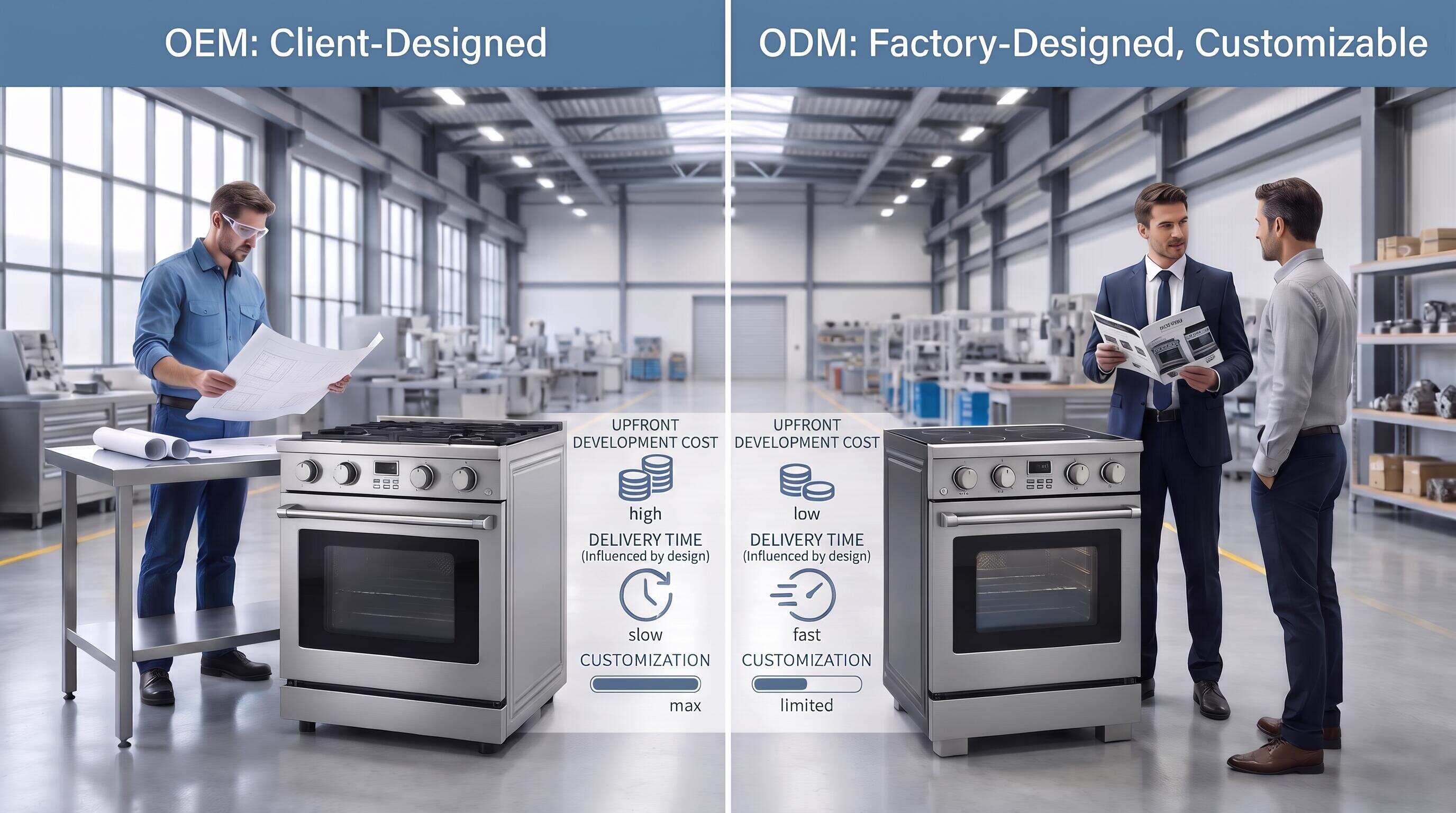
ALT: OEM vs ODM kitchen appliance manufacturing comparison for global B2B brand sourcing decisions
OEM vs. ODM for Kitchen Appliances: Understanding Which Manufacturing Model Fits Your Brand
Imagine you are a procurement manager at a mid-sized kitchen appliance distributor. You have a proven retail channel, strong customer relationships, and a clear sense of what your market wants — but your current product lineup lacks differentiation. You need to bring something new to shelves this quarter without building a factory from scratch. The question your team keeps circling back to is deceptively simple: should you go OEM or ODM?
This question is not just about manufacturing jargon. It is a strategic decision that affects how much control you have over product design, how quickly you can launch, how much upfront investment is required, and ultimately how well the finished product represents your brand in the market. In our work with global B2B clients — importers, distributors, and private-label brands sourcing smart kitchen appliances — this choice consistently shapes the entire trajectory of a product launch. Getting it right from the start saves time, capital, and frustration.
This article compares OEM (Original Equipment Manufacturing) and ODM (Original Design Manufacturing) across the criteria that matter most to procurement decision-makers: design ownership, speed to market, cost structure, customization depth, minimum order quantities, and long-term brand equity. By the end, you will have a clear framework for deciding which model fits your brand's situation right now.
The Criteria That Define a Smart Manufacturing Decision
The right manufacturing model is determined by evaluating six core dimensions that directly affect business outcomes for kitchen appliance buyers.
Design ownership and intellectual property determines who controls the product's blueprint. If your brand's competitive advantage depends on a proprietary feature set — say, a smart oven with a unique connectivity protocol or a rangetop with a patented burner configuration — this criterion is decisive. Brands that own their designs build long-term defensibility; brands that license a manufacturer's existing design move faster but share that design with others.
Speed to market measures how quickly a product can go from concept to container. Seasonal buying cycles, retailer deadlines, and competitive pressure make this a live variable. A model that requires eighteen months of engineering work may be the right long-term investment but the wrong choice for a Q3 launch window.
Cost structure and capital exposure covers both tooling investment and unit economics. Upfront tooling costs, sample fees, and minimum order quantities all affect how much cash is committed before a single unit sells. For new entrants or brands testing a new category, capital efficiency is a primary filter.
Customization depth defines how far a manufacturer will go in adapting a product to your specifications — from color and packaging all the way to firmware, interface language, and mechanical configuration. This matters most for brands selling into regulated markets or serving customers with specific use-case requirements.
Compliance and certification support reflects whether the manufacturing partner can help navigate the regulatory requirements of your target markets — such as UL, CE, ETL, or RoHS standards — and whether certifications transfer to your branded product or must be re-obtained.
Long-term brand equity asks whether the manufacturing arrangement helps or hinders your brand's ability to differentiate, command premium pricing, and protect its market position over time.
The Two Models in Detail
OEM Manufacturing for Kitchen Appliances
OEM, or Original Equipment Manufacturing, is a model in which the buyer (your brand) supplies the product design, engineering specifications, and technical documentation, and the manufacturer produces the product according to those instructions. The finished goods are then sold under your brand name.
In the kitchen appliance context, OEM means your team — or a design agency you commission — develops the product concept and detailed specifications for items such as smart ranges, induction cooktops, or outdoor kitchen cabinet systems. The factory's role is precision execution: sourcing components, assembling units, performing quality control, and delivering to your standards.
If exclusivity matters, specify the products, territories and period covered in the manufacturing agreement. This creates strong competitive barriers but requires meaningful upfront investment in engineering and tooling.
OEM is the model that established global appliance brands have relied on for decades when expanding their manufacturing footprint into lower-cost regions. It is also increasingly adopted by well-funded challenger brands that want to build a defensible product portfolio from the ground up. The tradeoff is clear: higher upfront design and tooling costs, longer lead times before first production run, but maximum control over the finished product.
ODM Manufacturing for Kitchen Appliances
ODM, or Original Design Manufacturing, is a model in which the manufacturer develops and owns the base product design, and the buyer customizes, brands, and markets that product under their own label. The manufacturer handles both design and production; the buyer focuses on market positioning, distribution, and branding.
In practice, ODM for kitchen appliances means you select from a manufacturer's existing or in-development product portfolio — for example, a smart oven with built-in Wi-Fi connectivity, or a stainless-steel outdoor kitchen cabinet system — and work with the factory to apply your brand's visual identity, packaging, feature configurations, and any permitted technical customizations. The underlying product architecture was designed and tested by the manufacturer.
The defining characteristic of ODM is speed and capital efficiency. Because the product design already exists (or is being developed in parallel for multiple buyers), you skip the lengthy and expensive engineering phase. Lead times from agreement to first shipment are significantly shorter than a full OEM engagement.
ODM is the preferred model for distributors entering a new product category, retailers building private-label ranges, and brands that need to respond quickly to a market opportunity without the runway for full custom development. The tradeoff is that you share the base design with other buyers (though branding and some configuration options are exclusive to you), and your long-term ability to differentiate on product architecture is limited.
At Hyxion, we operate across both models, and in our experience, the right choice depends entirely on the buyer's strategic position, timeline, and investment appetite — not on a universal preference for one model over the other.
Head-to-Head Comparison: OEM vs. ODM for Kitchen Appliances
| Criterion | OEM (Original Equipment Manufacturing) | ODM (Original Design Manufacturing) |
|---|---|---|
| Design Ownership | The buyer supplies the design specifications. Ownership of tooling, firmware and newly developed work depends on the agreement | Manufacturer owns base design; buyer owns branding and permitted customizations |
| Speed to Market | Longer — requires full design and tooling phase before production | Faster — existing or in-development base design accelerates launch |
| Upfront Investment | Higher — tooling, engineering, and prototype costs borne by buyer | Lower — tooling costs shared or absorbed by manufacturer across multiple buyers |
| Customization Depth | Maximum — full control over every component, feature, and aesthetic | Moderate — customization within the manufacturer's existing platform |
| Minimum Order Quantities | Consult provider — varies by product category and tooling complexity | Consult provider — often lower per SKU due to shared tooling |
| Compliance & Certification | Buyer drives certification process; manufacturer supports documentation | Manufacturer often holds baseline certifications; additional market-specific certs may be required |
| Brand Differentiation | Product exclusivity depends on the agreed scope | Moderate — base design may be shared; differentiation through branding and configuration |
| Long-Term Scalability | Future modifications and licensing depend on the rights granted in the contract | Moderate — dependent on manufacturer's platform roadmap |
| Risk Profile | Higher upfront risk; lower competitive risk over time | Lower upfront risk; higher long-term risk of commoditization |
The table above reveals a consistent pattern: OEM and ODM are not competing quality tiers — they are different risk-reward profiles suited to different business contexts.
The most important distinction for procurement decision-makers is the relationship between design ownership and time horizon. OEM rewards brands that are playing a long game: investing now in proprietary product architecture to build defensible market positions over multiple product cycles. ODM rewards brands that are playing an agility game: moving quickly into a market, learning from live sales data, and iterating on go-to-market strategy before committing to full custom development.
A second critical difference is capital deployment. The lower upfront investment of ODM frees working capital for marketing, channel development, and inventory — activities that drive near-term revenue. OEM concentrates capital in product development, with the expectation that design exclusivity will generate premium pricing and margin over time. Neither approach is financially superior in the abstract; the right choice depends on your margin structure, cash position, and competitive strategy.
Third, compliance complexity deserves more attention than it typically receives. For smart kitchen appliances destined for North America, Europe, or Australia, regulatory certification is non-negotiable. For an existing ODM platform, ask which models and brand names the current listing covers and whether your proposed changes require further evaluation.
Which Model Fits Your Brand's Situation This Quarter?
The right manufacturing model is not a permanent identity — it is a situational choice that should align with where your brand is right now.
If you are entering a new product category for the first time, ODM is almost always the right starting point. You do not yet have validated demand data, and committing to full OEM tooling before you understand your market's specific preferences is a high-risk use of capital. An ODM arrangement lets you bring a credible, well-manufactured product to market quickly, generate real sales intelligence, and then make informed decisions about future custom development.
If you have an existing product that is selling well and needs a next-generation version, OEM becomes compelling. You now have design requirements grounded in real customer feedback, the confidence of proven demand, and a clear business case for the tooling investment. Building a proprietary next-generation product protects the market position you have already earned.
If your competitive advantage is a proprietary technology or feature set, OEM is the only path that fully protects that advantage. ODM arrangements, by their nature, limit how deeply a buyer can modify the core product architecture. If your differentiation lives in the hardware — a unique heating element design, a patented airflow system, or a proprietary smart home integration — OEM is the appropriate vehicle.
If you are a retailer or distributor building a private-label range under time pressure, ODM is purpose-built for your situation. An existing ODM platform can shorten development when changes are limited. Confirm the schedule for your configuration, testing and certification requirements before setting a launch date.
Pros and Cons Summary:
OEM strengths: full design ownership, maximum differentiation, long-term IP value, strongest competitive barriers. OEM limitations: higher upfront cost, longer development timeline, greater engineering resource requirement.
ODM strengths: faster time to market, lower upfront investment, reduced certification complexity, flexibility to test new categories. ODM limitations: shared base design architecture, limited ability to modify core product features, long-term dependency on manufacturer's platform direction.
In our work with global kitchen appliance buyers, a pattern we consistently see is that the most successful brands do not choose between OEM and ODM as a philosophy — they use ODM to enter a market or test a category, and OEM to consolidate and defend the positions they prove out.
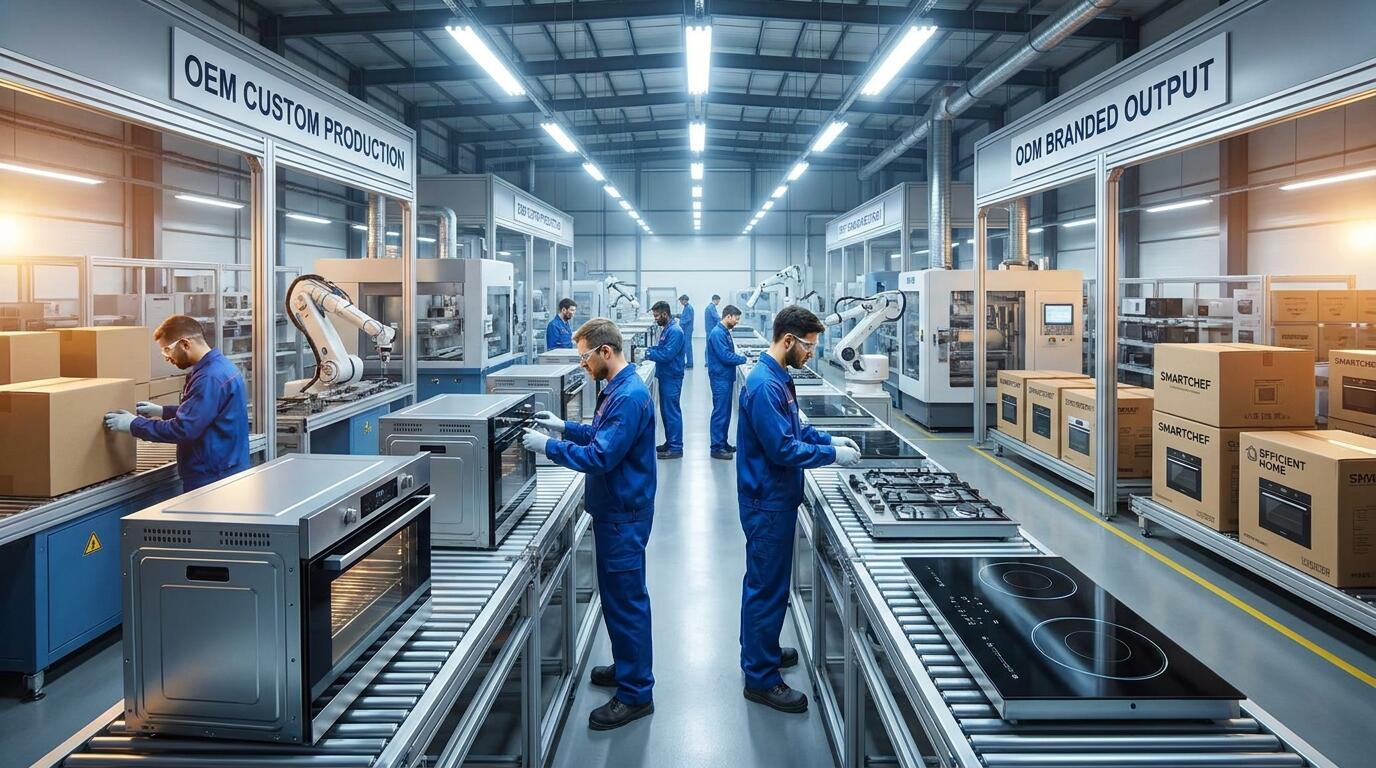
ALT: Smart kitchen appliance manufacturing floor showing OEM and ODM production options for global B2B buyers seeking custom-branded kitchen equipment from a China-based supplier
Common Questions
Q1: How do OEM and ODM agreements differ in terms of intellectual property ownership for kitchen appliances?
In an OEM agreement, the buyer retains full intellectual property ownership of the product design — the manufacturer is a production service provider working to the buyer's specifications. In an ODM agreement, the manufacturer owns the base product design; the buyer owns the branding, any proprietary customizations made within the platform, and the right to market the product under their label. For buyers with long-term plans to build a proprietary product portfolio, understanding this IP distinction before signing any manufacturing agreement is essential.
Q2: Is it possible to transition from an ODM arrangement to OEM with the same manufacturer?
Transitioning from ODM to OEM with the same manufacturing partner is both possible and common. In our experience, buyers often start with an ODM product to validate a market opportunity, then work with the same factory to develop a fully custom OEM version once demand is proven. This approach builds a productive working relationship with the manufacturer while managing early-stage risk. The key is to ensure your ODM contract does not contain exclusivity or IP provisions that would complicate a future OEM engagement.
Q3: How long does it typically take to launch a kitchen appliance under each model?
ODM timelines are significantly shorter because the base product design already exists. Depending on the customization scope — branding, packaging, firmware localization, and configuration options — an ODM product launch can move from agreement to first shipment in a matter of months. OEM timelines vary considerably based on the complexity of the product design, tooling requirements, and certification needs. Full OEM development for a complex smart kitchen appliance typically requires a substantially longer runway. Buyers should build realistic lead times into their seasonal purchasing plans for either model.
The Bottom Line
Key Takeaways:
- OEM can give buyers greater control over product specifications. Design ownership and exclusivity.
- ODM accelerates time to market and reduces upfront capital exposure, making it the right choice for new category entries, private-label programs, and brands responding to near-term market opportunities.
- The two models are not mutually exclusive — many successful brands use ODM to enter and test, then graduate to OEM to build long-term defensibility.
- Compliance and certification complexity is a real cost in both models; working with a manufacturer that has established certification infrastructure on existing platforms (as is common in ODM arrangements) can materially reduce this burden.
- Choosing the right manufacturing partner matters as much as choosing the right model — a factory with genuine smart kitchen appliance expertise, flexible production capabilities, and a track record of supporting global B2B buyers in both OEM and ODM arrangements is a strategic asset.
The clearest next step is a direct conversation with a manufacturing partner who can honestly assess your product requirements, timeline, and budget against both models — and recommend the arrangement that serves your brand's current situation without overselling complexity you do not need.
Ready to elevate your kitchen appliance lineup with smart, factory-direct solutions? Hyxion partners with global B2B buyers to deliver fully customizable OEM and ODM smart kitchen appliances — from ranges and ovens to outdoor kitchen cabinets — backed by rigorous quality standards and flexible production capabilities. Visit the Hyxion smart kitchen appliances website today to explore product catalogues, request samples, or discuss a tailored manufacturing partnership that fits your brand's vision.
Sources & Further Reading
- Kodio Home. "OEM vs ODM vs Private Label: Key Differences".
https://kodiohome.com/oem-vs-odm-vs-private-label/ - Komaspec. "ODM, OEM, or CM: Which to Choose?".
https://www.komaspec.com/about-us/blog/odm-oem-cm-which-type-of-manufacturer-should-you-pick-for-your-project/ - YLD Home. "OEM vs ODM vs Private Label Kitchen Appliances".
https://yld-home.com/oem-vs-odm-vs-private-label-kitchen-appliances/ - Cheffcooker. "OEM vs ODM: Which Model Fits Your Kitchen Brand?".
https://www.cheffcooker.com/blog/OEM-vs-ODM-Which-Model-Fits-Your-KitchenBrand_b26200
Note: Standards and regulatory requirements may be updated; please check the latest official documents or consult professional advisors for compliance guidance specific to your target markets.