
Navigating International Compliance When Importing Private-Label Kitchen Appliances

What You'll Achieve: A Clear Compliance Roadmap for Importing Private-Label Kitchen Appliances
Key Conclusion: Importing private-label kitchen appliances across international borders requires navigating a layered set of regulatory requirements — from product safety certifications and labeling mandates to customs documentation and importer-of-record obligations. This guide walks global B2B buyers, distributors, and retail brands through the essential compliance steps, common pitfalls, and advanced strategies that experienced sourcing teams use to bring products to market without costly delays or rejections.
Compliance is not a checkbox — it is a continuous process that begins the moment you select a manufacturing partner and continues through every shipment cycle. For importers sourcing private-label kitchen appliances from China, the regulatory landscape spans multiple jurisdictions, each with its own standards bodies, documentation requirements, and enforcement mechanisms. Whether you are launching a new appliance line under your own brand or scaling an existing catalog, understanding how compliance works — and where it routinely breaks down — is the difference between a smooth product launch and an expensive hold at the border.
This guide is written for procurement managers, product sourcing specialists, and business owners who are either entering the private-label appliance market for the first time or looking to systematize and strengthen an existing import compliance process.
Before You Start: Prerequisites and Preparation for Appliance Import Compliance
Effective compliance management for private-label kitchen appliances is not reactive — it is built into the sourcing strategy from the outset. Before you can execute the step-by-step compliance process, you need the right foundation in place. Skipping this preparation phase can increase the risk of compliance delays, failed inspections, and unexpected costs. Establishing the applicable requirements before production helps buyers identify potential issues earlier and plan the necessary testing, documentation, and regulatory reviews.
What you need before starting:
- A clearly defined target market (or markets), because regulatory requirements differ significantly between the United States, the European Union, the United Kingdom, Canada, Australia, and other regions. A product compliant in one market may require additional testing or documentation for another.
- A shortlist of manufacturing partners who have demonstrable experience producing appliances for export — not just domestic-market products. Manufacturers with prior export experience may be more familiar with destination-market documentation requirements and testing procedures. However, buyers should independently verify each supplier's document management capabilities, available test reports, laboratory relationships, and experience with the specific product categories and target markets involved.
- A basic understanding of the product categories you are importing. Kitchen appliances fall across different regulatory classifications — a gas range, an electric cooktop, and an outdoor kitchen cabinet each trigger different standards and testing protocols.
- Access to a licensed customs broker or trade compliance consultant in your destination market. While a good OEM/ODM partner will prepare export-side documentation, import-side compliance — including tariff classification, duties, and importer-of-record obligations — requires local expertise.
- A realistic timeline. Compliance testing alone, depending on the market and product type, can require substantial lead time. Build this into your product launch schedule rather than treating it as a parallel fast-track.
Checklist before starting:
- Confirm target import market(s) and identify the applicable regulatory bodies for kitchen appliances in each
- Verify that your manufacturing partner holds relevant factory-level quality certifications and has prior export documentation experience
- Engage a licensed customs broker or compliance advisor in your destination country
- Establish a document management system for tracking test reports, certificates, declarations, and labeling approvals
- Align your product development timeline with realistic certification lead times
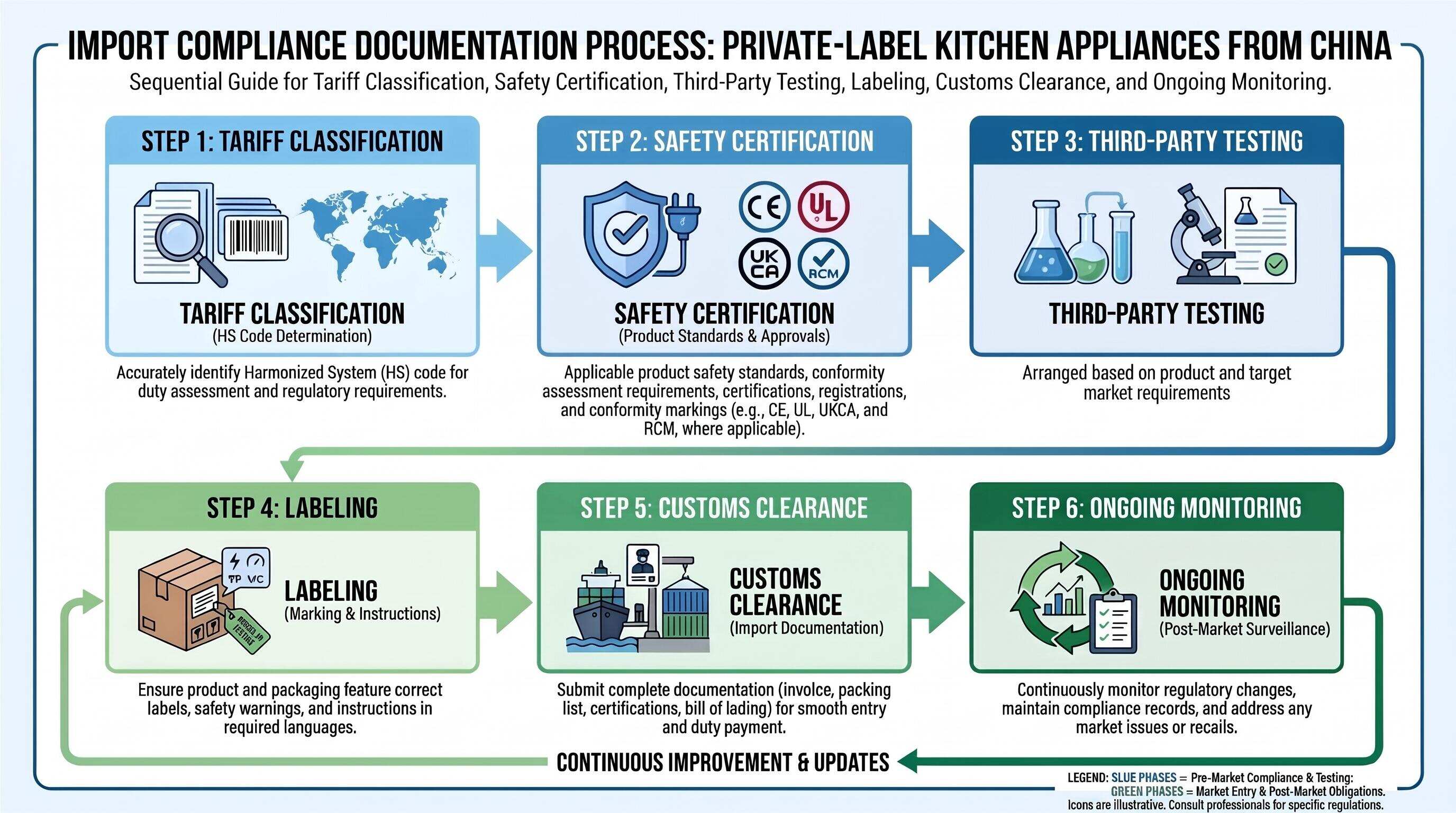
ALT: Step-by-step international compliance documentation process for importing private-label kitchen appliances from China
Step-by-Step: How to Navigate International Compliance When Importing Private-Label Kitchen Appliances
Step 1: Classify Your Products Under the Correct Tariff and Regulatory Framework
Before any compliance work begins in earnest, your products must be accurately classified. In the United States, this means identifying the correct Harmonized System (HS) code under the Harmonized Tariff Schedule administered by the U.S. International Trade Commission. In the EU, the Combined Nomenclature applies. Most global trade systems trace back to the World Customs Organization's HS framework, so getting the classification right at the source cascades through every downstream obligation — duty rates, applicable safety standards, anti-dumping provisions, and licensing requirements.
Kitchen appliances cover a wide range of product categories, and their HS classifications depend on their specific characteristics, functions, composition, and applicable tariff classification rules. For example, certain electric ovens and electric cooktops may fall under heading 8516, while gas ranges, dishwashers, and outdoor kitchen cabinets may be classified under different headings or subheadings depending on their specifications and intended use. Buyers should verify the classification of each product based on its actual design and applicable customs rules rather than assuming that every appliance type has a separate HS heading. Misclassification, whether caused by incomplete product information or an incorrect tariff interpretation, can create compliance risks, including additional duties, customs delays, penalties, or other enforcement actions. Tariff classification should reflect the product's actual characteristics, composition, function, and applicable classification rules rather than an attempt to obtain a lower duty rate.
Tip: Work with your customs broker to request binding tariff classification rulings from the relevant customs authority before your first shipment. A binding classification ruling, where available and applicable, can help clarify how a specific product should be classified under the relevant customs rules. Buyers should confirm the ruling's scope, validity, and applicability to their actual product specifications with the relevant customs authority or qualified customs broker.
Step 2: Identify the Applicable Safety Standards and Certification Requirements for Each Destination Market
International compliance for kitchen appliances is fundamentally a standards-matching exercise. Each major import market designates which safety standards apply to which product categories, and private-label importers bear the responsibility of ensuring their products conform to those standards — regardless of where the appliance was manufactured.
Key market-specific frameworks include:
- United States: Kitchen appliance compliance requirements depend on the product category, applicable federal and state regulations, and the intended sales channel. The Consumer Product Safety Commission (CPSC) oversees applicable consumer product safety requirements, while the U.S. Department of Energy (DOE) establishes energy conservation standards for covered appliance categories. Relevant product safety standards may be developed by organizations such as UL or ANSI-accredited standards bodies. Depending on the product and applicable requirements, testing or certification by an appropriately recognized Nationally Recognized Testing Laboratory (NRTL) may be necessary or requested by buyers and authorities. Gas and electric appliances should be assessed separately against the standards applicable to their specific product types and configurations.
- European Union: Kitchen appliances placed on the EU market must comply with the EU legislation applicable to their specific product categories. Where a product falls within the scope of CE-marking legislation, the manufacturer must complete the required conformity assessment, prepare the relevant technical documentation, and issue an EU Declaration of Conformity before affixing the CE marking. Depending on the product, applicable requirements may include electrical safety, electromagnetic compatibility, energy efficiency, and other relevant EU regulations. The applicable legislation, assessment procedures, documentation requirements, and responsibilities should be verified for each product model and configuration.
- United Kingdom : Product compliance requirements in Great Britain should be assessed against the applicable UK legislation and current conformity-marking rules. Depending on the product category and the relevant regulatory provisions, manufacturers may be able to use CE marking, UKCA marking, or another permitted conformity route. Buyers should verify the current requirements for the specific appliance, including applicable standards, conformity assessment procedures, technical documentation, and any requirements concerning UK-based responsible persons or authorized representatives. Northern Ireland may follow different product-marking arrangements and should be assessed separately.
- Canada: Kitchen appliances sold in Canada must meet the applicable Canadian product safety and energy efficiency requirements for their specific categories. Where electrical product approval is required, buyers should verify that the product has been evaluated and certified by an appropriately recognized certification body for the intended Canadian market. CSA and cUL are examples of certification marks that may appear on approved products, but the applicable certification route and covered product models must be confirmed. Energy efficiency obligations should also be checked against the requirements administered by Natural Resources Canada for the relevant appliance category.
- Australia and New Zealand: Electrical appliance compliance requirements should be assessed separately for Australia and New Zealand. For applicable products in Australia, buyers should verify the relevant electrical safety obligations, supplier registration requirements, and Regulatory Compliance Mark (RCM) requirements under the applicable regulatory framework. Any SAA-related certification or testing documentation should be distinguished from the RCM marking and supplier compliance obligations. For New Zealand, buyers should independently confirm the applicable electrical safety, product approval, and labeling requirements. Energy efficiency labeling obligations should be checked for each covered appliance category in the intended sales market.
Regulatory requirements for kitchen appliances can differ across destination markets, even when certain technical standards or testing requirements overlap. A product specification accepted in one market may require additional documentation, testing, labeling, or conformity assessment in another. Buyers should therefore evaluate compliance requirements separately for each target market and confirm whether a shared product configuration can satisfy the applicable requirements in all intended destinations. Market-specific compliance planning can help reduce the risk of regulatory issues, product recalls, and additional market-entry costs.
Tip: Request a detailed list of existing test reports, certificates, and conformity documents from your OEM/ODM partner. Verify the issuing organization, certificate holder, covered product models, configurations, applicable standards, and brand names. Existing certifications or technical reports should not be assumed to cover a private-label product automatically. Any changes to the brand, model, components, or product configuration should be reviewed with the relevant certification body or compliance specialist to determine whether additional assessment or testing is required. Existing documentation may help reduce duplicated preparation work, but it does not guarantee a shorter certification timeline.
Step 3: Engage Accredited Third-Party Testing Laboratories
Third-party testing is the operational backbone of private-label appliance compliance. Whether third-party laboratory testing is required depends on the target market, product category, applicable product safety standards, and conformity assessment or certification requirements. Buyers should verify the applicable testing procedures and laboratory acceptance criteria for each product and market before proceeding with compliance assessments.
Testing laboratories should be selected based on the applicable product standards, required test methods, accreditation scope, and acceptance criteria of the relevant regulatory or certification program. Laboratory accreditation under an ILAC-recognized arrangement does not automatically mean that every test report will be accepted by every certification body or regulatory authority. For certain U.S. consumer product categories subject to specific CPSC testing requirements, buyers should verify whether testing by a CPSC-accepted third-party laboratory is required. For EU products, Notified Bodies are involved only where the applicable legislation requires or permits their participation in the relevant conformity assessment procedure. Buyers should confirm the laboratory's accreditation scope, authorized testing activities, and report acceptance requirements before submitting samples.
The testing and conformity assessment process generally involves several stages. The OEM/ODM partner prepares and submits product samples to a qualified laboratory, which conducts the required tests against the applicable standards. The laboratory then issues a test report documenting the results. Depending on the regulatory framework and certification program, additional conformity assessment, certification, registration, or declaration procedures may be required before the product can be placed on the target market. A successful test report does not automatically constitute a product certificate or type approval. Buyers should confirm which documents are required and whether they must accompany shipments or be retained for regulatory inspection.
Tip: During supplier evaluation, ask whether the manufacturer has experience coordinating product testing with laboratories that are qualified for the relevant standards and certification programs. Request details of previous testing projects where appropriate, and verify the laboratory's accreditation scope and acceptance requirements. An established sample preparation and testing coordination process may help organize project activities more efficiently, but the overall timeline will still depend on product complexity, testing requirements, laboratory availability, and any necessary corrective actions.
Step 4: Develop Market-Specific Labeling and Documentation Packages
For private-label kitchen appliances, labeling, conformity markings, and supporting documentation must be prepared in accordance with the requirements of each target market. The legal responsibilities of the manufacturer, importer, brand owner, authorized representative, and other supply-chain parties depend on the applicable regulations and the actual role each party performs. Selling a product under a private label does not automatically establish that the brand owner is the sole legally responsible party. Buyers should identify the applicable regulatory roles before market entry and define contractual responsibilities for product labeling, technical documentation, conformity declarations, regulatory communication, and ongoing compliance maintenance.
Labeling requirements for kitchen appliances typically include:
- The manufacturer, importer, authorized representative, or other responsible party information required by the applicable regulations of the destination market.
- The model number and product description
- Applicable conformity marks (CE, UKCA, RCM, etc.)
- Energy efficiency ratings or labels where mandated
- Warning language and safety instructions in the official language(s) of the target market
- Country of origin, in the format required by the destination country's customs authority
- Electrical ratings, gas connection specifications, and other technical parameters in the format required by the applicable standard
Import documentation requirements depend on the destination market, product category, and shipping arrangement. Common shipping and customs documents may include commercial invoices, packing lists, bills of lading or other applicable transport documents, and certificates of origin where required. Additional product compliance documents, such as conformity declarations, test reports, certification records, and energy efficiency documentation, should be prepared and retained according to the applicable regulatory requirements. Buyers should confirm which documents must accompany the shipment and which must be made available upon request.
Tip: Build your labeling requirements into your product specification and tooling stage, not as an afterthought before shipping. Last-minute label changes on physical product are expensive and time-consuming.
Step 5: Manage Import Customs Clearance and Duty Obligations
Customs clearance for private-label kitchen appliances involves more than presenting the correct paperwork. It requires accurate valuation of the goods (which, for OEM/ODM products with tooling and mold costs, can be more complex than it appears), correct application of applicable duty rates, and — in markets with active trade remedy measures — attention to anti-dumping or countervailing duty orders that may apply to specific product categories from specific countries of origin.
In the United States, certain kitchen appliance products and components may be subject to trade remedy measures, including applicable anti-dumping or countervailing duty orders. Importers should review current measures based on the product's tariff classification, country of origin, and other relevant product-specific factors. U.S. Customs and Border Protection (CBP) administers customs entry procedures and applicable import requirements. Entry documentation, customs bond arrangements, and Importer Security Filing (ISF) obligations should be assessed according to the shipment type, transportation method, and applicable U.S. customs rules.
Tip: For recurring imports into the United States, discuss the appropriate customs bond arrangement with your customs broker. A continuous bond may be suitable for importers making multiple entries over a period of time, while the appropriate bond type and coverage should be determined based on the importer's circumstances and applicable CBP requirements. Customs bond arrangements should not be treated as a universal requirement across all destination markets.
Step 6: Establish an Ongoing Compliance Monitoring and Quality Assurance Process
Compliance for private-label kitchen appliances is not a one-time event tied to a product launch. Standards are updated, regulatory interpretations evolve, and new requirements emerge. Importers who treat compliance documentation as a static archive may overlook changes that affect product conformity. Product updates, component substitutions, manufacturing process modifications, or new destination-market regulations may require a compliance review. Whether additional testing, reassessment, or recertification is necessary depends on the nature of the change, the applicable standards, and the requirements of the relevant certification body or regulatory authority.
An effective ongoing compliance program includes:
- Scheduled reviews of applicable standards and regulations at intervals appropriate to the product category, target market, and regulatory update frequency, with additional reviews whenever relevant regulatory changes occur.
- A change-control process that flags product modifications — including component substitutions or manufacturing process changes — for compliance review before implementation
- Coordination with your OEM/ODM partner to ensure that any factory-level changes that could affect product conformity are communicated promptly
- Retention of compliance documentation for the period specified by the applicable regulations, taking into account the product category, destination market, document type, and relevant market-placement or import date.
Tip: Designate a specific point of contact — internally or through your compliance consultant — who maintains the compliance calendar and owns the documentation system. Clearly assigned responsibilities and documented communication procedures can help reduce the risk of missed compliance tasks, incomplete documentation, and delayed regulatory responses.
Common Mistakes and Troubleshooting in Private-Label Appliance Import Compliance
Compliance issues in kitchen appliance imports can arise from documentation gaps, product specification changes, incorrect tariff classification, or incomplete market-specific labeling. Understanding these potential risk areas and establishing appropriate corrective procedures can help buyers manage compliance issues and avoid unnecessary delays or costs.
| Symptom | Likely Cause | How to Fix |
|---|---|---|
| Shipment held at customs pending additional documentation | Incomplete or missing certificates of conformity, test reports, or country of origin documentation | Maintain a pre-shipment documentation checklist; confirm all required certificates are finalized before cargo is loaded |
| Product fails third-party safety testing | Specification drift between approved samples and production units; component substitutions not flagged for compliance review | Implement a formal change-control process; require the OEM/ODM partner to notify you of any component or process changes before implementation |
| CE marking applied without valid technical file or Declaration of Conformity | Manufacturer or importer treated CE marking as a sticker rather than a conformity process | Commission a full technical file review with a qualified EU Notified Body or conformity assessment consultant |
| Incorrect duty rate applied, triggering a customs audit | Tariff misclassification — either an honest error or an aggressive classification strategy | Request binding classification rulings before shipping; engage a licensed customs broker for all entries |
| Energy label non-compliance flagged by market surveillance authority | Energy efficiency labeling requirements not incorporated into product development; incorrect efficiency class claimed | Build energy label requirements into the product specification stage; validate efficiency ratings through accredited testing |
| Private-label brand name not correctly reflected on product labeling | Labeling reviewed only in the factory specification without reference to the market-specific regulatory labeling requirements | Develop a market-specific labeling specification document and have it reviewed by a compliance consultant before tooling finalization |
Pro Tips for Better Results in Appliance Import Compliance
Build compliance into the sourcing brief, not the QC process. Including the regulatory requirements of each target market in the initial product brief can help buyers and OEM/ODM partners identify applicable standards, labeling requirements, and testing needs before production begins. Addressing these requirements during product planning may reduce the risk of late-stage modifications, additional testing, and shipment delays. When compliance is embedded in the brief, the OEM/ODM partner can configure the product accordingly from the outset, and testing can be planned in parallel with production rather than after it.
Leverage your OEM/ODM partner's existing certification portfolio. Some manufacturers may have existing test reports, certificates, or technical documentation for their standard product configurations. Before relying on these materials, buyers should verify the issuing organization, certificate holder, covered models, product configurations, applicable standards, and brand listing details. A private-label arrangement, product modification, or component change may affect the scope of existing certification. Any required reassessment, supplementary testing, or certification updates should be confirmed with the relevant certification body. Existing documentation may support the compliance review process, but it does not guarantee faster certification or eliminate the need for additional testing.
Do not conflate factory certifications with product certifications. ISO 9001 certification relates to an organization's quality management system and should not be treated as evidence that a specific appliance model meets the product safety requirements of a particular market. Product compliance must be verified separately through the applicable product standards, testing reports, conformity assessments, and certification documents for the specific models and configurations being purchased. ISO 9001 certifies the factory's processes; it does not certify that any given product meets UL, CE, CSA, or other product safety requirements. Depending on the target market and product category, buyers should verify the applicable conformity assessment procedures, technical documentation, required product markings, and any necessary certifications or registrations. Third-party certification should only be pursued where required by the applicable regulations or conformity assessment scheme.
Account for intellectual property in your compliance documentation. When sourcing private-label appliances, buyers should distinguish between product design ownership, tooling ownership, trademark rights, licensing arrangements, and product certification responsibilities. These matters should be addressed separately in the OEM/ODM agreement. Where relevant, buyers may also evaluate trademark recordation or other available intellectual property protection measures in their target markets. Contractual ownership documentation can help clarify the parties' rights and obligations, but it does not automatically transfer product certifications or prevent all unauthorized sales of similar products. Specific protection strategies should be reviewed with qualified intellectual property professionals.
Monitor trade remedy developments proactively. Anti-dumping and countervailing duty proceedings on kitchen appliances and components are an active area of trade enforcement in multiple major markets. Importers should monitor relevant trade remedy developments and seek qualified customs or trade counsel when a proceeding may affect their products. Potential responses, including changes to sourcing arrangements or applications for available exclusions, depend on the applicable trade rules, product classification, country of origin, and eligibility requirements. Buyers should assess each situation individually rather than assuming that an exemption or alternative sourcing arrangement will be available.
Common Questions
Q1: How do I determine which safety certifications my private-label kitchen appliances need for the U.S. market?
The safety compliance requirements for kitchen appliances in the United States depend on the product category, applicable regulations, and intended sales channel. Buyers should identify the relevant product safety standards and determine whether testing or certification by an OSHA-recognized Nationally Recognized Testing Laboratory (NRTL) is required or specified by the applicable compliance program. UL and ANSI-related standards should not be treated as interchangeable certification requirements. Gas and electric appliances may be subject to different standards and assessment procedures, so each product type and model should be evaluated separately. Retailers and distributors may also impose additional vendor compliance requirements. Confirming these requirements before submitting products for testing can help avoid unnecessary assessment costs or documentation gaps.
Q2: Is CE marking sufficient for selling kitchen appliances across all European Union member states?
For product categories covered by applicable EU CE-marking legislation, a properly affixed CE marking indicates that the manufacturer has declared conformity with the relevant EU requirements. A product that has completed the required conformity assessment and meets all applicable EU legislation can generally be placed on the EU single market without obtaining separate national product certifications for the same harmonized requirements. However, CE marking alone does not demonstrate compliance with every requirement that may apply to a product. Buyers should verify the applicable legislation, technical documentation, EU Declaration of Conformity, labeling obligations, and any additional product-specific requirements before placing an appliance on the market. The CE marking is generally affixed under the manufacturer's responsibility and should not be treated as a government-issued quality certificate.
Q3: How much time should I budget for the full compliance and testing process when importing private-label appliances for the first time?
There is no fixed universal timeline for completing international compliance and testing, so the required schedule should be determined on a project-by-project basis. The overall duration depends on factors such as the product category, technical complexity, applicable target-market regulations, whether existing test reports or certifications can be leveraged, laboratory testing capacity, and any product modifications needed during evaluation. Buyers should consult their OEM/ODM manufacturing partner, accredited testing laboratories, and market-specific compliance advisors early in the sourcing process to establish a realistic schedule tailored to their specific project.
Summary
Navigating international compliance when importing private-label kitchen appliances is a multi-stage process that requires coordination between the importer, the OEM/ODM manufacturing partner, accredited testing laboratories, and market-specific compliance advisors.
Key Takeaways:
- Product classification under the correct HS code is the foundation of all downstream compliance obligations — misclassification creates cascading risk.
- Safety certification requirements are market-specific: U.S., EU, UK, Canadian, and Australian markets each have distinct standards, marks, and documentation requirements that cannot be interchanged.
- Regulatory responsibilities for private-label appliances depend on the applicable market regulations and the roles of the manufacturer, importer, brand owner, authorized representative, and other relevant parties. Buyers should confirm their specific legal obligations and establish clear contractual arrangements for labeling, conformity documentation, and ongoing compliance management.
- Testing and conformity assessment requirements vary by product category and destination market. Depending on the applicable regulations and certification program, testing by a qualified or accredited third-party laboratory may be required. Buyers should identify the applicable testing requirements and arrange the necessary assessments as part of the product development and compliance planning process.
- Compliance is an ongoing program, not a one-time event — standards evolve, products change, and regulatory monitoring must be sustained throughout the product lifecycle.
An effective approach to managing international compliance is to work with an OEM/ODM manufacturer whose product experience, documentation capabilities, testing coordination processes, and quality management arrangements can be verified. Buyers should also review the manufacturer's existing certification coverage for the specific models and configurations under consideration and consult qualified compliance professionals in each target market when necessary.
If your business is ready to source private-label kitchen appliances with the confidence that comes from working with an experienced manufacturing partner, explore what Hyxion's OEM/ODM platform offers — from ranges, ovens, cooktops, and rangetops to dishwashers and outdoor kitchen cabinets. Buyers can review the available product information and discuss model-specific requirements, documentation, and compliance considerations with the Hyxion team before confirming a sourcing project.
Sources & Further Reading
Note: Standards and regulations may be updated; please check the latest official documents or consult professional advisors.
- Amesto Global. "Key Import and Export Compliance Considerations for a U.S. Market Entry".
https://www.amesto.global/insights/news/key-import-and-export-compliance-considerations-for-us-market-entry - Export Compliance Guide for Kitchen Appliances. "Export Compliance Guide for Kitchen Appliances: What Global Buyers Need to Know".
https://www.ikangye.com/blog/Export-Compliance-Guide-for-Kitchen-Appliances-What-Global-Buyers-Need-to-Know-in-2026_b30207 - Passport Global. "Compliance Archives".
https://passportglobal.com/blog/category/compliance/