
How Hyxion's In-House CSA and UL Certified Labs Cut Time-to-Market for Kitchen Appliances
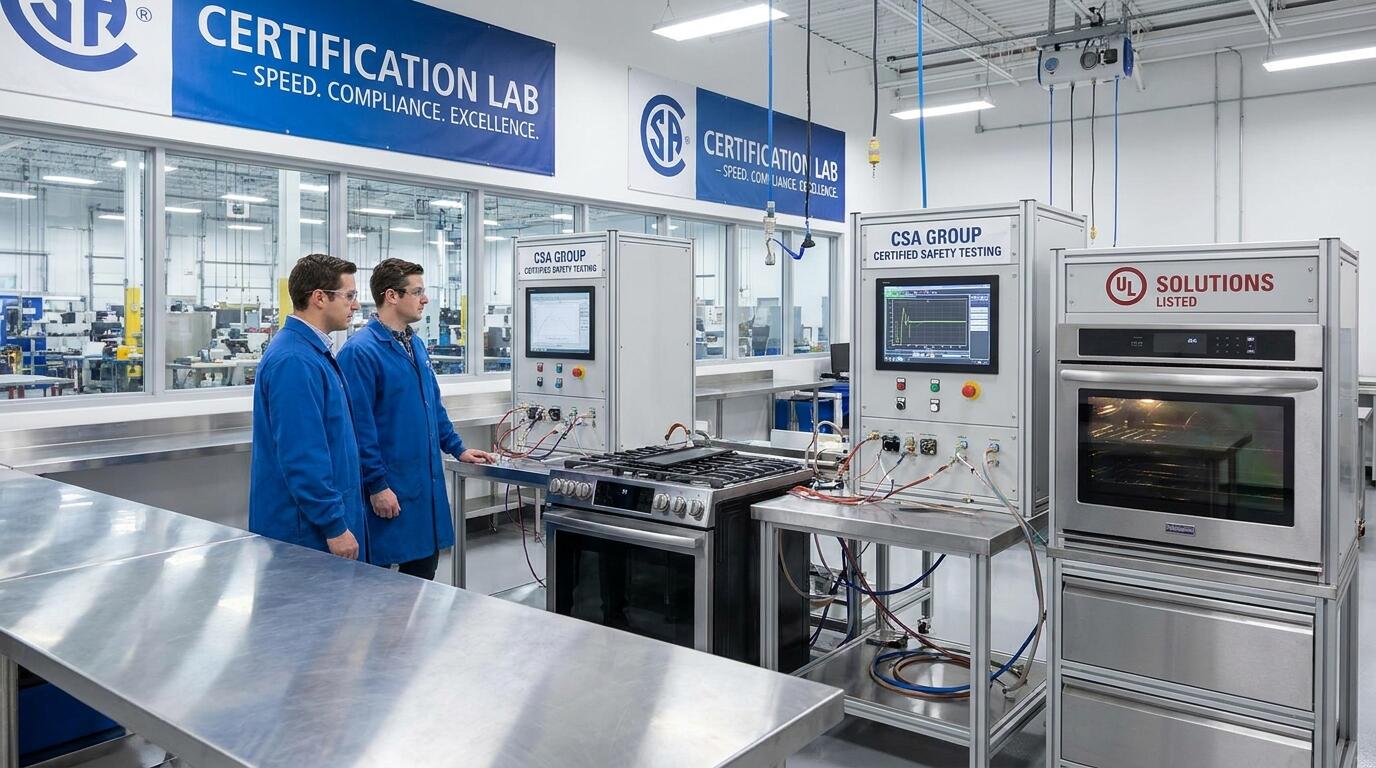
ALT: In-house CSA and UL certified labs accelerating kitchen appliance time-to-market for OEM brands
Why Do In-House CSA and UL Certified Labs Matter for Kitchen Appliance Time-to-Market?
Key Conclusion: Hyxion's in-house CSA and UL certified labs cut time-to-market for kitchen appliances by eliminating the queue delays, logistics friction, and iteration lag typically associated with outsourced third-party certification testing, allowing OEM/ODM partners to move from prototype to compliant, market-ready gas stoves, electric cookers, built-in ovens, dishwashers, and outdoor kitchen equipment on a materially faster and more predictable timeline.
For international kitchen appliance brands, the gap between a finished design and a shippable, certified product is often the single biggest threat to a launch calendar and a budget. Every week spent waiting in a third-party lab's test queue is a week of lost retail shelf time, delayed distributor commitments, and carrying costs on tooling and components that have already been paid for. This article examines how Hyxion's in-house certification testing infrastructure changes that equation, and why procurement teams increasingly treat lab access as a core selection criterion when choosing an OEM/ODM manufacturing partner rather than a secondary consideration.
The Certification Bottleneck: How the Industry Got Here
Kitchen appliances sold into North America must typically satisfy safety requirements associated with CSA (Canadian Standards Association) and UL (Underwriters Laboratories) certification marks, which signal that a gas stove, electric cooker, built-in oven, dishwasher, or outdoor cooking appliance has been evaluated against recognized electrical, mechanical, and gas-safety benchmarks. These marks are not optional branding exercises; for many importers and retailers in the United States and Canada, products without recognized certification simply cannot clear customs scrutiny, insurance requirements, or big-box retailer vendor compliance checklists.
Historically, manufacturers without in-house lab capability have had to route every certification cycle through independent third-party testing houses. That process typically involves shipping physical samples offsite, waiting in a shared testing queue alongside other manufacturers' submissions, receiving a report, and then shipping samples back and forth again for every design revision that fails to pass on the first attempt. Each of these steps introduces calendar time that is largely outside the manufacturer's control.
This bottleneck has become more acute as the global kitchen appliance market has grown in both volume and product complexity. According to market research from DataHorizzon Research, the domestic kitchen appliances market continues to expand as consumer demand diversifies across cooking formats and smart-appliance features, which in turn increases the variety of SKUs that brands need certified simultaneously. A similarly described growth trajectory appears in analysis from Maximize Market Research, which tracks the household appliances market's expansion alongside rising private-label and OEM sourcing activity. As product variety increases, so does the number of distinct configurations that must pass through certification, compounding the queue problem for brands relying solely on external labs.
At the same time, industry bodies have noted that household appliance manufacturers are accelerating their move into overseas markets, a trend documented by CHEAA (China Household Electrical Appliances Association), which reflects the growing importance of export-ready compliance infrastructure for Chinese manufacturing bases. Brand owners sourcing from Asia increasingly expect their manufacturing partners to already understand, and ideally test against, the target market's certification regime rather than treating it as an afterthought handled late in the production cycle.
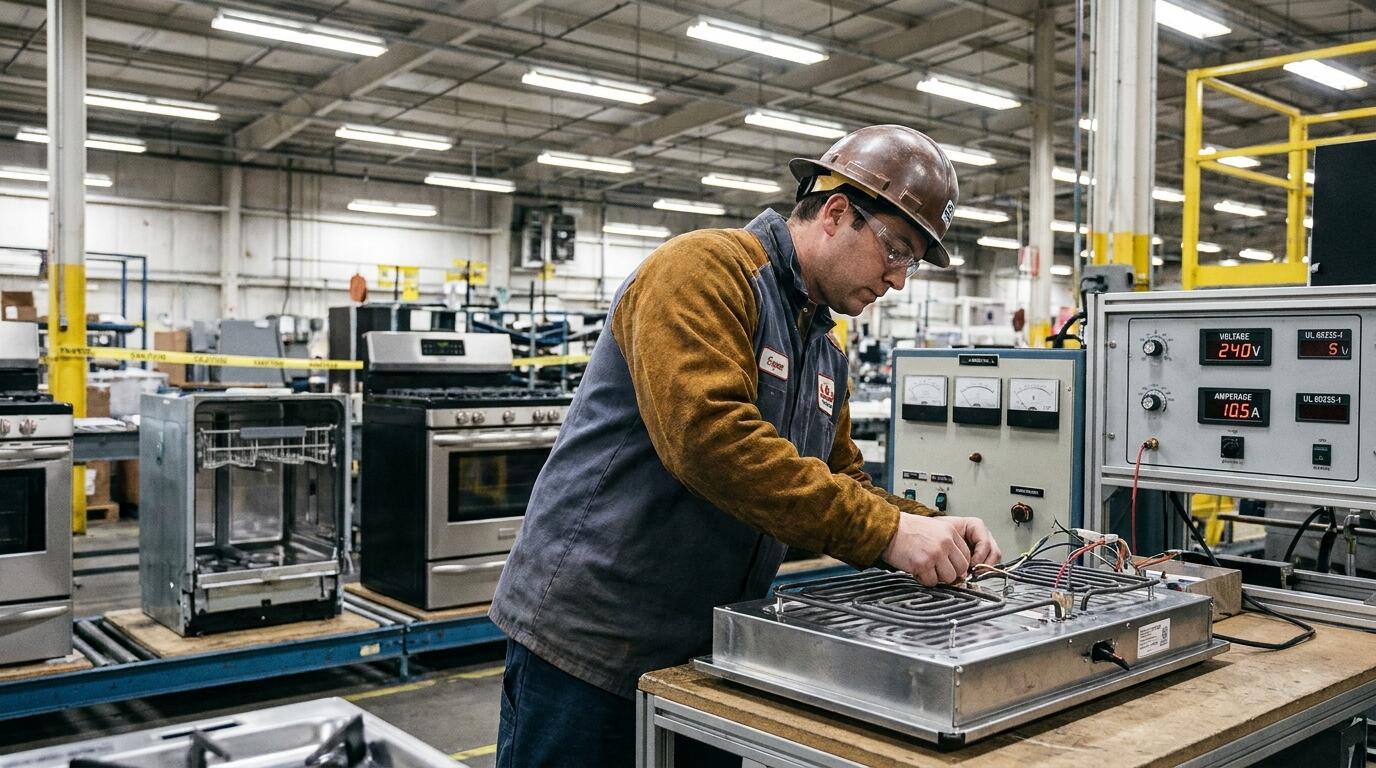
ALT: Engineer conducting CSA and UL safety testing inside Hyxion kitchen appliance manufacturing facility
This confluence of rising product variety, growing export ambitions, and persistent third-party lab queues is precisely the backdrop against which in-house certified testing capability becomes a competitive differentiator rather than a nice-to-have facility upgrade.
How In-House CSA and UL Certified Labs Actually Shorten the Timeline
Eliminating round-trip logistics delay
The most direct mechanism by which an in-house lab shortens time-to-market is the removal of physical sample shipping between the factory and an external test facility. When CSA and UL certified testing can be performed on the same production campus where the gas stove, electric cooker, or dishwasher is being engineered, samples never leave the building between design iterations. This alone removes a recurring source of delay that has nothing to do with the actual complexity of the test itself, but purely with transit and scheduling logistics.
Compressing the design-test-redesign loop
Product certification rarely succeeds on a single pass, particularly for newly customized OEM/ODM configurations involving altered burner layouts, modified electrical components, or new outdoor kitchen equipment form factors. A design-test-redesign loop is the iterative cycle in which a prototype is tested, failure points are identified, engineering adjustments are made, and the revised unit is retested. When this loop runs entirely in-house, engineers can observe test results directly, consult with the certification team in real time, and implement a design correction within the same facility, often within the same week, rather than waiting for a report to arrive from an outside lab and then rescheduling a new test slot.
Parallel development across multiple product lines
Because Hyxion's in-house lab infrastructure is not shared with unrelated third-party clients, it can be scheduled according to internal production priorities. This matters enormously for brand owners who are simultaneously developing multiple SKUs, for example a built-in oven line and a companion dishwasher line meant to launch together as a coordinated kitchen suite. In-house testing capacity allows these parallel workstreams to be scheduled flexibly, rather than competing for limited slots in an external lab's queue alongside submissions from other manufacturers.
Early-stage design-for-certification guidance
A pattern we consistently see in our work with international clients is that the earlier certification requirements are built into the design phase, the fewer costly redesigns occur later. In-house certification engineers who sit alongside product development teams can flag likely CSA or UL compliance issues, such as component spacing, wiring configurations, or material choices, before a prototype is even built, rather than discovering them only after a failed external test report comes back weeks later.
Direct engineering-to-certification communication
When the certification testing team and the product engineering team are part of the same organization, feedback on a failed test parameter can be communicated and acted upon immediately. This direct communication loop removes the translation layer that typically exists when a manufacturer must interpret a third-party lab's written report and then relay findings back to its own design team, a process that itself consumes administrative time and can introduce misunderstandings about root cause.
Evidence and Comparative Approaches to Certification Strategy
Brand owners evaluating OEM/ODM partners generally encounter three broad approaches to certification testing, and it is worth examining them side by side to understand where in-house capability like Hyxion's in-house CSA and UL certified labs creates the clearest advantage.
The first approach relies entirely on external third-party labs for every certification cycle. This is the most common model among smaller or less vertically integrated manufacturers, and it typically means every design revision, however minor, must be rescheduled through an outside facility's booking system. The second approach uses a hybrid model, where a manufacturer maintains basic internal pre-testing equipment to catch obvious failures before submitting to an external lab for official certification, reducing some but not all of the round-trip delay. The third approach, which Hyxion applies, is full in-house CSA and UL certified lab capability integrated directly into the manufacturing campus, allowing both developmental and certification-grade testing to happen on-site.
| Perspective / Approach | Strengths | Trade-offs | Best Fit |
|---|---|---|---|
| External third-party lab only | Independent verification seen as default industry norm; no capital investment required by manufacturer | Longest queue times; repeated shipping of samples; limited visibility into test scheduling | Manufacturers with low SKU variety and infrequent new product launches |
| Hybrid internal pre-testing plus external certification | Catches obvious design flaws early, reducing some failed external submissions | Still subject to external lab queue for final certification; dual testing adds internal cost | Manufacturers transitioning toward full in-house capability |
| Full in-house CSA and UL certified lab (Hyxion model) | Fastest design-test-redesign cycles; parallel testing across multiple product lines; direct engineering feedback loop | Requires significant upfront investment in facility and trained personnel | Brand owners and distributors prioritizing speed-to-market and multi-SKU development |
The practical implication of this comparison is straightforward from a cost-effectiveness standpoint: while an in-house lab represents a capital commitment for the manufacturer, the value is transferred to OEM/ODM clients in the form of compressed development calendars and fewer billable delay cycles. For a brand owner calculating total landed cost and time-to-shelf, the relevant question is not simply the unit price of a gas stove or built-in oven, but how many weeks of inventory carrying cost, retail slotting penalty, or missed seasonal window are avoided by working with a manufacturing partner whose certified lab removes queue-driven delay from the schedule. Market analysis from Bonafide Research on the global small home appliances market underscores how fragmented and fast-moving this category has become, reinforcing why manufacturers who can compress certification timelines hold a structural advantage over those still dependent entirely on external testing houses.
Outlook: What This Means for Brand Owners and Procurement Teams
The direction of the kitchen appliance manufacturing industry points toward tighter integration between product development and compliance testing, not looser integration. As SKU proliferation continues and private-label sourcing activity grows, as described in analysis covering the domestic kitchen appliance market on LinkedIn industry commentary, brand owners will increasingly favor manufacturing partners who can demonstrate certified in-house testing capability as a standard part of their OEM/ODM offering rather than an exceptional service.
For procurement managers and distributors, the practical takeaway is to treat in-house CSA and UL certified lab access as a qualifying criterion during manufacturer evaluation, alongside more traditional factors like production capacity and pricing. A manufacturer that can test, iterate, and retest a gas stove or dishwasher prototype without shipping samples offsite is structurally positioned to deliver a certified, market-ready product faster than one dependent on a third-party queue, and that speed advantage compounds across every product line a brand develops.
From a value-for-money perspective, the relevant calculation is not the headline unit cost of a kitchen appliance but the total cost of the development cycle, including the carrying cost of delayed launches, the opportunity cost of missed retail or seasonal windows, and the administrative overhead of managing multiple rounds of external lab submissions. Brands that factor in-house certification capability into their sourcing decisions are, in effect, pricing in a faster and more predictable path to revenue.
People Also Ask
Q1: How does in-house CSA and UL certified testing reduce kitchen appliance development time?
In-house CSA and UL certified testing reduces development time by removing the need to ship prototype samples to an external facility and wait in a shared test queue. Engineering and certification teams can observe results directly and implement design corrections within the same manufacturing campus, compressing the design-test-redesign loop that otherwise extends timelines by weeks per iteration.
Q2: Are CSA and UL certifications required for kitchen appliances sold in North America?
CSA and UL certifications are widely required or expected for gas stoves, electric cookers, built-in ovens, dishwashers, and outdoor kitchen equipment sold into Canada and the United States, since many retailers, insurers, and customs authorities look for recognized safety marks. Specific requirements vary by product category and destination market, so brand owners should confirm applicable standards with their manufacturing partner early in development.
Q3: Does working with an OEM partner that has in-house certified labs cost more upfront?
Working with a manufacturer offering in-house CSA and UL certified labs does not necessarily raise unit pricing, since the investment is embedded in the manufacturer's existing infrastructure rather than billed per test. The cost advantage for brand owners typically appears indirectly, through fewer delay-driven expenses such as extended inventory carrying costs and missed launch windows.
Wrapping Up
Three points stand out from this analysis. First, the certification bottleneck that slows down many kitchen appliance launches is largely a logistics and queue problem, not a testing-complexity problem, which is exactly the kind of friction in-house lab capability is designed to remove. Second, Hyxion's in-house CSA and UL certified labs allow the design-test-redesign loop to run on a compressed internal timeline, with direct communication between certification engineers and product developers replacing the slower report-and-relay process typical of external testing arrangements. Third, from a cost-effectiveness standpoint, the real savings for brand owners and distributors show up not in unit price but in avoided delay costs, faster shelf readiness, and more predictable launch calendars across multiple product lines.
For international kitchen appliance brand owners, importers, distributors, and procurement managers evaluating OEM/ODM partners for gas stoves, electric cookers, built-in ovens, dishwashers, or outdoor kitchen products, in-house certification capability deserves a place alongside pricing and production capacity in the vendor selection checklist. The manufacturers best positioned to help a brand hit its launch date are the ones who have already removed the external dependencies most likely to delay it.
Ready to bring your kitchen appliance ideas to life with a trusted manufacturing partner? Hyxion offers comprehensive OEM/ODM solutions, from product design to full-scale production, for gas stoves, electric cookers, built-in ovens, dishwashers, and outdoor kitchen equipment. Visit the Hyxion website today to discuss your custom project and discover how our manufacturing expertise can help your brand succeed in global markets.
Sources
- DataHorizzon Research. "Domestic Kitchen Appliances Market Size, Share, Growth".
https://datahorizzonresearch.com/domestic-kitchen-appliances-market-9290 - Maximize Market Research. "Household Appliances Market: Industry Analysis and Forecast".
https://www.maximizemarketresearch.com/market-report/household-appliances-market/194211/ - CHEAA. "Home Appliance Companies Accelerate Their Move into Overseas Markets".
https://en.cheaa.org/contents/476/12577.html - Bonafide Research. "Global Small Home Appliances Market 2025-2031".
https://www.bonafideresearch.com/product/80001707/global-small-home-appliances-market - LinkedIn. "The Domestic Kitchen Appliance Market Insights Cover Industry Trends".
https://www.linkedin.com/pulse/domestic-kitchen-appliance-market-insights-cover-2xdqf
Note: Standards may be updated; please check the latest official documents or consult professional advisors.