
China + Thailand Dual-Site Strategy: This Quarter's Guide to Hedging Global Kitchen Appliance Supply Chain Risk
Guide for kitchen appliance brands on building a China+Thailand dual-site manufacturing strategy to hedge tariff and logistics risk. Covers prerequisites, 6-step implementation, troubleshooting, FAQs, and pro tips. Emphasizes standardized processes, flexible allocation, and quarterly reviews over tariff-avoidance alone. Targets procurement teams seeking supply chain resilience.</summary> </invoke>
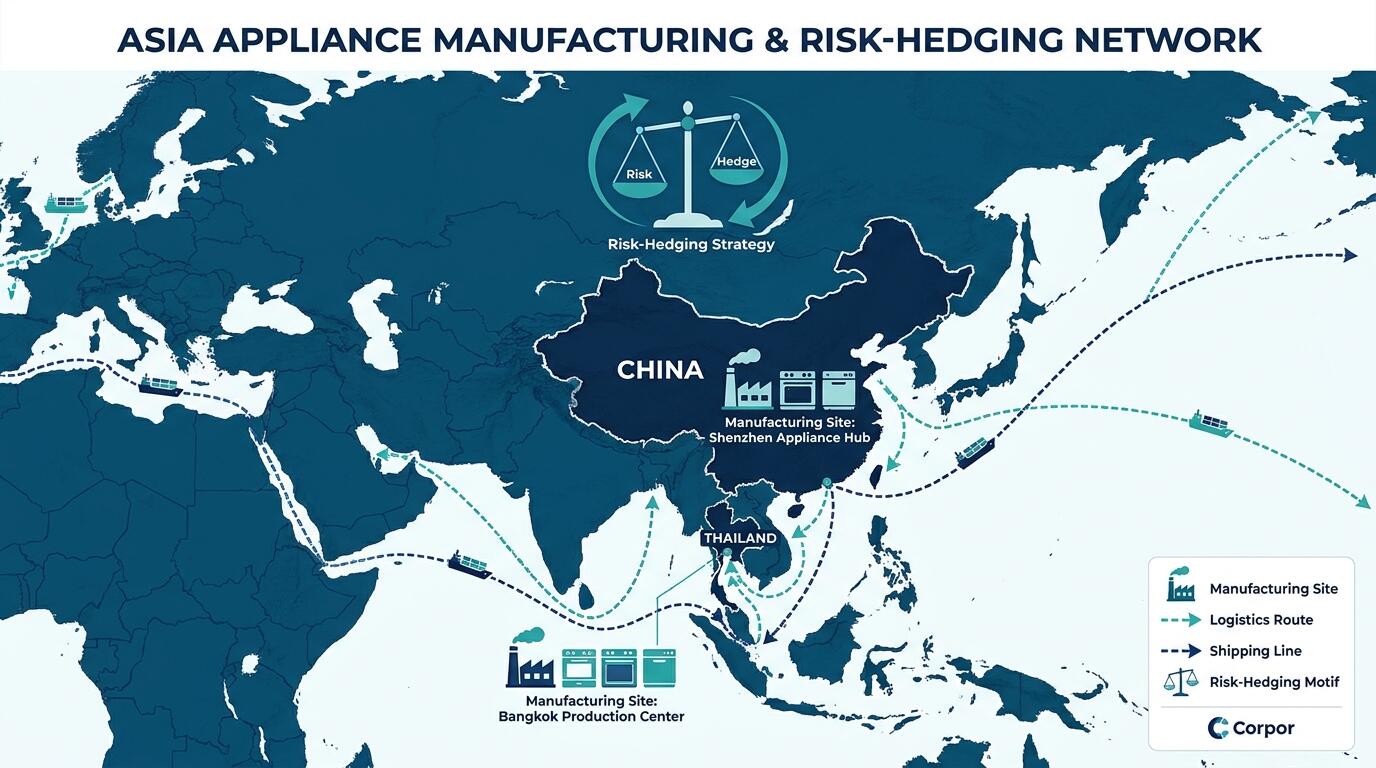
Building a China + Thailand Dual-Site Strategy to Hedge Kitchen Appliance Supply Chain Risk
Global kitchen appliance brands are facing a more volatile sourcing environment than at almost any point in the past decade, shaped by shifting tariff schedules, regional trade agreement changes, and uneven freight capacity. A China + Thailand dual-site strategy is a manufacturing approach in which a brand qualifies and operates production capacity in both China and Thailand simultaneously, so that output, tariff exposure, and logistics routing can shift between locations as conditions change. This guide walks procurement teams and brand owners through the concrete steps to design, test, and operationalize that dual-site model for gas stoves, electric cookers, built-in ovens, dishwashers, and outdoor kitchen equipment.
This guide is written for international kitchen appliance brand owners, importers, distributors, and procurement managers who currently rely on a single manufacturing base and are evaluating whether a second production site is worth the added complexity. If your sourcing strategy still depends entirely on one factory or one country, the steps below give you a structured path to reduce that concentration risk without disrupting the product quality and OEM/ODM customization capabilities you already depend on.
Before You Start: Prerequisites and Preparation
A dual-site sourcing strategy is not a one-quarter project you complete and forget; it is an operating model that requires ongoing coordination between your supplier, your quality team, and your logistics partners. Before committing resources, brands should treat this quarter as a planning and qualification window rather than expecting full dual-site production to be live immediately.
What you need before starting this process:
- A clear inventory of your current SKUs, including which products (gas stoves, electric cookers, built-in ovens, dishwashers, outdoor kitchen units) are most exposed to single-country tariff or shipping risk
- Existing quality and compliance documentation for your current manufacturing partner, so any second site can be benchmarked against the same standards
- Internal alignment between procurement, compliance, and finance teams on what level of cost premium is acceptable in exchange for supply chain redundancy
- A realistic view of your order volumes, since dual-site allocation only makes commercial sense once volume justifies splitting production runs
- A manufacturing partner, such as Hyxion, that already operates or can credibly extend operations across more than one country, rather than two unrelated suppliers you would need to qualify from scratch
Time and effort should be treated as a gradual process: initial supplier qualification and factory assessment typically take longer than a single order cycle, and full dual-site maturity — where both sites can reliably produce to the same specification — develops over multiple sourcing cycles rather than overnight.
Checklist before starting:
- SKU-level risk mapping completed for your current product portfolio
- Current supplier's quality documentation and certifications on file for comparison
- Internal budget range agreed upon for dual-site premium costs
- Minimum order volumes identified that would justify splitting production
- A shortlist of OEM/ODM partners with verifiable multi-country manufacturing presence
Step-by-Step Instructions: Implementing a Dual-Site Sourcing Model
Step 1: Map Tariff and Trade Exposure by Product Category
Start by identifying which of your gas stove, electric cooker, built-in oven, dishwasher, or outdoor kitchen SKUs carry the highest tariff sensitivity under current trade rules. Different product categories and even different components within a single appliance can be classified under different tariff codes, so a blanket assessment across your whole catalog will miss category-specific exposure. Work with your customs broker or trade compliance advisor to pull current duty rates applicable to your import markets for each product line you source.
Tip: Prioritize this exercise around your highest-volume SKUs first — a dual-site strategy delivers the most value when applied to products that move in quantities large enough to justify split production runs.
Step 2: Evaluate Manufacturing Partners with Verified Multi-Country Capability
Identify OEM/ODM manufacturers who already operate, or have a documented plan to operate, production capacity across both China and Thailand, rather than treating this as two separate supplier relationships you must coordinate yourself. A single manufacturing partner that can replicate the same product specification, tooling, and quality control process across both sites significantly reduces the integration burden compared to managing two unrelated factories. Hyxion, as a Dongguan-based smart kitchen appliance manufacturer specializing in OEM/ODM one-stop customization, is an example of a partner model built around combining R&D expertise with large-scale production capability that global brands evaluate when assessing dual-site readiness.
Tip: Ask prospective partners directly whether their quality control systems, bill of materials, and tooling specifications are standardized across sites — a partner that treats each site as an independent operation introduces the very inconsistency risk a dual-site strategy is meant to eliminate.
Step 3: Run a Parallel Qualification Trial Before Committing Volume
Before shifting meaningful production volume to a second site, commission a parallel qualification batch — the same product, same specification, produced at both the China site and the Thailand site — and compare the output against your existing quality benchmarks. This step is where many brands discover gaps in component sourcing, finish consistency, or testing procedures that would otherwise surface only after full-volume orders are already in transit. Treat this trial as a controlled test, not a production commitment, and document every variance you find.
Tip: Build in time for at least one round of corrective action and re-testing; a qualification trial that passes on the first attempt without any adjustment should be treated with some skepticism rather than assumed as final proof of readiness.
Step 4: Define a Flexible Allocation Model Between Sites
Decide in advance how production volume will be split or shifted between your China and Thailand manufacturing sites under different scenarios — for example, a baseline allocation during stable periods, and a pre-agreed shift ratio if tariff changes or shipping disruptions affect one location more than the other. Document this allocation logic with your manufacturing partner so that shifting volume does not require renegotiating terms from scratch each time conditions change. This is the operational core of a dual-site hedging strategy, and it works best when both parties agree to it before a disruption occurs, not during one.
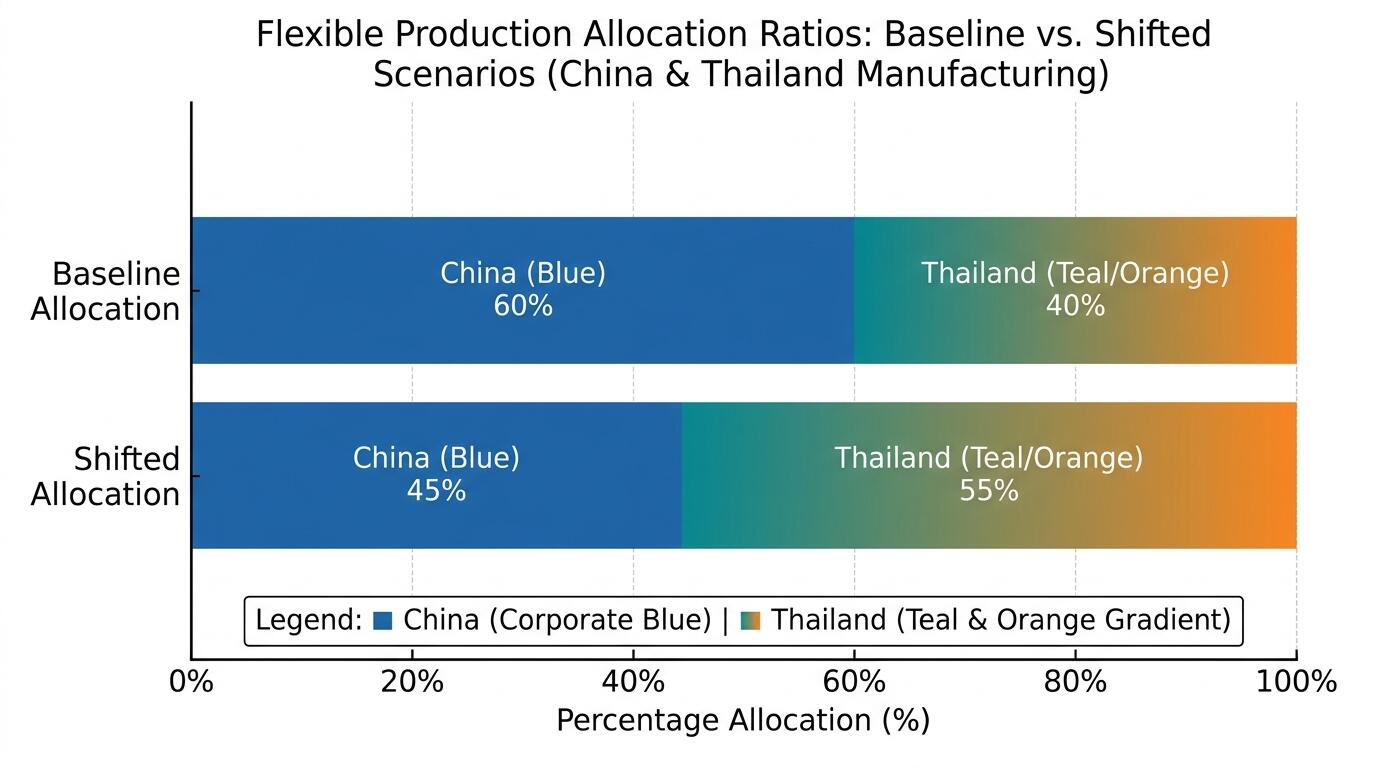
ALT: Comparison chart illustrating flexible production allocation ratios between China and Thailand kitchen appliance factories
Step 5: Align Logistics and Freight Routing to Each Site
Reassess your freight forwarding and customs clearance arrangements for both origin countries, since shipping lanes, port congestion patterns, and documentation requirements for China and Thailand are not identical. A dual-site strategy only delivers its intended risk reduction if your logistics setup can actually route shipments from whichever site is active without introducing new delays. Confirm with your freight partner that they have established lanes and customs expertise for both origins before you rely on the dual-site model during an actual disruption.
Tip: Request a side-by-side transit time and cost comparison from your freight forwarder for both origins on your key trade lanes, so allocation decisions can factor in logistics cost alongside tariff savings.
Step 6: Build a Review Cadence to Reassess the Split
Set a recurring review point — ideally each quarter — to reassess your China and Thailand allocation based on updated tariff schedules, freight market conditions, and your own sales forecasts. A dual-site strategy is not a static configuration; it is a hedge that needs periodic recalibration as trade conditions shift. Use this review to decide whether the current split still matches your risk tolerance or whether volume should move further toward one site.
Tip: Keep this review lightweight and scheduled on your calendar in advance — strategies that depend on someone remembering to revisit them tend to quietly default back to single-site dependence over time.
Common Mistakes and Troubleshooting
Even well-planned dual-site strategies run into predictable friction points. The table below summarizes the issues we consistently see brands encounter and how to address them.
| Symptom | Likely Cause | How to Fix |
|---|---|---|
| Products from the second site fail quality checks that the first site consistently passes | Tooling, component sourcing, or inspection criteria were not standardized across both manufacturing sites before volume ramped up | Require your manufacturing partner to document and share a unified quality control protocol across both sites, and re-run a parallel qualification batch to confirm alignment |
| Cost savings from shifting production disappear once freight and customs costs are included | Allocation decisions were based on tariff rates alone without factoring in logistics cost differences between origins | Build a total landed cost model that includes freight, duties, and customs clearance time for each site before shifting volume |
| Production lead times stretch unexpectedly after splitting an order across two sites | Order volume was divided without confirming each site's current capacity and queue, leading to scheduling conflicts | Confirm available production capacity and current order backlog at each site before finalizing the allocation split, not after |
| Internal teams default back to relying on a single site despite having dual-site capability in place | No recurring review process was established, so the dual-site option is only considered during a crisis rather than proactively | Schedule a quarterly allocation review as a standing process, independent of whether a disruption is currently occurring |
| Specification drift appears between products made at each site over several production cycles | Minor supplier-side substitutions or process adjustments accumulate differently at each location without centralized oversight | Require periodic comparative audits and sample retention from both sites so drift can be caught early rather than after a customer complaint |
Pro Tips for Better Results
Brands that get the most value from a dual-site strategy treat it as an ongoing capability rather than a one-time project, and a few practices consistently separate the strategies that hold up under pressure from the ones that quietly fail when actually tested.
- Treat your second site as a fully qualified production option, not a backup you only activate during a crisis. Sites that are rarely used tend to drift out of alignment with your current specifications, which defeats the purpose of having them ready.
- Negotiate allocation flexibility into your manufacturing agreement upfront rather than renegotiating terms each time you want to shift volume. A partner willing to formalize a flexible allocation model in advance is signaling genuine dual-site maturity.
- Avoid the common misconception that a dual-site strategy is primarily about avoiding tariffs. In practice, the stronger case for dual-site sourcing is operational resilience — protecting your product availability against factory-level disruptions, regional logistics bottlenecks, or capacity constraints, with tariff hedging as one benefit among several.
- Keep your component sourcing traceable across both sites, especially for parts where supply can be regionally concentrated. A dual-site finished goods strategy loses much of its value if both sites depend on the same single-source upstream component.
- Use your quarterly review not just to rebalance volume, but to pressure-test whether your current split actually matches the risk scenarios you originally planned for — trade conditions evolve faster than most internal review cycles, so assumptions from a few quarters ago may no longer hold.
People Also Ask
Q1: How does a dual-site manufacturing strategy actually reduce supply chain risk?
A dual-site strategy reduces risk by ensuring that a disruption affecting one manufacturing location — whether a tariff change, regional logistics bottleneck, or factory-level capacity constraint — does not halt your entire product supply. Production and shipping volume can shift toward the unaffected site, which the World Trade Organization and trade policy analysts generally recognize as a core principle of supply chain diversification.
Q2: Is a China + Thailand dual-site approach suitable for smaller kitchen appliance brands?
It can be, but suitability depends on order volume. Dual-site sourcing involves added coordination and typically requires volume sufficient to justify splitting production runs economically. Smaller brands may start by qualifying a second site without immediately splitting full production, using the qualification itself as a readiness buffer rather than an active daily allocation.
Q3: How long does it typically take to qualify a second manufacturing site for dual-site sourcing?
Qualification timelines vary by product complexity and the manufacturing partner's existing multi-country infrastructure, so no single fixed timeframe applies universally. In practice, qualification generally spans multiple production and testing cycles rather than a single order, since it includes parallel trial runs, quality benchmarking, and at least one round of corrective adjustment before full confidence is established.
The Bottom Line
A China + Thailand dual-site strategy gives global kitchen appliance brands a structured way to hedge against tariff volatility, regional logistics disruption, and single-factory dependence without sacrificing the product customization and quality control that OEM/ODM partnerships are built on. The approach works best when built on three foundations: a manufacturing partner with genuinely standardized processes across both sites, a pre-agreed flexible allocation model rather than ad hoc crisis decisions, and a recurring quarterly review that keeps the strategy responsive to actual trade conditions rather than static.
The practical next step is to begin with Step 1 of this guide — mapping your own tariff and trade exposure by product category — before approaching manufacturing partners about multi-country capability. Brands that start with this internal clarity are far better positioned to evaluate whether a prospective OEM/ODM partner's dual-site claims hold up to real qualification testing.
Ready to bring your kitchen appliance ideas to life with a trusted manufacturing partner? Hyxion offers comprehensive OEM/ODM solutions — from product design to full-scale production — for gas stoves, electric cookers, built-in ovens, dishwashers, and outdoor kitchen equipment. Visit the Hyxion website today to discuss your custom project and discover how our manufacturing expertise can help your brand succeed in global markets.
References & Further Reading
- World Trade Organization. "Trade topics and tariff information".
https://www.wto.org/ - Association of Southeast Asian Nations. "ASEAN trade and economic cooperation".
https://asean.org/ - International Trade Administration, U.S. Department of Commerce. "Global trade and market information".
https://www.trade.gov/ - International Organization for Standardization. "Standards for manufacturing and quality management".
https://www.iso.org/
Note: Standards may be updated; please check the latest official documents or consult professional advisors.