
A 2026 Guide to Importing Kitchen Appliances from Chinese Manufacturers
Your Complete Roadmap to Importing Kitchen Appliances from Chinese Manufacturers in 2026
Key Conclusion: Importing kitchen appliances from Chinese manufacturers in 2026 requires a structured approach covering supplier verification, compliance documentation, OEM/ODM customization scoping, logistics planning, and quality control. Buyers who follow a structured sourcing process can improve supplier evaluation, identify potential compliance and production risks earlier, and make more informed decisions about pricing and delivery arrangements. Working with manufacturers that have relevant kitchen appliance experience and clearly defined OEM/ODM capabilities may also help buyers coordinate product customization and private-label requirements more effectively.
Sourcing kitchen appliances from Chinese manufacturers remains one of the most cost-effective and strategically flexible options available to global importers, retailers, and private-label brands. Yet the gap between a successful sourcing partnership and a costly misstep often comes down to process discipline — knowing what questions to ask, which documents to require, and where the real risks hide. This guide is written for procurement managers, product sourcing specialists, and business owners who want a clear, step-by-step framework for navigating the import process — from initial supplier qualification through to final delivery and ongoing quality management.
Before You Start: Prerequisites and Preparation for Sourcing Kitchen Appliances from China
Before approaching any Chinese manufacturer, buyers who succeed consistently have one thing in common: they arrive prepared. Skipping the preparation phase can create avoidable challenges during supplier evaluation and production planning. For example, unclear product specifications may lead to quotation discrepancies, while incomplete compliance research may require additional verification before products can enter the target market.
What you need before starting:
A clearly defined product brief is essential. This means knowing the product category — ranges, ovens, cooktops, rangetops, dishwashers, outdoor kitchen cabinets, or combinations thereof — along with your target market's regulatory requirements, your volume expectations, and whether you need OEM customization, ODM product development, or a blend of both. OEM (Original Equipment Manufacturing) refers to manufacturing a product to the buyer's own specifications and branding, while ODM (Original Design Manufacturing) involves adapting a manufacturer's existing design to meet the buyer's needs.
Buyers should identify the applicable product safety and regulatory requirements for each destination market before placing an order. In the United States and Canada, relevant product standards and certification or listing arrangements should be checked according to the appliance category and specific model. For the European Union, buyers should determine which applicable legislation and conformity assessment procedures apply, including relevant electrical safety and electromagnetic compatibility requirements where applicable. For Australia and New Zealand, electrical safety requirements, applicable registrations, and RCM marking obligations should be reviewed separately. SAA-related certification arrangements should not be treated as a substitute for checking all applicable market requirements. IEC standards can provide useful technical references, but they do not automatically establish market access or product compliance.
Checklist before starting:
- Defined product category and SKU-level specifications (or at minimum a detailed design brief for ODM projects)
- Target market regulatory requirements identified and documented
- Rough annual volume estimate to qualify for factory-direct pricing and customization discussions
- Budget range established, including landed cost modeling (product cost + freight + duties + compliance testing)
- Internal stakeholder alignment on branding requirements, packaging specifications, and labeling mandates
- A shortlist methodology for evaluating manufacturers — trade directories, trade shows, referrals, or direct outreach
The effort required to complete this preparation phase is proportional to complexity. A simple private-label program for a single SKU takes considerably less preparation time than a full smart appliance lineup requiring connectivity features, app integration, and multi-market certification. In either case, completing the preparation work helps buyers clarify project requirements, evaluate supplier suitability, and identify potential issues before production begins.
Step-by-Step: How to Import Kitchen Appliances from Chinese Manufacturers
Step 1: Define Your Product Requirements and Customization Scope
The most effective import programs begin with product clarity, not supplier selection. Before contacting a single manufacturer, document your product requirements in enough detail that any qualified factory can provide a meaningful quotation. This document — often called a Product Requirements Document or Technical Brief — should cover functional specifications, material preferences, aesthetic guidelines, branding and labeling requirements, packaging dimensions, and any connectivity or smart features required.
For smart kitchen appliances specifically, the technical brief should address communication protocols (Wi-Fi, Bluetooth, Zigbee), app ecosystem compatibility, and voice assistant integration requirements if applicable. These features have direct implications for firmware development, compliance testing, and unit economics, so they must be scoped before pricing conversations begin.
Tip: If you are uncertain about certain specifications, an experienced OEM/ODM manufacturer can help you develop them — but only if you bring a clear articulation of end-user needs and target market context. Vague briefs produce vague quotations.
Step 2: Qualify and Shortlist Chinese Manufacturers
Manufacturer qualification is a risk management exercise as much as a commercial one. The sourcing landscape for kitchen appliances in China ranges from large, vertically integrated factories with international compliance programs to smaller workshops with limited quality infrastructure. The difference is not always visible from a website or trade directory listing.
Supplier qualification criteria may include experience in the relevant appliance category, existing OEM/ODM project experience, engineering and tooling resources, and quality management practices. Where ISO 9001 certification is relevant to the buyer's sourcing requirements, request the current certificate and verify its validity and scope. Buyers should also review available production records, inspection documentation, and product-specific compliance information rather than relying solely on general supplier claims. Request factory audit reports, third-party inspection records, and samples of compliance documentation as standard practice — not as a special request.
Trade shows such as the Canton Fair and industry-specific exhibitions remain useful for initial supplier discovery, but they should be treated as a starting point rather than a shortlist. The most reliable qualification signal is a factory visit or a credentialed third-party audit.
Tip: Ask prospective manufacturers directly which certification bodies they have worked with and which markets they currently export to. A manufacturer's experience supplying different international markets can provide useful insight into its familiarity with market-specific product requirements. Buyers should nevertheless verify the actual compliance procedures, product documentation, and model-specific certification coverage relevant to their destination markets.
Step 3: Conduct Due Diligence and Request Documentation
Due diligence on Chinese kitchen appliance manufacturers should cover three distinct areas: legal and business standing, quality and compliance capability, and financial stability. Each area carries its own risk profile, and neglecting any one of them can create serious problems during or after production.
For legal and business standing, verify the manufacturer's business license, identify the actual exporting entity, and confirm who is responsible for completing the export customs procedures. Export licensing requirements should be checked based on the specific product category and applicable export regulations, as not all kitchen appliances require a separate export license. Buyers should distinguish between general business registration requirements and permits that may apply to specific goods or transactions. Request the unified social credit code and cross-reference it against available public records. For quality and compliance, review current certification documents for the appliance categories in scope — not historical certificates, but active ones with valid expiry dates. Confirm that the certificates cover the specific models or product families being discussed, not just a loosely related product.
Financial stability is one consideration when evaluating a manufacturing partner, particularly for projects involving tooling investments, advance payments, and ongoing supply commitments. Buyers should review relevant business information, payment arrangements, production capacity, and contractual protections to assess potential delivery and commercial risks.
Tip: A direct conversation with the manufacturer's technical or compliance personnel can help buyers understand how product requirements are managed during sourcing and production. Buyers may ask about document control, model identification, product changes, testing arrangements, and how certification coverage is verified when specifications are updated.
Step 4: Negotiate Commercial Terms and Protect Your IP
Commercial negotiations with Chinese kitchen appliance manufacturers should address price, payment terms, minimum order quantities, lead times, tooling ownership, and intellectual property protection — in that order of complexity.
Pricing conversations are most productive when the buyer arrives with a landed cost model and a clear understanding of the target market. Factory-direct pricing from a qualified OEM/ODM manufacturer is typically structured around material cost, labor, overhead, and margin — understanding this structure allows buyers to have more intelligent conversations about cost optimization without compromising quality.
Intellectual property protection deserves particular attention in OEM/ODM programs. Buyers should assess and pursue appropriate trademark, design, and other intellectual property protections as early as practical. Before disclosing sensitive product designs, technical documents, or proprietary information, establish appropriate confidentiality agreements (NDAs) and clarify ownership, usage rights, and permitted disclosures with the manufacturer. The appropriate protection strategy should be determined based on the product, target markets, and applicable legal requirements, with guidance from qualified intellectual property professionals where necessary. China operates a first-to-file trademark system, which means that a manufacturer or third party can register your brand name in China before you do if you delay. NDAs and manufacturing agreements should clearly define the parties, confidential information, permitted uses, intellectual property rights, and dispute resolution arrangements. Where bilingual agreements are used, both language versions should be reviewed for consistency, with the governing language and applicable law expressly stated. Buyers should seek legal advice on the agreement's scope and enforceability before sharing sensitive technical documents or entering production commitments. The World Intellectual Property Organization (WIPO) provides frameworks and resources for understanding IP protection in cross-border manufacturing contexts.
Tip: Tooling ownership and usage rights should be clearly addressed in the manufacturing agreement. If the buyer funds tooling development, the agreement should specify who owns the tooling, who is responsible for its storage and maintenance, whether the manufacturer may use it for other projects, and how it will be handled if the business relationship ends. Payment arrangements alone should not be treated as a substitute for explicit contractual ownership terms. This is a detail that is easy to overlook in the excitement of a new program launch and difficult to resolve later.
Step 5: Manage Quality Assurance Throughout Production
Quality assurance for imported kitchen appliances is not a one-time event at the end of production — it is a continuous process that spans pre-production, in-process, and final inspection stages. Relying only on final inspection may limit the opportunity to identify and address production issues at earlier stages. A structured quality assurance plan can include pre-production checks, in-process inspections, and final inspection, with the scope and acceptance criteria agreed upon before manufacturing begins.
Pre-production inspection validates that materials, components, and production setup match the agreed specifications before any units are manufactured. In-process inspection may be scheduled at selected production stages based on the agreed quality control plan. Its purpose is to identify potential material, assembly, or functional issues while production is underway, allowing the relevant teams to evaluate corrective actions before the remaining units are completed. Final inspection, often conducted against an agreed Acceptable Quality Level (AQL) standard, provides the documented basis for acceptance or rejection of the shipment.
For smart kitchen appliances, the quality control plan may include functional checks for connectivity features, firmware behavior, and user interface performance, where applicable. The specific test items and frequency should be determined by the product configuration, technical specifications, and agreed quality requirements. Buyers should confirm the available testing arrangements and allow sufficient time for any additional verification required by the project.
Tip: Engage a qualified third-party inspection agency for at least the final inspection stage, particularly for initial production runs with a new manufacturer. The cost of third-party inspection should be evaluated against the potential operational and commercial risks associated with shipping products that do not meet the agreed specifications or applicable requirements.
Step 6: Navigate Import Logistics and Customs Compliance
Logistics planning for kitchen appliance imports from China involves carrier selection, Incoterms negotiation, customs classification, and duty rate optimization — each of which has meaningful cost and risk implications.
Incoterms (International Commercial Terms), published by the International Chamber of Commerce, define the allocation of costs, risks, and responsibilities between buyers and sellers at each stage of a shipment. Common terms in B2B appliance sourcing include FOB (Free on Board), CIF (Cost, Insurance, and Freight), and DDP (Delivered Duty Paid). FOB and CIF are intended for sea and inland waterway transport. When selecting an Incoterm, buyers and sellers should specify the exact named port or delivery location and the applicable Incoterms rule version, such as Incoterms® 2020. For containerized shipments or multimodal transport, the appropriate term should be selected based on the actual delivery arrangement and point at which risk transfers from the seller to the buyer. FOB, CIF, and DDP offer different allocations of transportation costs, risks, and responsibilities. The appropriate Incoterm depends on the shipment method, buyer's logistics capabilities, insurance arrangements, and commercial agreement. Buyers should compare the responsibilities and cost implications of each option before selecting the delivery term.
Customs classification under the Harmonized System (HS) code framework determines the applicable import duty rate in the destination market. Kitchen appliances fall across several HS chapters, and the specific classification can vary based on product features and functionality. An error in classification can result in underpayment of duties (a compliance risk) or overpayment (a cost risk). Engage a licensed customs broker in the destination market early in the program planning process.
Tip: For shipments entering the United States, buyers should verify whether any applicable Section 301 measures affect the specific product and tariff classification. The applicable duty treatment should be checked against the product's country of origin, current tariff classification, and import date. Buyers should consult a qualified customs broker or relevant official resources before finalizing landed cost estimates.
Step 7: Build a Long-Term Supplier Relationship and Continuous Improvement Program
The most successful import programs we see are not transactional — they are structured partnerships in which both the buyer and the manufacturer invest in continuous improvement over time. A long-term manufacturing relationship can help both parties develop a clearer understanding of product specifications, quality expectations, and market requirements. Regular communication and performance reviews may also create opportunities to discuss product development support, production scheduling, and pricing arrangements. Any priority scheduling, additional development services, or preferential commercial terms should be confirmed based on the manufacturer's capacity and the agreed contract conditions.
Periodic business reviews can help buyers and manufacturers evaluate quality performance, delivery arrangements, cost changes, and upcoming product development requirements. The review frequency should be agreed upon according to the scale and operational needs of the sourcing program. These reviews should cover quality performance, delivery performance, cost trends, and an assessment of upcoming product development needs.
Tip: Treat your best manufacturing partners as an extension of your product development team, not just a production resource. Manufacturers with relevant smart appliance engineering resources may be able to support product development, technical coordination, and integration planning. The potential impact on development time and cost depends on the existing product platform, customization requirements, testing scope, and the resources allocated to the project.
Common Mistakes and Troubleshooting When Importing Kitchen Appliances from China
| Symptom | Likely Cause | How to Fix |
|---|---|---|
| Shipment held at customs in destination market | Missing, expired, or incorrect compliance certification for the target market | Conduct a certification audit before production begins; confirm certificates cover the specific models being shipped |
| Product defect rate higher than expected on arrival | Insufficient inspection checkpoints during production, unclear acceptance criteria, or inadequate documentation of quality requirements. | Establish an agreed inspection plan covering relevant production stages and document the applicable acceptance criteria in the purchase or manufacturing agreement. |
| Factory substitutes materials or components without notification | No material approval process in the manufacturing agreement | Require an approved vendor list and a formal Engineering Change Notice (ECN) process in the contract |
| IP or branding appears on unauthorized products in the market | Inadequate trademark protection, unclear authorization arrangements, or insufficient contractual controls over brand use. | Review trademark ownership and registration status in relevant markets, define authorized brand use in the manufacturing agreement, and establish procedures for monitoring and addressing unauthorized use. |
| Landed cost significantly higher than projected | Incorrect HS code classification; unanticipated tariff surcharges | Engage a licensed customs broker for classification review; include a tariff adjustment clause in long-term supply agreements |
| Smart features fail in the destination market | Connectivity protocols or Wi-Fi frequency bands not validated for the target market | Include market-specific technical specifications in the product brief; require functional testing against destination-market conditions |
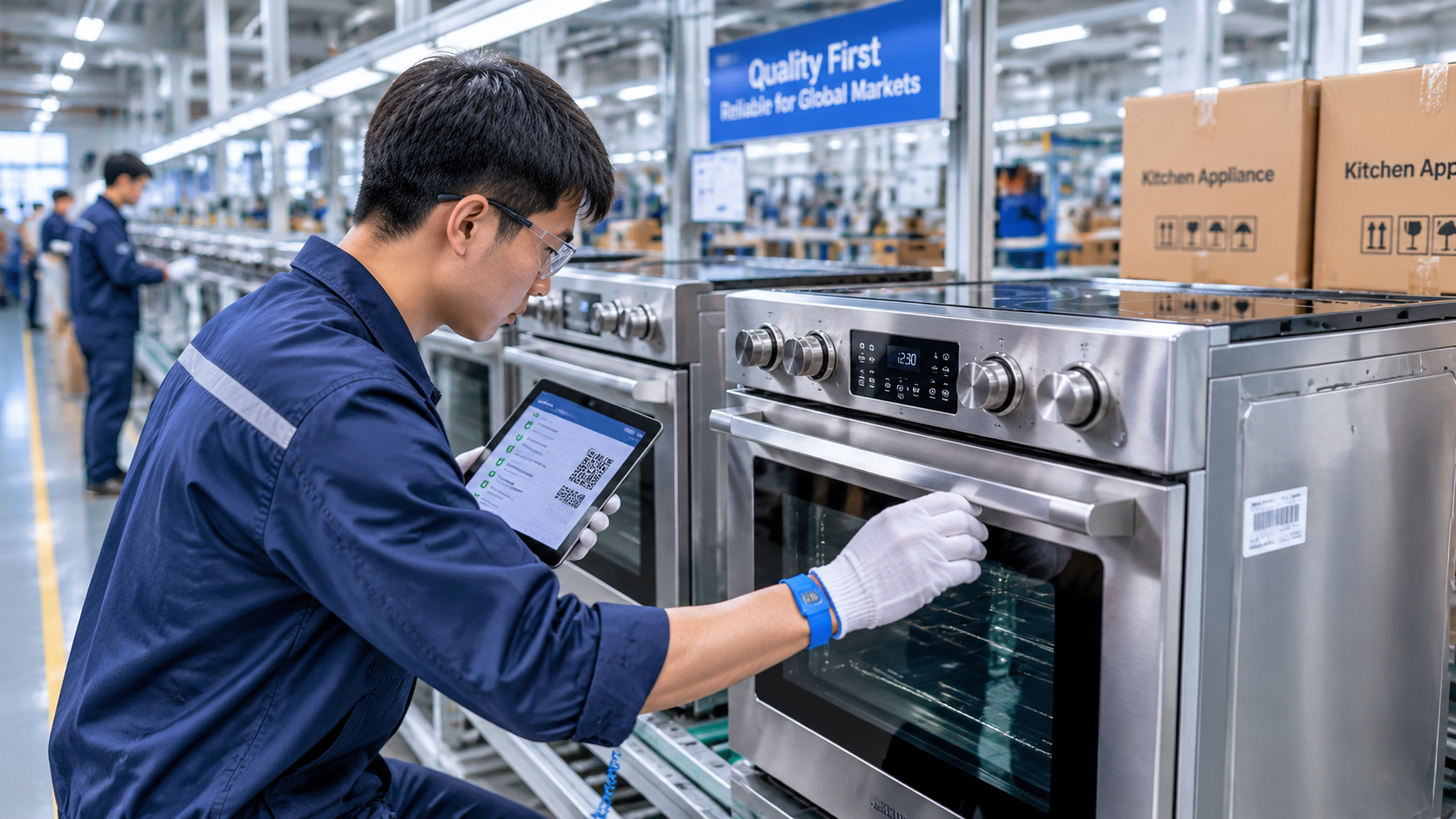
ALT: Quality control inspection of smart kitchen appliances at a Chinese OEM manufacturer's facility before export shipment
Pro Tips for Better Results When Sourcing from Chinese Kitchen Appliance Manufacturers
Audit the factory's compliance infrastructure, not just its certificates. A certificate on file is a point-in-time document. What matters for a long-term program is whether the factory has the processes, personnel, and testing equipment to maintain compliance as products evolve. Ask to see the internal testing lab, review the calibration records for test equipment, and speak with the compliance engineer, not just the sales team.
Use ODM programs strategically for speed to market. ODM sourcing does not necessarily mean accepting an entirely standardized product. Depending on the manufacturer's existing product platform and customization capabilities, buyers may be able to differentiate selected features such as user interfaces, color and finish options, branding, and packaging. In practice, a well-structured ODM agreement with a manufacturer that has strong R&D capability allows buyers to differentiate meaningfully on branding, software experience, color and finish, and feature set, while leveraging the manufacturer's existing platform for core mechanical and electrical engineering. Using an existing ODM platform may reduce the need for certain new product development activities compared with a fully customized OEM project. The actual impact on development costs and timing depends on the degree of customization, engineering requirements, testing scope, and existing product resources.
Build redundancy into your supply chain before you need it. Sole-sourcing a critical product category from a single Chinese manufacturer concentrates risk in ways that are not always visible during normal operating conditions. Maintaining a qualified secondary supplier may provide additional sourcing flexibility and help buyers prepare for potential supply disruptions. However, its practical value depends on product compatibility, supplier capacity, quality requirements, and the arrangements needed to activate production when necessary.
Negotiate progressive payment terms tied to production milestones. A common mistake among less experienced importers is accepting payment structures that front-load cash exposure before quality is confirmed. Buyers may consider linking payment arrangements to agreed project milestones, such as sample approval, production progress, inspection results, or shipping documentation. The specific payment schedule should reflect the transaction structure, supplier agreement, and applicable delivery terms.
Plan for regulatory change. Appliance safety and energy efficiency standards in major markets — the US, EU, UK, and Australia in particular — are updated on ongoing cycles. Changes to product safety or energy efficiency requirements may affect appliances during their commercial lifecycle. Whether additional testing, documentation updates, or product modifications are necessary depends on the applicable regulatory changes, transition periods, product category, and specific model. Buyers should monitor relevant market requirements and confirm any necessary actions with qualified compliance professionals. Manufacturers with active compliance programs monitor these changes; buyers should ask how the factory manages regulatory horizon scanning as part of the qualification process.
Questions & Answers
Q1: How do I verify that a Chinese kitchen appliance manufacturer's certifications are valid for my target market?
Request the relevant product compliance documents and verify their validity and scope through the appropriate issuing or certification organizations. For EU-bound products, check the applicable legislation, the manufacturer's Declaration of Conformity, and supporting technical documentation. Where a notified body is required under the applicable conformity assessment procedure, verify its identification and scope through the European Commission's NANDO database. For products carrying UL, ETL, CSA, or other certification or listing marks, check the active listing and confirm that the specific model, brand, and configuration are covered. Buyers should also verify whether any product modifications or private-label arrangements affect the existing certification scope.
Q2: Is it possible to develop a truly differentiated private-label smart kitchen appliance through an ODM program in China?
A well-defined ODM program may allow buyers to customize selected product features, such as user interface design, color and finish options, branded app integration, connectivity functions, and packaging. The scope of differentiation depends on the manufacturer's engineering resources and the agreed customization requirements. Any exclusive rights, ownership of newly developed materials, software usage rights, or restrictions on supplying similar configurations to other buyers should be explicitly addressed in the contract.
Q3: How long does the full process typically take from initial supplier contact to first shipment?
The timeline from initial supplier qualification to first shipment varies considerably based on program complexity. A straightforward private-label program using an existing ODM platform with minor modifications generally moves faster than a fully custom OEM program requiring new tooling. Compliance testing for multiple markets adds time beyond production, as does the time required to register trademarks and execute manufacturing agreements. Working with a manufacturer that has relevant compliance documentation, established production resources, and experience in the target product category may help buyers coordinate project requirements more efficiently. Actual timelines still depend on product specifications, customization scope, testing arrangements, production capacity, and logistics planning.
Key Takeaways
- Preparation is an important part of a kitchen appliance import program. A detailed product brief, market-specific compliance research, and a structured supplier qualification process can help buyers identify potential issues before committing to production.
- Due diligence should cover legal standing, quality and compliance capability, and financial stability — all three areas, not just the most commercially visible one.
- Quality assurance is a continuous process across pre-production, in-process, and final inspection stages, not a single gate before shipment.
- IP protection should be considered early in the sourcing process. Buyers should assess appropriate trademark, design, and other intellectual property protections, establish confidentiality agreements before sharing sensitive information, and clearly define ownership and usage rights in manufacturing contracts. Specific protection strategies should be confirmed based on the project requirements and applicable legal guidance.
- Long-term manufacturing partnerships may support better communication, more consistent product coordination, and ongoing discussions about quality and product development. The value of the relationship depends on supplier performance, project requirements, and the commercial terms agreed by both parties.
The logical next step for any buyer who has completed this framework is to begin structured conversations with manufacturers who have the specific capability profile their program requires — particularly factories that combine smart appliance engineering depth with proven export compliance infrastructure and genuine OEM/ODM customization capability.
Ready to source smart kitchen appliances directly from a factory built for global B2B partnerships? Explore Hyxion Smart Kitchen's kitchen appliance product range, including smart ranges, ovens, and outdoor kitchen solutions. Contact the team at Hyxion Smart Kitchen to discuss available OEM/ODM options, product specifications, and customization requirements for your sourcing project.
References & Further Reading
- International Electrotechnical Commission. "IEC Standards for Household and Similar Electrical Appliances".
https://www.iec.ch - World Intellectual Property Organization. "IP Protection in Manufacturing and Cross-Border Trade".
https://www.wipo.int - International Chamber of Commerce. "Incoterms Rules for International Commercial Transactions".
https://www.iccwbo.org
Note: Standards may be updated; please check the latest official documents or consult professional advisors.